





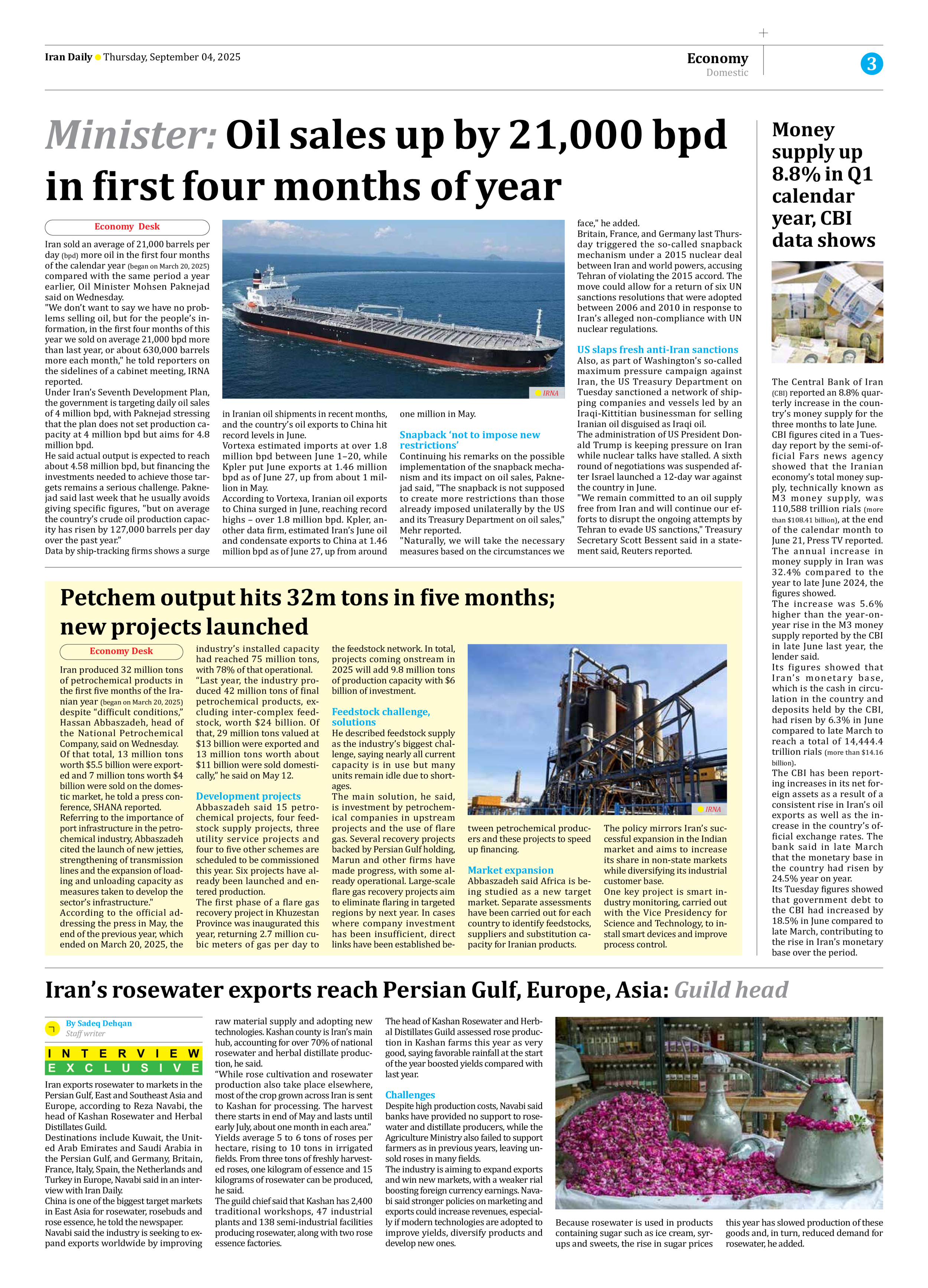


Iran’s rosewater exports reach Persian Gulf, Europe, Asia: Guild head
By Sadeq Dehqan
Staff writer
Iran exports rosewater to markets in the Persian Gulf, East and Southeast Asia and Europe, according to Reza Navabi, the head of Kashan Rosewater and Herbal Distillates Guild.
Destinations include Kuwait, the United Arab Emirates and Saudi Arabia in the Persian Gulf, and Germany, Britain, France, Italy, Spain, the Netherlands and Turkey in Europe, Navabi said in an interview with Iran Daily.
China is one of the biggest target markets in East Asia for rosewater, rosebuds and rose essence, he told the newspaper.
Navabi said the industry is seeking to expand exports worldwide by improving raw material supply and adopting new technologies. Kashan county is Iran’s main hub, accounting for over 70% of national rosewater and herbal distillate production, he said.
“While rose cultivation and rosewater production also take place elsewhere, most of the crop grown across Iran is sent to Kashan for processing. The harvest there starts in end of May and lasts until early July, about one month in each area.”
Yields average 5 to 6 tons of roses per hectare, rising to 10 tons in irrigated fields. From three tons of freshly harvested roses, one kilogram of essence and 15 kilograms of rosewater can be produced, he said.
The guild chief said that Kashan has 2,400 traditional workshops, 47 industrial plants and 138 semi-industrial facilities producing rosewater, along with two rose essence factories.
The head of Kashan Rosewater and Herbal Distillates Guild assessed rose production in Kashan farms this year as very good, saying favorable rainfall at the start of the year boosted yields compared with last year.
Challenges
Despite high production costs, Navabi said banks have provided no support to rosewater and distillate producers, while the Agriculture Ministry also failed to support farmers as in previous years, leaving unsold roses in many fields.
The industry is aiming to expand exports and win new markets, with a weaker rial boosting foreign currency earnings. Navabi said stronger policies on marketing and exports could increase revenues, especially if modern technologies are adopted to improve yields, diversify products and develop new ones.
Because rosewater is used in products containing sugar such as ice cream, syrups and sweets, the rise in sugar prices this year has slowed production of these goods and, in turn, reduced demand for rosewater, he added.