





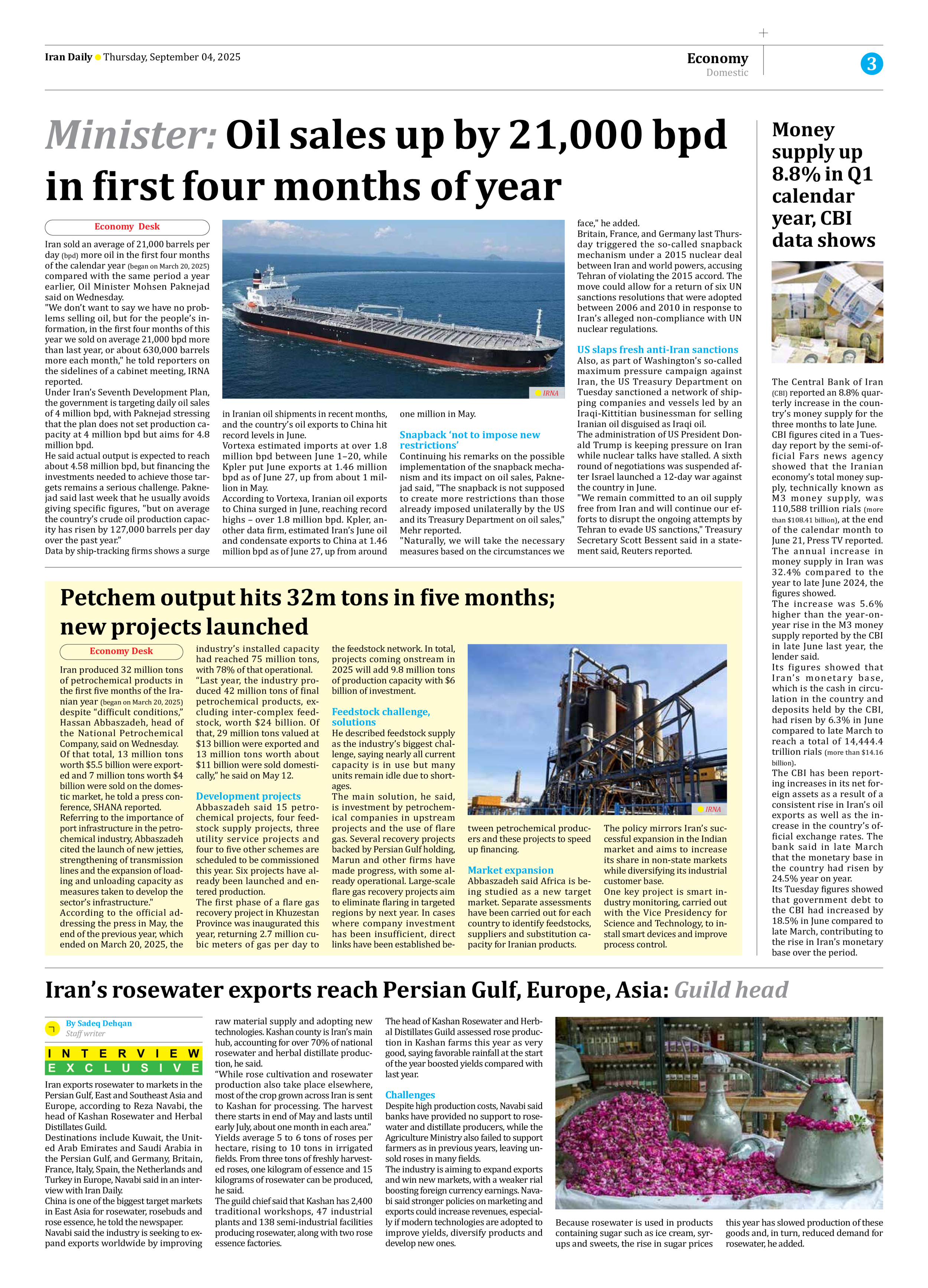


Minister: Oil sales up by 21,000 bpd in first four months of year
Iran sold an average of 21,000 barrels per day (bpd) more oil in the first four months of the calendar year (began on March 20, 2025) compared with the same period a year earlier, Oil Minister Mohsen Paknejad said on Wednesday.
"We don’t want to say we have no problems selling oil, but for the people’s information, in the first four months of this year we sold on average 21,000 bpd more than last year, or about 630,000 barrels more each month," he told reporters on the sidelines of a cabinet meeting, IRNA reported.
Under Iran’s Seventh Development Plan, the government is targeting daily oil sales of 4 million bpd, with Paknejad stressing that the plan does not set production capacity at 4 million bpd but aims for 4.8 million bpd.
He said actual output is expected to reach about 4.58 million bpd, but financing the investments needed to achieve those targets remains a serious challenge. Paknejad said last week that he usually avoids giving specific figures, "but on average the country’s crude oil production capacity has risen by 127,000 barrels per day over the past year."
Data by ship-tracking firms shows a surge in Iranian oil shipments in recent months, and the country’s oil exports to China hit record levels in June.
Vortexa estimated imports at over 1.8 million bpd between June 1–20, while Kpler put June exports at 1.46 million bpd as of June 27, up from about 1 million in May.
According to Vortexa, Iranian oil exports to China surged in June, reaching record highs – over 1.8 million bpd. Kpler, another data firm, estimated Iran’s June oil and condensate exports to China at 1.46 million bpd as of June 27, up from around one million in May.
Snapback ‘not to impose new restrictions’
Continuing his remarks on the possible implementation of the snapback mechanism and its impact on oil sales, Paknejad said, "The snapback is not supposed to create more restrictions than those already imposed unilaterally by the US and its Treasury Department on oil sales," Mehr reported.
"Naturally, we will take the necessary measures based on the circumstances we face," he added.
Britain, France, and Germany last Thursday triggered the so-called snapback mechanism under a 2015 nuclear deal between Iran and world powers, accusing Tehran of violating the 2015 accord. The move could allow for a return of six UN sanctions resolutions that were adopted between 2006 and 2010 in response to Iran’s alleged non-compliance with UN nuclear regulations.
US slaps fresh anti-Iran sanctions
Also, as part of Washington’s so-called maximum pressure campaign against Iran, the US Treasury Department on Tuesday sanctioned a network of shipping companies and vessels led by an Iraqi-Kittitian businessman for selling Iranian oil disguised as Iraqi oil.
The administration of US President Donald Trump is keeping pressure on Iran while nuclear talks have stalled. A sixth round of negotiations was suspended after Israel launched a 12-day war against the country in June.
"We remain committed to an oil supply free from Iran and will continue our efforts to disrupt the ongoing attempts by Tehran to evade US sanctions," Treasury Secretary Scott Bessent said in a statement said, Reuters reported.