







Sacred, architectural legacy of South Khorasan Province
South Khorasan Province, with its rich heritage of grand mosques, Husseiniehs (buildings designed specifically for gatherings of Shia Muslims for religious practice), shrines, and mausoleums of Imamzadehs (descendants of Imams), is far more than just a tourist destination. It is a place to return to one’s roots and establish a profound connection with spirituality. This province, while preserving its historical authenticity, stands as one of the most pristine regions for religious tourism in the country, fully prepared to welcome pilgrims, researchers, and enthusiasts of Islamic culture. At a time when cultural identity gains ever greater importance, safeguarding and promoting these invaluable treasures is not only a national responsibility but also a golden opportunity to advance sustainable tourism development within this desert province.
Grand Mosque of Ferdows: It is a lasting monument dating back to the 7th century AH, representing one of the most prominent examples of Khorasani architectural style. This magnificent structure, characterized by its tall qibla (prayer niche), surrounding prayer halls, and columns, vividly displays the exquisite artistry and authentic architecture of Iran. The distinctive brickwork on the base of the ivan, combined with the elegant interplay of brick and tile, bestows upon this religious building a particularly majestic grandeur.
Grand Mosque of Qaen: Situated in the city of Qaen, the mosque, featuring two entrances from the northeast and northwest, pointed arches, angled corridors, and a stunning main courtyard, is recognized as one of the most beautiful symbols of religious architecture. The harmonious blend of architectural design and structural solidity, enhanced by simple yet impactful decoration, creates an atmosphere imbued with spirituality and inspiration.
Grand Mosque of Sarayan: It boasts an ivan soaring to a height of 13 meters, two prayer halls, and a stucco mihrab adorned with Surah Al-Fatiha. It stands among the most exquisite religious structures from the Safavid era. The intricate muqarnas (stalactite) works on the ivan’s ceiling and the ribbed vaults of the western night hall elevate this mosque to the status of a complete artistic masterpiece.
Grand Mosque of Hendevalan: The monument is among the most magnificent and oldest historic-religious buildings in Darmian, situated in a village bearing the same name. It is also one of the most distinguished mosques from the Timurid period. Its central domed chamber is ingeniously constructed on a quadrilateral base employing squinches that skillfully transform the shape from square to circle and finally to the dome. This mosque serves as a testament to the exceptional ingenuity of Iranian architects in adapting to the climate while implementing Islamic engineering techniques.
Grand Mosque of Afin: Located in a village sharing its name, this mosque, with its pointed arches and domed chambers crafted using squinches, is attributed to the Seljuk period. Despite partial destruction of the main ivan, the overall architecture remains a vivid reflection of the grandeur and beauty of the Islamic era in eastern Iran.
Grand Mosque of Mian Deh: The mosque located in a village with the same name in Boshruyeh features a southern ivan, arcades supported by brick columns, a large northern hall, and an exquisite inscription in Thuluth script. It exemplifies the harmonious integration of local and traditional architecture with Islamic motifs. The design reveals the architects’ mastery over both aesthetic principles and the religious functions of the building.
Grand Mosque of Khusf: Situated within the historic fabric of Khusf, the Grand Mosque of Khosf is distinguished by halls supported by quadrilateral columns and four-segmented domes. The Abdulkhaleq hall, the oldest section of the mosque, contains six columns and twelve domes, creating a serene and spiritual environment for worship.
Mausoleum of Bozorgmehr Qaeni: Bozorgmehr Qaeni, a renowned mystic of the 4th and 5th centuries AH, is interred in a mausoleum designed with a cruciform layout and four ivans. The exquisite stucco work beneath the dome, the artistic muqarnas, and the harmonious combination of stone, plaster, and brick collectively elevate this structure to the status of a unique architectural masterpiece.
Holy Shrine of Hazrat Hussein ibn Musa al-Kazim (PBUH): The holy shrine of Hazrat Hussein ibn Musa al-Kazim (PBUH), the brother of Imam Reza (PBUH), is located in the city of Tabas. Historical records indicate that the original edifice was constructed in the 5th century AH and subsequently underwent restoration and reconstruction in the 13th century AH. Although it was completely destroyed in the earthquake of 1978, it was meticulously rebuilt through the dedicated efforts of Astan Quds Razavi Foundation. This restoration included the main shrine and the surrounding arcades. Today, the shrine annually welcomes a large number of pilgrims and tourists, serving as a significant spiritual and cultural landmark.
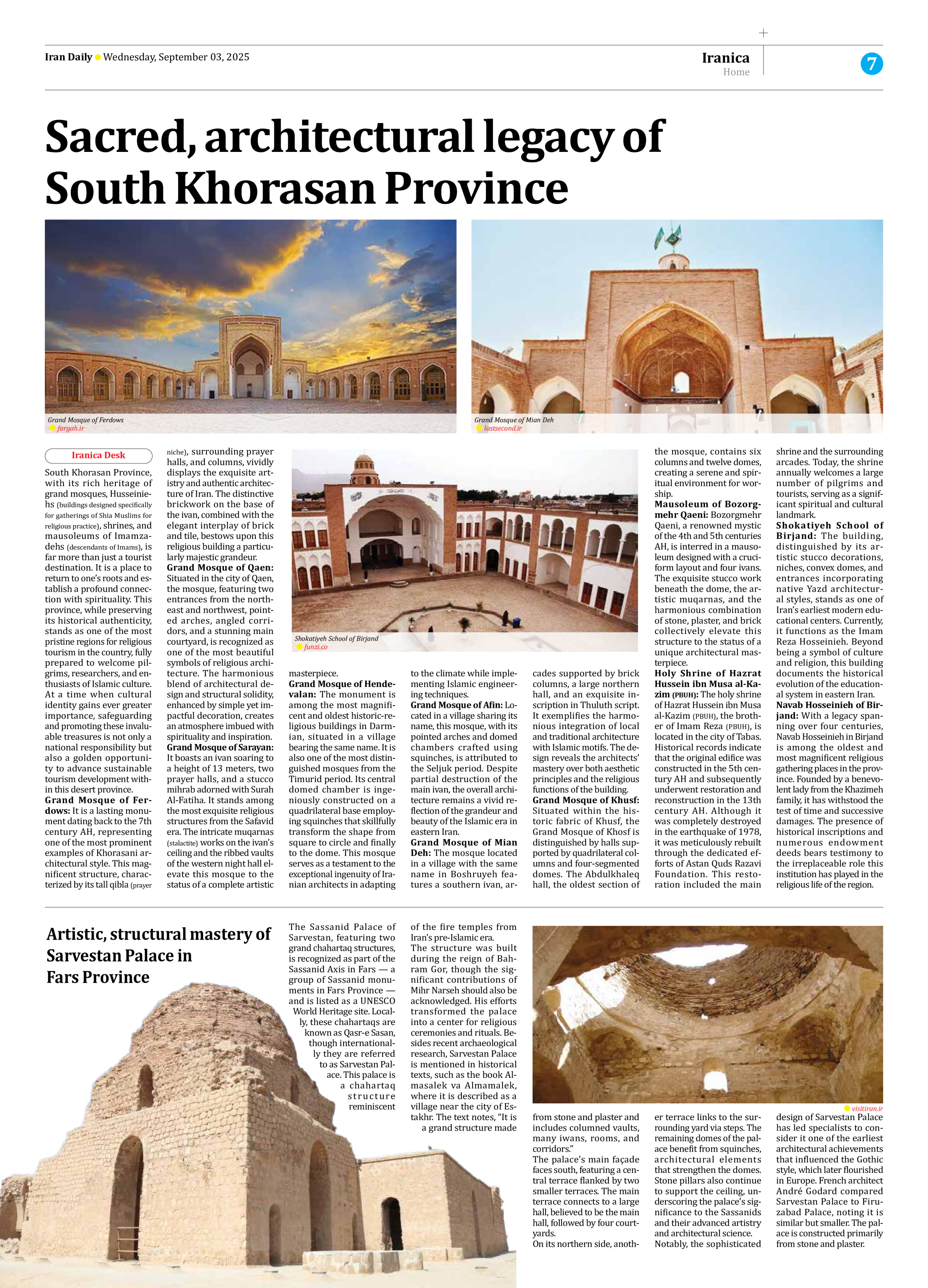
Shokatiyeh School of Birjand: The building, distinguished by its artistic stucco decorations, niches, convex domes, and entrances incorporating native Yazd architectural styles, stands as one of Iran’s earliest modern educational centers. Currently, it functions as the Imam Reza Hosseinieh. Beyond being a symbol of culture and religion, this building documents the historical evolution of the educational system in eastern Iran.
Navab Hosseinieh of Birjand: With a legacy spanning over four centuries, Navab Hosseinieh in Birjand is among the oldest and most magnificent religious gathering places in the province. Founded by a benevolent lady from the Khazimeh family, it has withstood the test of time and successive damages. The presence of historical inscriptions and numerous endowment deeds bears testimony to the irreplaceable role this institution has played in the religious life of the region.