







Copy in clipboard...
Archaeologists unearth 100 historic coins in central Isfahan
The announcement was made on Monday by Amir Karamzadeh, director general of the provincial cultural heritage, tourism and handicrafts department, IRNA reported.
The find adds weight to the theory that Kamar Zarrin, on the city’s northern edge, once served as a bustling commercial hub. Researchers believe more relics may lie beneath the soil, offering a rare glimpse into Isfahan’s economic past and cultural exchanges in the Islamic era.
Karamzadeh said 35 of the coins were unearthed on August 31 alone, calling the number “remarkable.” While most pieces appear to date back to Islamic dynasties, experts plan to clean and examine them in laboratories before assigning a precise age.
The excavation permit, originally limited to 40 days, has been extended by the Research Institute of Archaeology, allowing teams to keep digging in front of Kamar Zarrin Mosque.
“This opportunity lets us dig deeper and piece together more details of the region’s economic and cultural history,” Karamzadeh said.
Two years ago, bulldozers clearing ground for a planned street exposed remnants of ancient structures, forcing construction to halt and paving the way for joint archaeological work by the cultural heritage institute, Isfahan’s urban renewal agency, and the Art University.
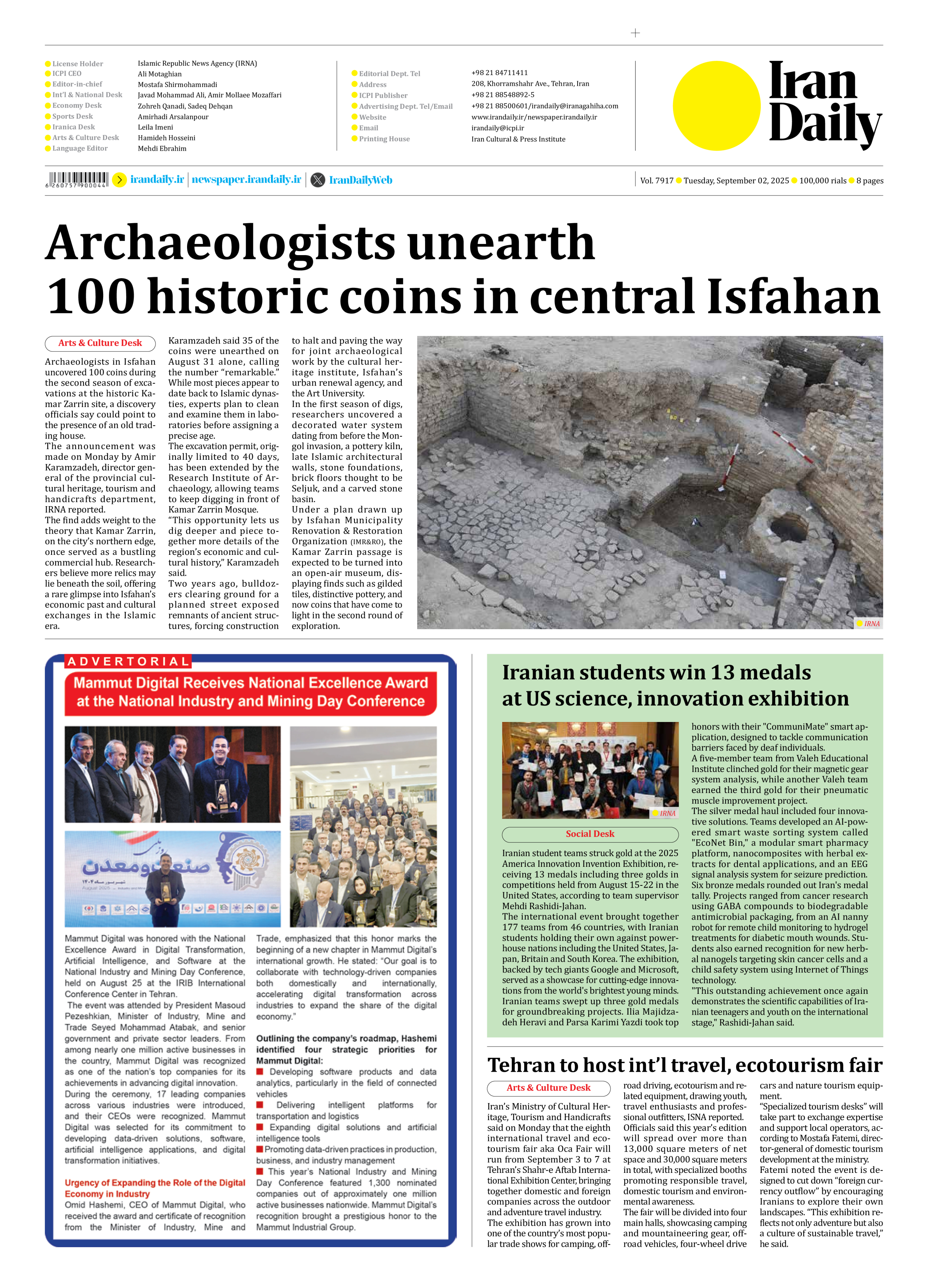
In the first season of digs, researchers uncovered a decorated water system dating from before the Mongol invasion, a pottery kiln, late Islamic architectural walls, stone foundations, brick floors thought to be Seljuk, and a carved stone basin.
Under a plan drawn up by Isfahan Municipality Renovation & Restoration Organization (IMR&RO), the Kamar Zarrin passage is expected to be turned into an open-air museum, displaying finds such as gilded tiles, distinctive pottery, and now coins that have come to light in the second round of exploration.