







Cultural, architectural legacy of Hendijan in Khuzestan Province
The city of Hendijan in Khuzestan Province is rich in history, featuring a multitude of sites and structures that are scattered throughout various parts of the county and in numerous villages. According to evidence and documented records, the most enduring and architecturally significant structures in Hendijan date from the late Qajar period, although the oldest remaining buildings have origins that trace back even further to the late Safavid era. One notable example is the old market, which once boasted a vibrant and historic fabric. Unfortunately, over the past 20 to 30 years, this market has completely vanished, with all the original shops replaced by modern commercial establishments.
Local residents believe that many of these shops are approximately 300 years old, as they belonged to the ancestors of current inhabitants. Based on this oral history and available evidence, it can be inferred that Hendijan was at least from the late Safavid period a prosperous and lively city, complete with a grand mosque. Although travel writers suggest that the city was inhabited even before that time, no concrete archaeological or historical evidence currently confirms this earlier habitation, chtn.ir wrote.
In addition to markets and shops, many other structures remain, including traditional houses, mosques, and tombs. Historically, the city also had numerous other notable edifices such as an old bathhouse built during the Qajar period. There used to be a pier and a school called Shoukat School, both of which are fondly remembered by the elders of Hendijan; however, nothing of these structures remains today.
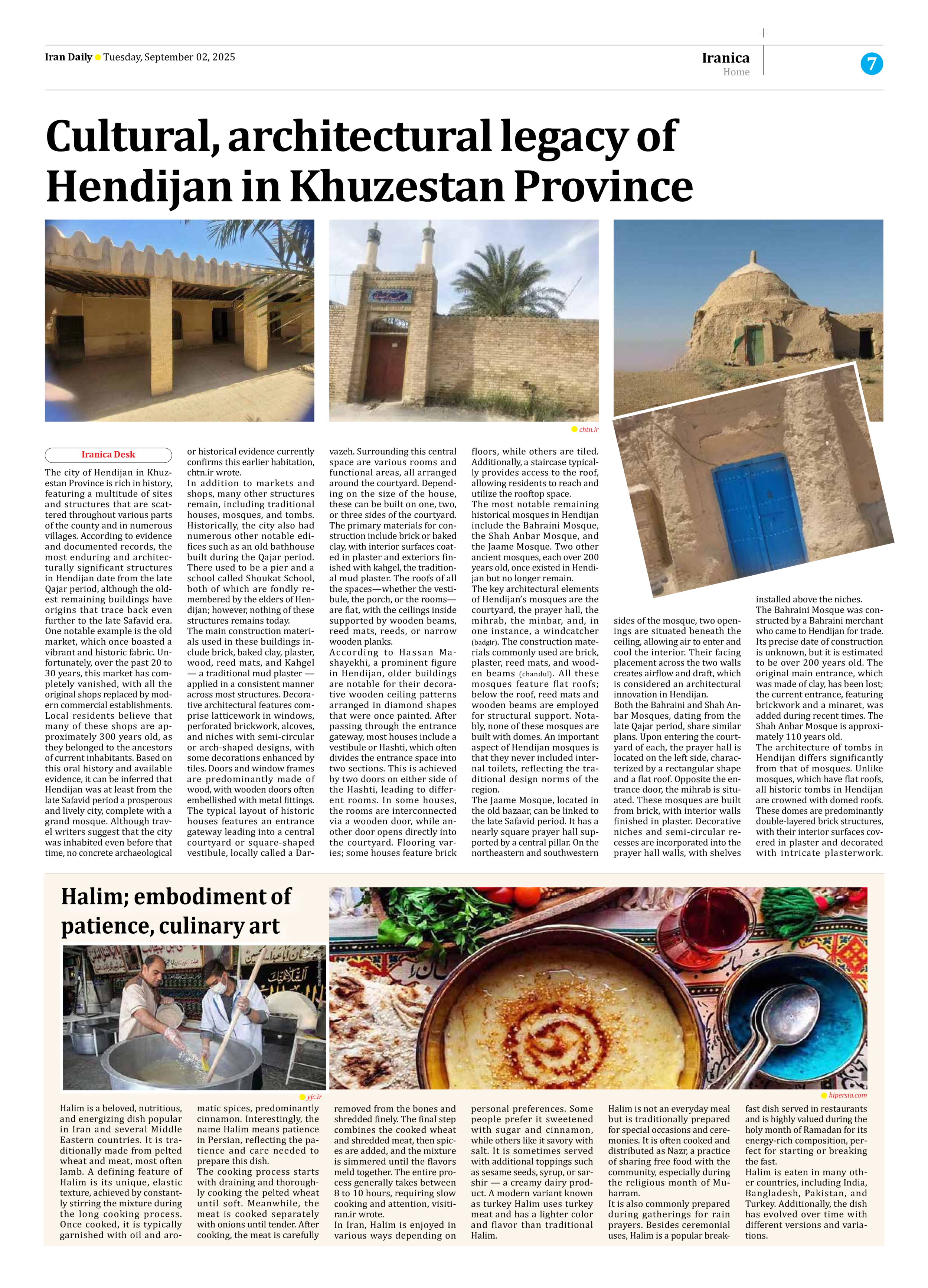
The main construction materials used in these buildings include brick, baked clay, plaster, wood, reed mats, and Kahgel — a traditional mud plaster — applied in a consistent manner across most structures. Decorative architectural features comprise latticework in windows, perforated brickwork, alcoves, and niches with semi-circular or arch-shaped designs, with some decorations enhanced by tiles. Doors and window frames are predominantly made of wood, with wooden doors often embellished with metal fittings.
The typical layout of historic houses features an entrance gateway leading into a central courtyard or square-shaped vestibule, locally called a Darvazeh. Surrounding this central space are various rooms and functional areas, all arranged around the courtyard. Depending on the size of the house, these can be built on one, two, or three sides of the courtyard. The primary materials for construction include brick or baked clay, with interior surfaces coated in plaster and exteriors finished with kahgel, the traditional mud plaster. The roofs of all the spaces—whether the vestibule, the porch, or the rooms—are flat, with the ceilings inside supported by wooden beams, reed mats, reeds, or narrow wooden planks.
According to Hassan Mashayekhi, a prominent figure in Hendijan, older buildings are notable for their decorative wooden ceiling patterns arranged in diamond shapes that were once painted. After passing through the entrance gateway, most houses include a vestibule or Hashti, which often divides the entrance space into two sections. This is achieved by two doors on either side of the Hashti, leading to different rooms. In some houses, the rooms are interconnected via a wooden door, while another door opens directly into the courtyard. Flooring varies; some houses feature brick floors, while others are tiled. Additionally, a staircase typically provides access to the roof, allowing residents to reach and utilize the rooftop space.
The most notable remaining historical mosques in Hendijan include the Bahraini Mosque, the Shah Anbar Mosque, and the Jaame Mosque. Two other ancient mosques, each over 200 years old, once existed in Hendijan but no longer remain.
The key architectural elements of Hendijan’s mosques are the courtyard, the prayer hall, the mihrab, the minbar, and, in one instance, a windcatcher (badgir). The construction materials commonly used are brick, plaster, reed mats, and wooden beams (chandul). All these mosques feature flat roofs; below the roof, reed mats and wooden beams are employed for structural support. Notably, none of these mosques are built with domes. An important aspect of Hendijan mosques is that they never included internal toilets, reflecting the traditional design norms of the region.
The Jaame Mosque, located in the old bazaar, can be linked to the late Safavid period. It has a nearly square prayer hall supported by a central pillar. On the northeastern and southwestern sides of the mosque, two openings are situated beneath the ceiling, allowing air to enter and cool the interior. Their facing placement across the two walls creates airflow and draft, which is considered an architectural innovation in Hendijan.
Both the Bahraini and Shah Anbar Mosques, dating from the late Qajar period, share similar plans. Upon entering the courtyard of each, the prayer hall is located on the left side, characterized by a rectangular shape and a flat roof. Opposite the entrance door, the mihrab is situated. These mosques are built from brick, with interior walls finished in plaster. Decorative niches and semi-circular recesses are incorporated into the prayer hall walls, with shelves installed above the niches.
The Bahraini Mosque was constructed by a Bahraini merchant who came to Hendijan for trade. Its precise date of construction is unknown, but it is estimated to be over 200 years old. The original main entrance, which was made of clay, has been lost; the current entrance, featuring brickwork and a minaret, was added during recent times. The Shah Anbar Mosque is approximately 110 years old.
The architecture of tombs in Hendijan differs significantly from that of mosques. Unlike mosques, which have flat roofs, all historic tombs in Hendijan are crowned with domed roofs. These domes are predominantly double-layered brick structures, with their interior surfaces covered in plaster and decorated with intricate plasterwork.