







Decentralization of arts policy
Culture minister calls for stronger creative economy
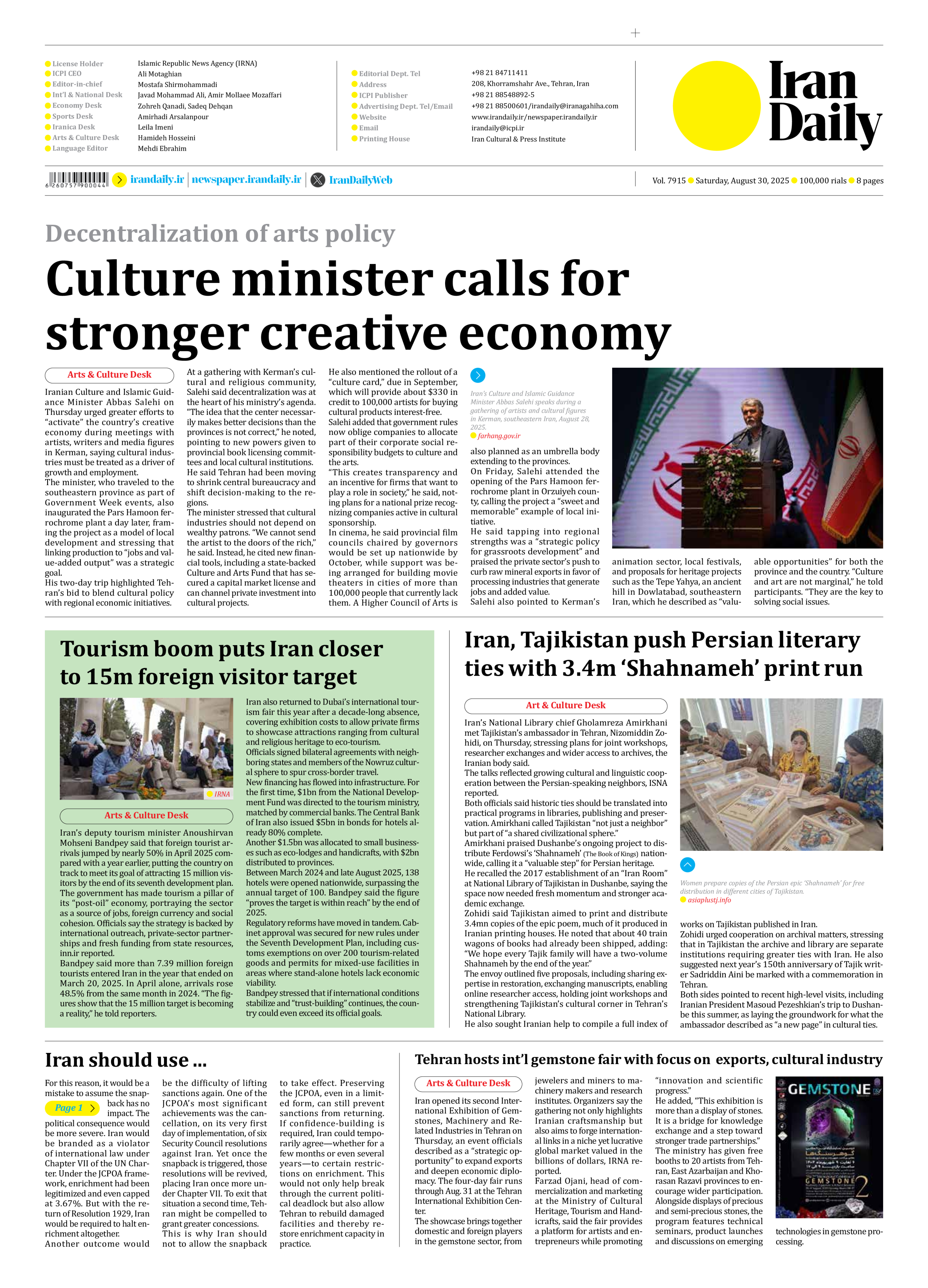
Iranian Culture and Islamic Guidance Minister Abbas Salehi on Thursday urged greater efforts to “activate” the country’s creative economy during meetings with artists, writers and media figures in Kerman, saying cultural industries must be treated as a driver of growth and employment.
The minister, who traveled to the southeastern province as part of Government Week events, also inaugurated the Pars Hamoon ferrochrome plant a day later, framing the project as a model of local development and stressing that linking production to “jobs and value-added output” was a strategic goal.
His two-day trip highlighted Tehran’s bid to blend cultural policy with regional economic initiatives.
At a gathering with Kerman’s cultural and religious community, Salehi said decentralization was at the heart of his ministry’s agenda. “The idea that the center necessarily makes better decisions than the provinces is not correct,” he noted, pointing to new powers given to provincial book licensing committees and local cultural institutions.
He said Tehran had been moving to shrink central bureaucracy and shift decision-making to the regions.
The minister stressed that cultural industries should not depend on wealthy patrons. “We cannot send the artist to the doors of the rich,” he said. Instead, he cited new financial tools, including a state-backed Culture and Arts Fund that has secured a capital market license and can channel private investment into cultural projects.
He also mentioned the rollout of a “culture card,” due in September, which will provide about $330 in credit to 100,000 artists for buying cultural products interest-free.
Salehi added that government rules now oblige companies to allocate part of their corporate social responsibility budgets to culture and the arts.
“This creates transparency and an incentive for firms that want to play a role in society,” he said, noting plans for a national prize recognizing companies active in cultural sponsorship.
In cinema, he said provincial film councils chaired by governors would be set up nationwide by October, while support was being arranged for building movie theaters in cities of more than 100,000 people that currently lack them. A Higher Council of Arts is also planned as an umbrella body extending to the provinces.
On Friday, Salehi attended the opening of the Pars Hamoon ferrochrome plant in Orzuiyeh county, calling the project a “sweet and memorable” example of local initiative.
He said tapping into regional strengths was a “strategic policy for grassroots development” and praised the private sector’s push to curb raw mineral exports in favor of processing industries that generate jobs and added value.
Salehi also pointed to Kerman’s animation sector, local festivals, and proposals for heritage projects such as the Tepe Yahya, an ancient hill in Dowlatabad, southeastern Iran, which he described as “valuable opportunities” for both the province and the country. “Culture and art are not marginal,” he told participants. “They are the key to solving social issues.