





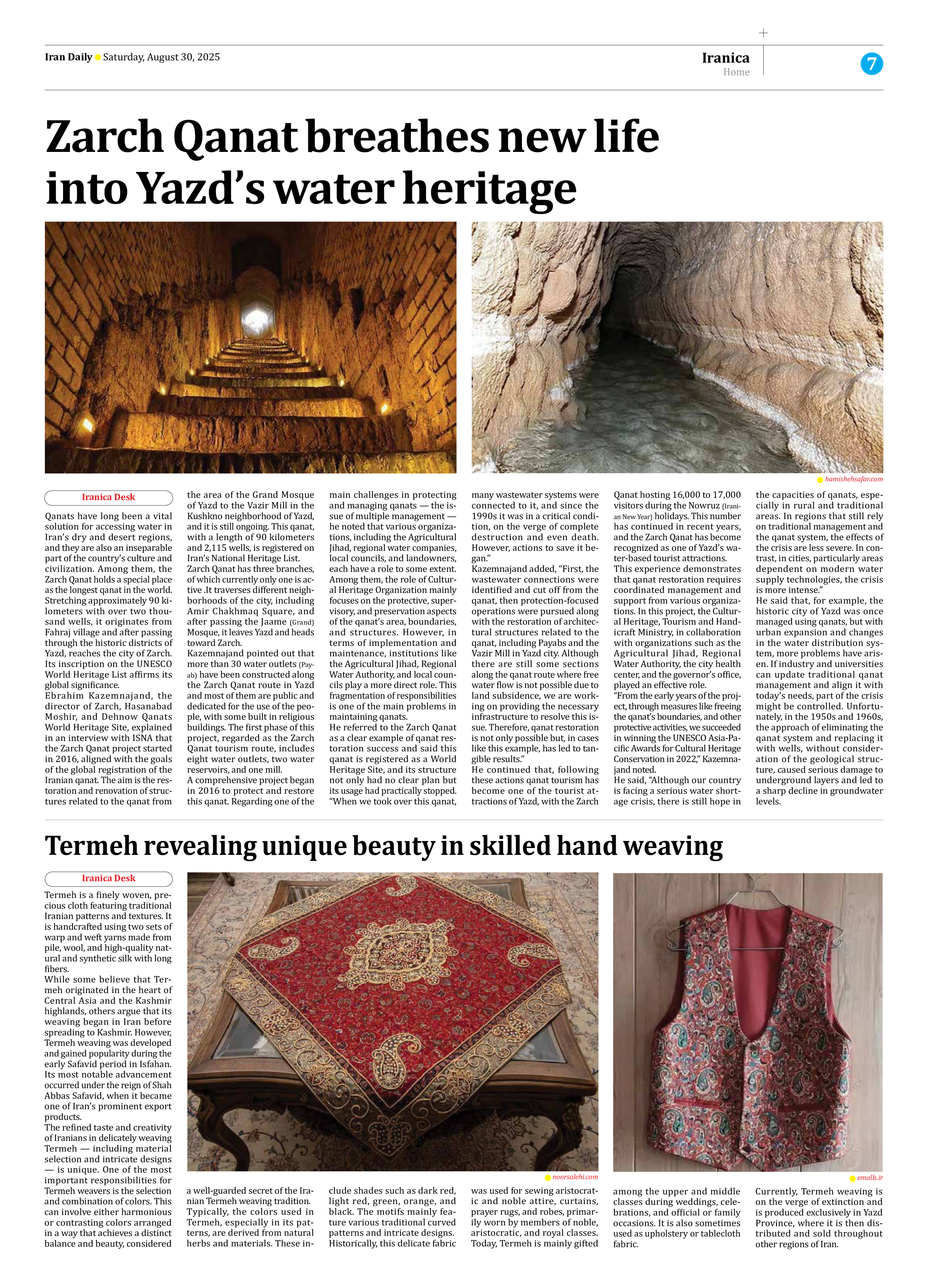


Zarch Qanat breathes new life into Yazd’s water heritage
Qanats have long been a vital solution for accessing water in Iran’s dry and desert regions, and they are also an inseparable part of the country’s culture and civilization. Among them, the Zarch Qanat holds a special place as the longest qanat in the world. Stretching approximately 90 kilometers with over two thousand wells, it originates from Fahraj village and after passing through the historic districts of Yazd, reaches the city of Zarch. Its inscription on the UNESCO World Heritage List affirms its global significance.
Ebrahim Kazemnajand, the director of Zarch, Hasanabad Moshir, and Dehnow Qanats World Heritage Site, explained in an interview with ISNA that the Zarch Qanat project started in 2016, aligned with the goals of the global registration of the Iranian qanat. The aim is the restoration and renovation of structures related to the qanat from the area of the Grand Mosque of Yazd to the Vazir Mill in the Kushkno neighborhood of Yazd, and it is still ongoing. This qanat, with a length of 90 kilometers and 2,115 wells, is registered on Iran’s National Heritage List.
Zarch Qanat has three branches, of which currently only one is active .It traverses different neighborhoods of the city, including Amir Chakhmaq Square, and after passing the Jaame (Grand) Mosque, it leaves Yazd and heads toward Zarch.
Kazemnajand pointed out that more than 30 water outlets (Payab) have been constructed along the Zarch Qanat route in Yazd and most of them are public and dedicated for the use of the people, with some built in religious buildings. The first phase of this project, regarded as the Zarch Qanat tourism route, includes eight water outlets, two water reservoirs, and one mill.
A comprehensive project began in 2016 to protect and restore this qanat. Regarding one of the main challenges in protecting and managing qanats — the issue of multiple management — he noted that various organizations, including the Agricultural Jihad, regional water companies, local councils, and landowners, each have a role to some extent. Among them, the role of Cultural Heritage Organization mainly focuses on the protective, supervisory, and preservation aspects of the qanat’s area, boundaries, and structures. However, in terms of implementation and maintenance, institutions like the Agricultural Jihad, Regional Water Authority, and local councils play a more direct role. This fragmentation of responsibilities is one of the main problems in maintaining qanats.
He referred to the Zarch Qanat as a clear example of qanat restoration success and said this qanat is registered as a World Heritage Site, and its structure not only had no clear plan but its usage had practically stopped.
“When we took over this qanat, many wastewater systems were connected to it, and since the 1990s it was in a critical condition, on the verge of complete destruction and even death. However, actions to save it began.”
Kazemnajand added, “First, the wastewater connections were identified and cut off from the qanat, then protection-focused operations were pursued along with the restoration of architectural structures related to the qanat, including Payabs and the Vazir Mill in Yazd city. Although there are still some sections along the qanat route where free water flow is not possible due to land subsidence, we are working on providing the necessary infrastructure to resolve this issue. Therefore, qanat restoration is not only possible but, in cases like this example, has led to tangible results.”
He continued that, following these actions qanat tourism has become one of the tourist attractions of Yazd, with the Zarch Qanat hosting 16,000 to 17,000 visitors during the Nowruz (Iranian New Year) holidays. This number has continued in recent years, and the Zarch Qanat has become recognized as one of Yazd’s water-based tourist attractions.
This experience demonstrates that qanat restoration requires coordinated management and support from various organizations. In this project, the Cultural Heritage, Tourism and Handicraft Ministry, in collaboration with organizations such as the Agricultural Jihad, Regional Water Authority, the city health center, and the governor’s office, played an effective role.
“From the early years of the project, through measures like freeing the qanat’s boundaries, and other protective activities, we succeeded in winning the UNESCO Asia-Pacific Awards for Cultural Heritage Conservation in 2022,” Kazemnajand noted.
He said, “Although our country is facing a serious water shortage crisis, there is still hope in the capacities of qanats, especially in rural and traditional areas. In regions that still rely on traditional management and the qanat system, the effects of the crisis are less severe. In contrast, in cities, particularly areas dependent on modern water supply technologies, the crisis is more intense.”
He said that, for example, the historic city of Yazd was once managed using qanats, but with urban expansion and changes in the water distribution system, more problems have arisen. If industry and universities can update traditional qanat management and align it with today’s needs, part of the crisis might be controlled. Unfortunately, in the 1950s and 1960s, the approach of eliminating the qanat system and replacing it with wells, without consideration of the geological structure, caused serious damage to underground layers and led to a sharp decline in groundwater levels.