





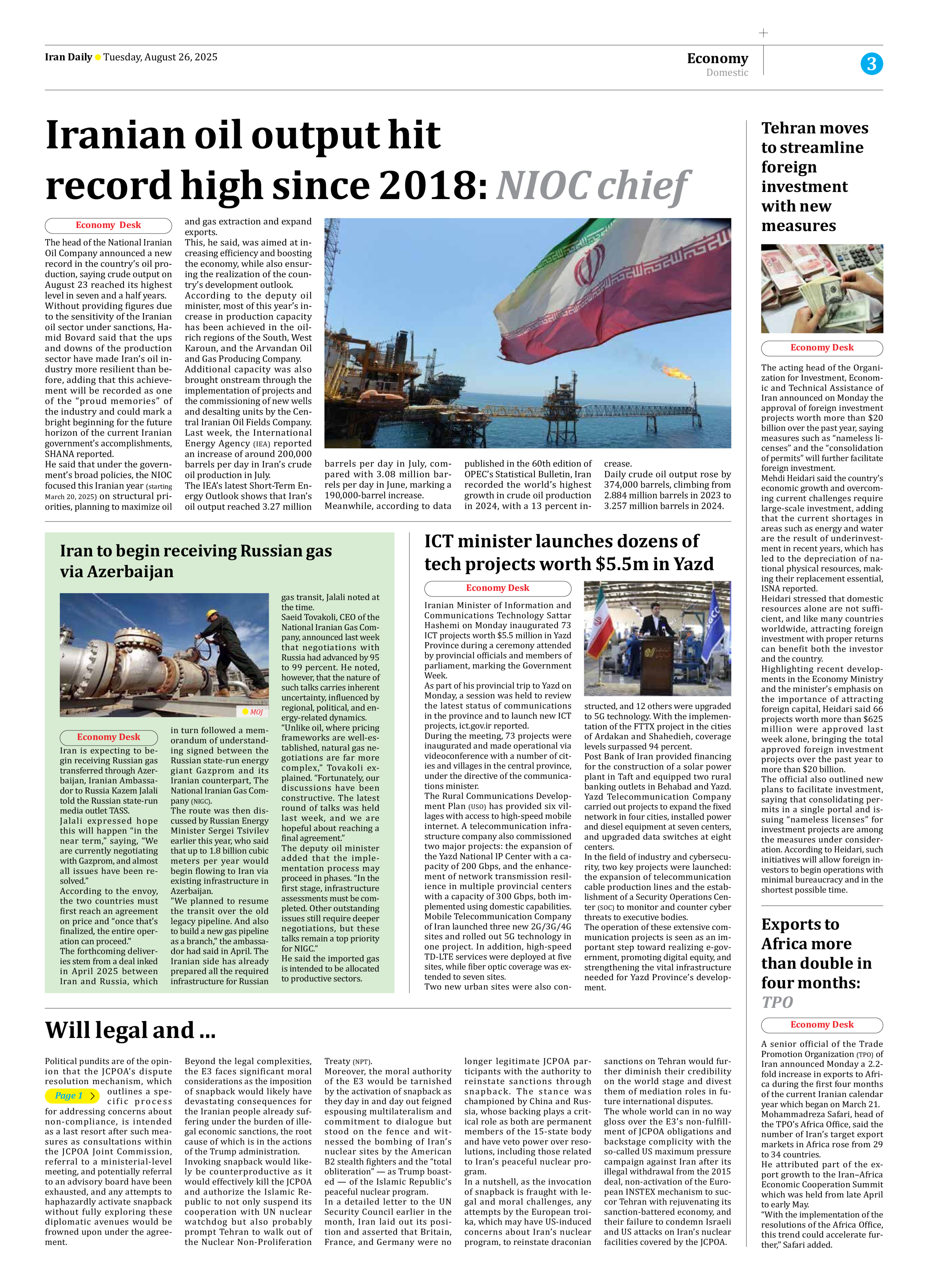


Iranian oil output hit record high since 2018: NIOC chief
The head of the National Iranian Oil Company announced a new record in the country’s oil production, saying crude output on August 23 reached its highest level in seven and a half years.
Without providing figures due to the sensitivity of the Iranian oil sector under sanctions, Hamid Bovard said that the ups and downs of the production sector have made Iran’s oil industry more resilient than before, adding that this achievement will be recorded as one of the “proud memories” of the industry and could mark a bright beginning for the future horizon of the current Iranian government’s accomplishments, SHANA reported.
He said that under the government’s broad policies, the NIOC focused this Iranian year (starting March 20, 2025) on structural priorities, planning to maximize oil and gas extraction and expand exports.
This, he said, was aimed at increasing efficiency and boosting the economy, while also ensuring the realization of the country’s development outlook.
According to the deputy oil minister, most of this year’s increase in production capacity has been achieved in the oil-rich regions of the South, West Karoun, and the Arvandan Oil and Gas Producing Company.
Additional capacity was also brought onstream through the implementation of projects and the commissioning of new wells and desalting units by the Central Iranian Oil Fields Company.
Last week, the International Energy Agency (IEA) reported an increase of around 200,000 barrels per day in Iran’s crude oil production in July.
The IEA’s latest Short-Term Energy Outlook shows that Iran’s oil output reached 3.27 million barrels per day in July, compared with 3.08 million barrels per day in June, marking a 190,000-barrel increase.
Meanwhile, according to data published in the 60th edition of OPEC’s Statistical Bulletin, Iran recorded the world’s highest growth in crude oil production in 2024, with a 13 percent increase.
Daily crude oil output rose by 374,000 barrels, climbing from 2.884 million barrels in 2023 to 3.257 million barrels in 2024.