







Copy in clipboard...
Traditional beauty preserved in craft of Charoq
Researchers trace the origins of Charoq back to the Sassanid era, noting its flourishing during the Safavid dynasty. Its cultural significance is reflected not only in craftsmanship but also in Iranian literature. For instance, in Rumi’s poem “The Shepherd and the Muses”, the shepherd humbly prays to God, saying he would sew His Charoq and comb His hair — a testament to the deep-rooted presence of this art form throughout history.
The tools used in making Charoq are similar to those of shoemaking, including the Derafsh (stitching awl), needles, scalp, knife, engraving pen tool, cutter, shoehorns, and wooden molds. The main materials consist of tanned cow leather, silk, Golabatoon (metallic threads), and cotton yarn, visitiran.ir wrote.
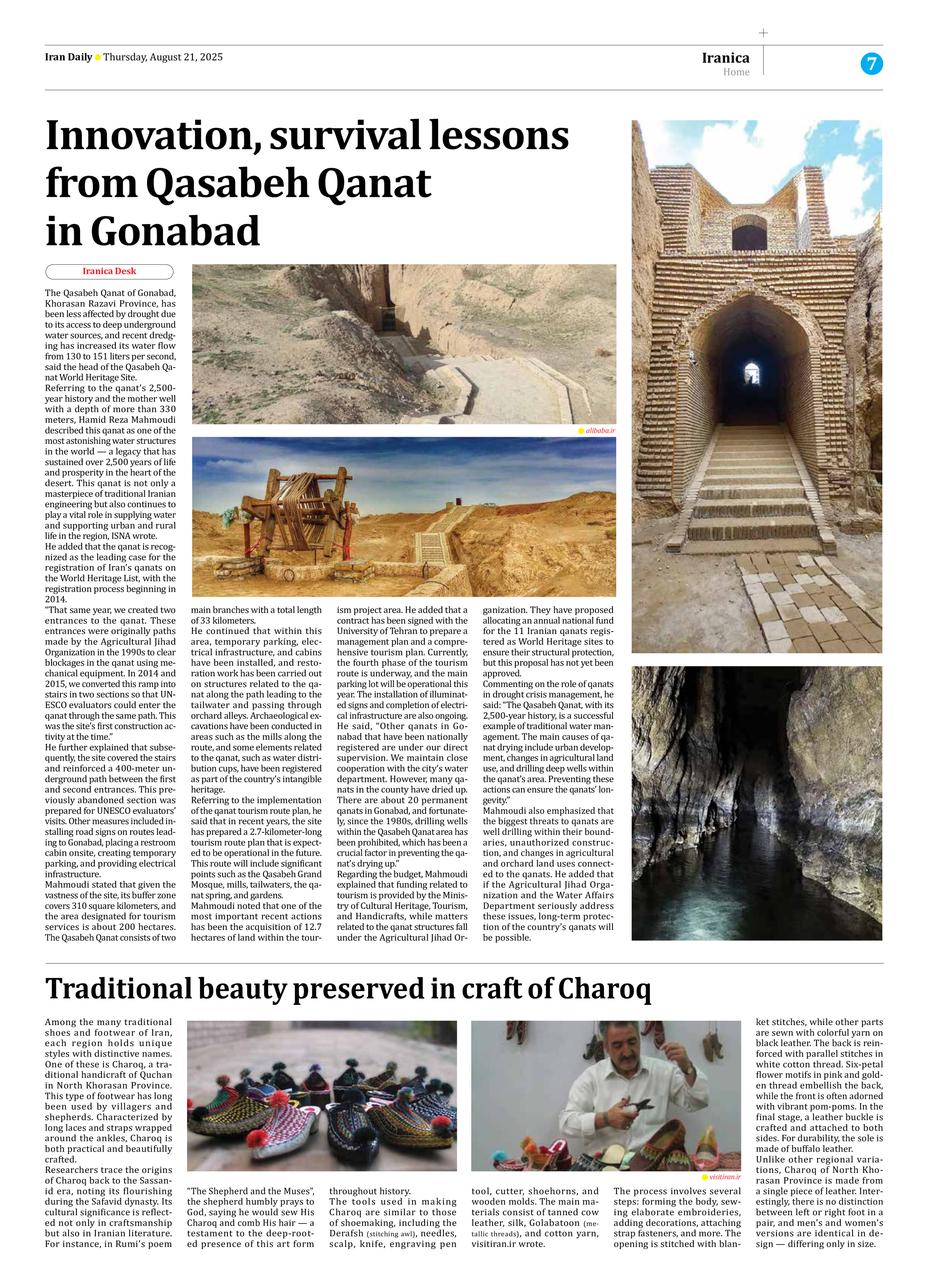
The process involves several steps: forming the body, sewing elaborate embroideries, adding decorations, attaching strap fasteners, and more. The opening is stitched with blanket stitches, while other parts are sewn with colorful yarn on black leather. The back is reinforced with parallel stitches in white cotton thread. Six-petal flower motifs in pink and golden thread embellish the back, while the front is often adorned with vibrant pom-poms. In the final stage, a leather buckle is crafted and attached to both sides. For durability, the sole is made of buffalo leather.
Unlike other regional variations, Charoq of North Khorasan Province is made from a single piece of leather. Interestingly, there is no distinction between left or right foot in a pair, and men’s and women’s versions are identical in design — differing only in size.