







Historical context, architectural design of Jajarmi Hosseinieh in Bojnord
Jajarmi Hosseinieh is a late Qajar historical building located in the city of Bojnord, North Khorasan Province. According to an inscription found in 1907 CE, the builder of this monument was Gholamreza Banna Yazdi. A Hosseinieh is a Shia Islamic congregation hall dedicated to hosting religious ceremonies, especially those commemorating the martyrdom of Imam Hussein (PBUH) and his companions. The owner of this Hosseinieh initially lived there and later dedicated it as a charitable endowment. The historical building was registered on Iran’s National Heritage List in 2004.
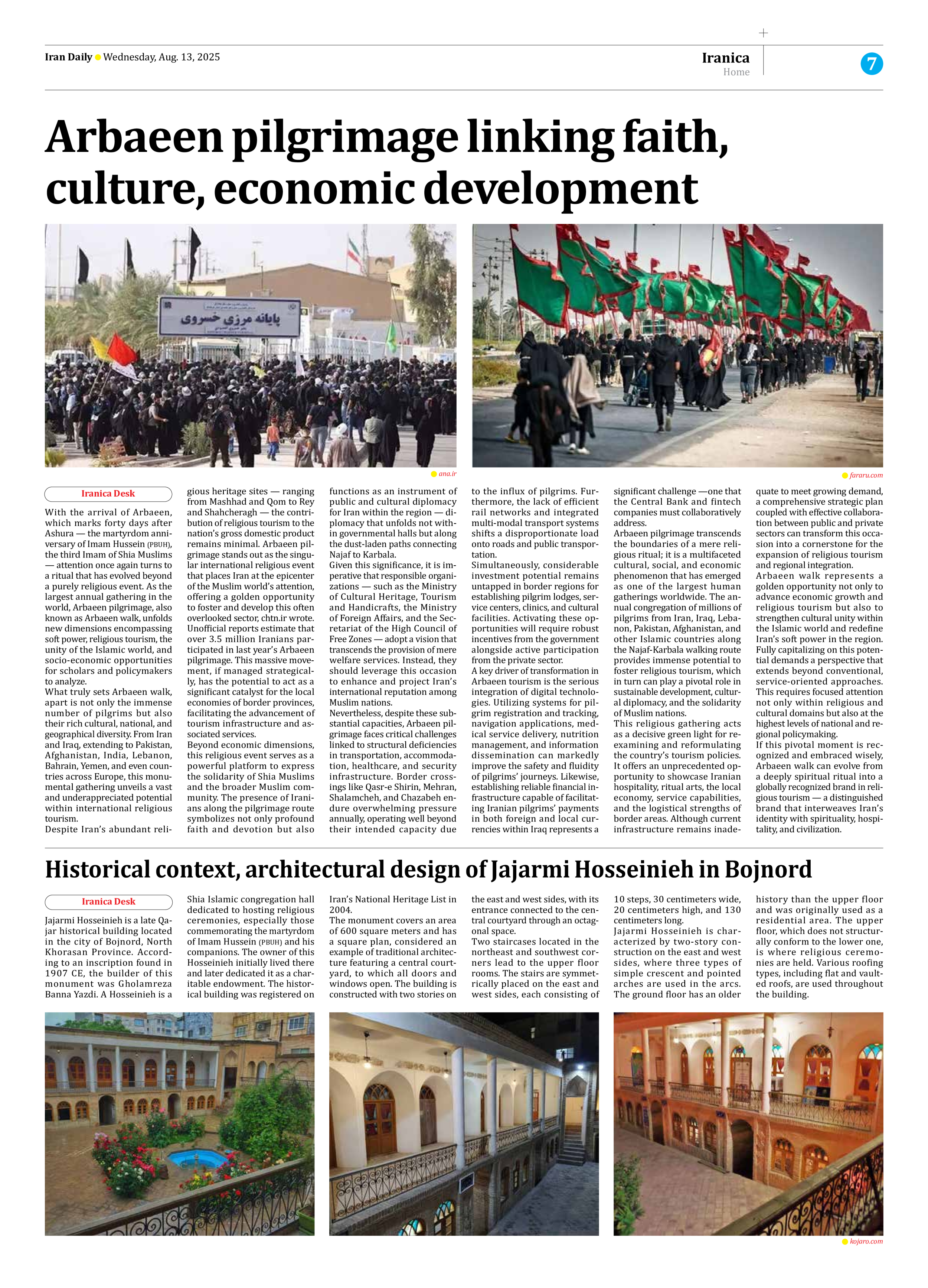
The monument covers an area of 600 square meters and has a square plan, considered an example of traditional architecture featuring a central courtyard, to which all doors and windows open. The building is constructed with two stories on the east and west sides, with its entrance connected to the central courtyard through an octagonal space.
Two staircases located in the northeast and southwest corners lead to the upper floor rooms. The stairs are symmetrically placed on the east and west sides, each consisting of 10 steps, 30 centimeters wide, 20 centimeters high, and 130 centimeters long.
Jajarmi Hosseinieh is characterized by two-story construction on the east and west sides, where three types of simple crescent and pointed arches are used in the arcs. The ground floor has an older history than the upper floor and was originally used as a residential area. The upper floor, which does not structurally conform to the lower one, is where religious ceremonies are held. Various roofing types, including flat and vaulted roofs, are used throughout the building.