







Arbaeen pilgrimage linking faith, culture, economic development
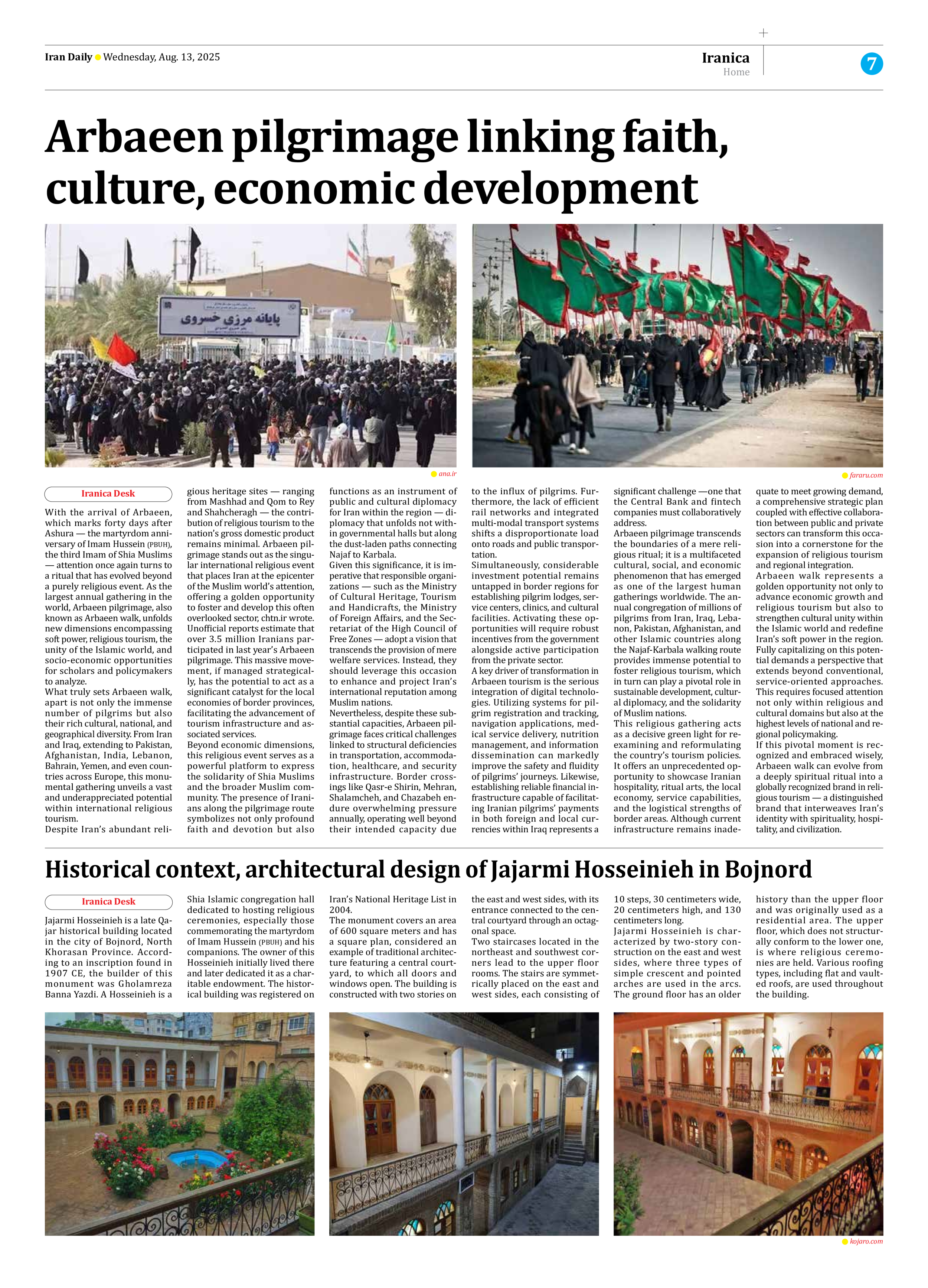
With the arrival of Arbaeen, which marks forty days after Ashura — the martyrdom anniversary of Imam Hussein (PBUH), the third Imam of Shia Muslims — attention once again turns to a ritual that has evolved beyond a purely religious event. As the largest annual gathering in the world, Arbaeen pilgrimage, also known as Arbaeen walk, unfolds new dimensions encompassing soft power, religious tourism, the unity of the Islamic world, and socio-economic opportunities for scholars and policymakers to analyze.
What truly sets Arbaeen walk, apart is not only the immense number of pilgrims but also their rich cultural, national, and geographical diversity. From Iran and Iraq, extending to Pakistan, Afghanistan, India, Lebanon, Bahrain, Yemen, and even countries across Europe, this monumental gathering unveils a vast and underappreciated potential within international religious tourism.
Despite Iran’s abundant religious heritage sites — ranging from Mashhad and Qom to Rey and Shahcheragh — the contribution of religious tourism to the nation’s gross domestic product remains minimal. Arbaeen pilgrimage stands out as the singular international religious event that places Iran at the epicenter of the Muslim world’s attention, offering a golden opportunity to foster and develop this often overlooked sector, chtn.ir wrote.
Unofficial reports estimate that over 3.5 million Iranians participated in last year’s Arbaeen pilgrimage. This massive movement, if managed strategically, has the potential to act as a significant catalyst for the local economies of border provinces, facilitating the advancement of tourism infrastructure and associated services.
Beyond economic dimensions, this religious event serves as a powerful platform to express the solidarity of Shia Muslims and the broader Muslim community. The presence of Iranians along the pilgrimage route symbolizes not only profound faith and devotion but also functions as an instrument of public and cultural diplomacy for Iran within the region — diplomacy that unfolds not within governmental halls but along the dust-laden paths connecting Najaf to Karbala.
Given this significance, it is imperative that responsible organizations — such as the Ministry of Cultural Heritage, Tourism and Handicrafts, the Ministry of Foreign Affairs, and the Secretariat of the High Council of Free Zones — adopt a vision that transcends the provision of mere welfare services. Instead, they should leverage this occasion to enhance and project Iran’s international reputation among Muslim nations.
Nevertheless, despite these substantial capacities, Arbaeen pilgrimage faces critical challenges linked to structural deficiencies in transportation, accommodation, healthcare, and security infrastructure. Border crossings like Qasr-e Shirin, Mehran, Shalamcheh, and Chazabeh endure overwhelming pressure annually, operating well beyond their intended capacity due to the influx of pilgrims. Furthermore, the lack of efficient rail networks and integrated multi-modal transport systems shifts a disproportionate load onto roads and public transportation.
Simultaneously, considerable investment potential remains untapped in border regions for establishing pilgrim lodges, service centers, clinics, and cultural facilities. Activating these opportunities will require robust incentives from the government alongside active participation from the private sector.
A key driver of transformation in Arbaeen tourism is the serious integration of digital technologies. Utilizing systems for pilgrim registration and tracking, navigation applications, medical service delivery, nutrition management, and information dissemination can markedly improve the safety and fluidity of pilgrims’ journeys. Likewise, establishing reliable financial infrastructure capable of facilitating Iranian pilgrims’ payments in both foreign and local currencies within Iraq represents a significant challenge —one that the Central Bank and fintech companies must collaboratively address.
Arbaeen pilgrimage transcends the boundaries of a mere religious ritual; it is a multifaceted cultural, social, and economic phenomenon that has emerged as one of the largest human gatherings worldwide. The annual congregation of millions of pilgrims from Iran, Iraq, Lebanon, Pakistan, Afghanistan, and other Islamic countries along the Najaf-Karbala walking route provides immense potential to foster religious tourism, which in turn can play a pivotal role in sustainable development, cultural diplomacy, and the solidarity of Muslim nations.
This religious gathering acts as a decisive green light for reexamining and reformulating the country’s tourism policies. It offers an unprecedented opportunity to showcase Iranian hospitality, ritual arts, the local economy, service capabilities, and the logistical strengths of border areas. Although current infrastructure remains inadequate to meet growing demand, a comprehensive strategic plan coupled with effective collaboration between public and private sectors can transform this occasion into a cornerstone for the expansion of religious tourism and regional integration.
Arbaeen walk represents a golden opportunity not only to advance economic growth and religious tourism but also to strengthen cultural unity within the Islamic world and redefine Iran’s soft power in the region. Fully capitalizing on this potential demands a perspective that extends beyond conventional, service-oriented approaches. This requires focused attention not only within religious and cultural domains but also at the highest levels of national and regional policymaking.
If this pivotal moment is recognized and embraced wisely, Arbaeen walk can evolve from a deeply spiritual ritual into a globally recognized brand in religious tourism — a distinguished brand that interweaves Iran’s identity with spirituality, hospitality, and civilization.