





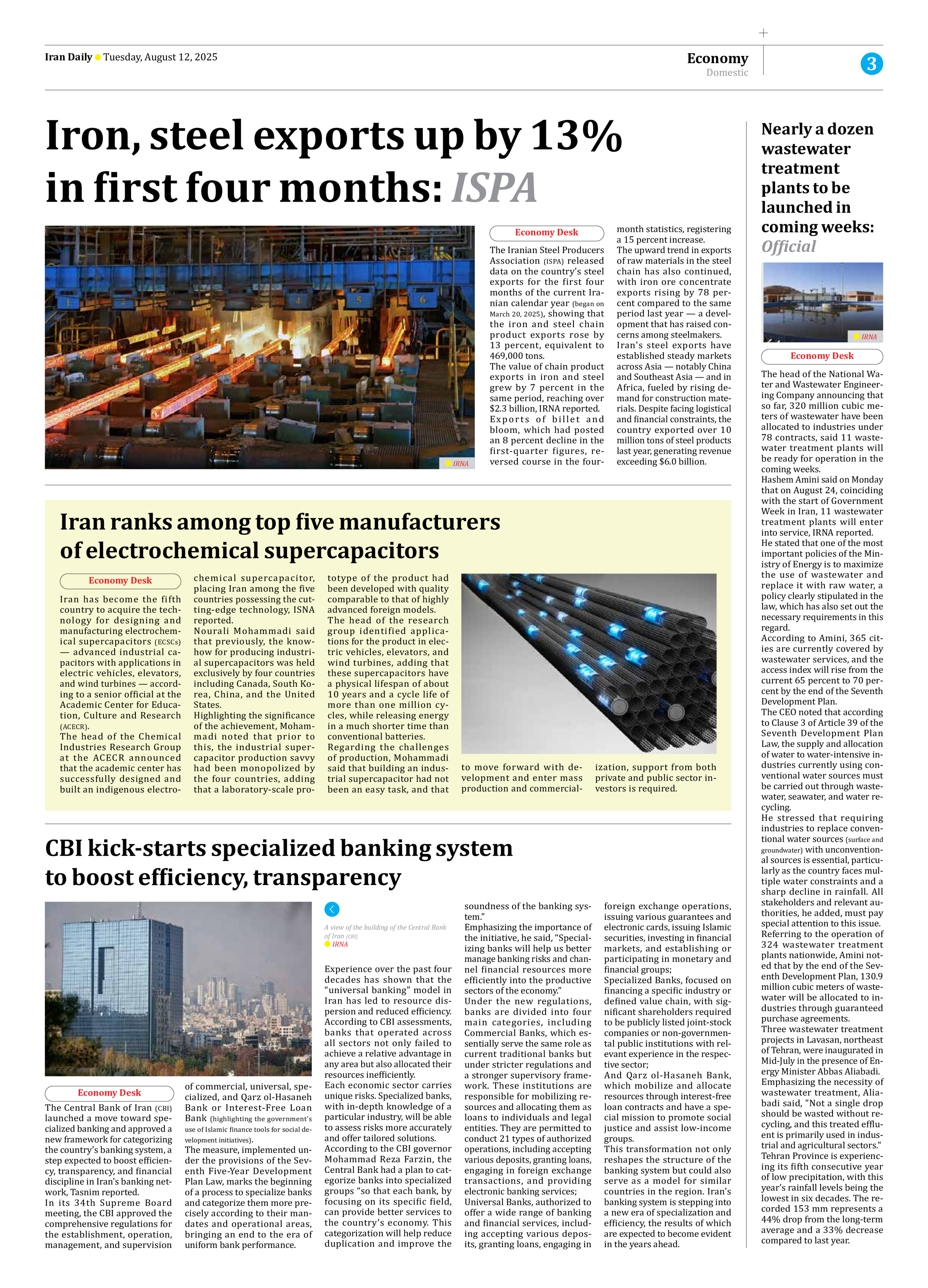


Nearly a dozen wastewater treatment plants to be launched in coming weeks: Official
The head of the National Water and Wastewater Engineering Company announcing that so far, 320 million cubic meters of wastewater have been allocated to industries under 78 contracts, said 11 wastewater treatment plants will be ready for operation in the coming weeks.
Hashem Amini said on Monday that on August 24, coinciding with the start of Government Week in Iran, 11 wastewater treatment plants will enter into service, IRNA reported.
He stated that one of the most important policies of the Ministry of Energy is to maximize the use of wastewater and replace it with raw water, a policy clearly stipulated in the law, which has also set out the necessary requirements in this regard.
According to Amini, 365 cities are currently covered by wastewater services, and the access index will rise from the current 65 percent to 70 percent by the end of the Seventh Development Plan.
The CEO noted that according to Clause 3 of Article 39 of the Seventh Development Plan Law, the supply and allocation of water to water-intensive industries currently using conventional water sources must be carried out through wastewater, seawater, and water recycling.
He stressed that requiring industries to replace conventional water sources (surface and groundwater) with unconventional sources is essential, particularly as the country faces multiple water constraints and a sharp decline in rainfall. All stakeholders and relevant authorities, he added, must pay special attention to this issue.
Referring to the operation of 324 wastewater treatment plants nationwide, Amini noted that by the end of the Seventh Development Plan, 130.9 million cubic meters of wastewater will be allocated to industries through guaranteed purchase agreements.
Three wastewater treatment projects in Lavasan, northeast of Tehran, were inaugurated in Mid-July in the presence of Energy Minister Abbas Aliabadi.
Emphasizing the necessity of wastewater treatment, Aliabadi said, "Not a single drop should be wasted without recycling, and this treated effluent is primarily used in industrial and agricultural sectors."
Tehran Province is experiencing its fifth consecutive year of low precipitation, with this year’s rainfall levels being the lowest in six decades. The recorded 153 mm represents a 44% drop from the long-term average and a 33% decrease compared to last year.