







Grasping sense of time warp at mountain stronghold of Qamchqay
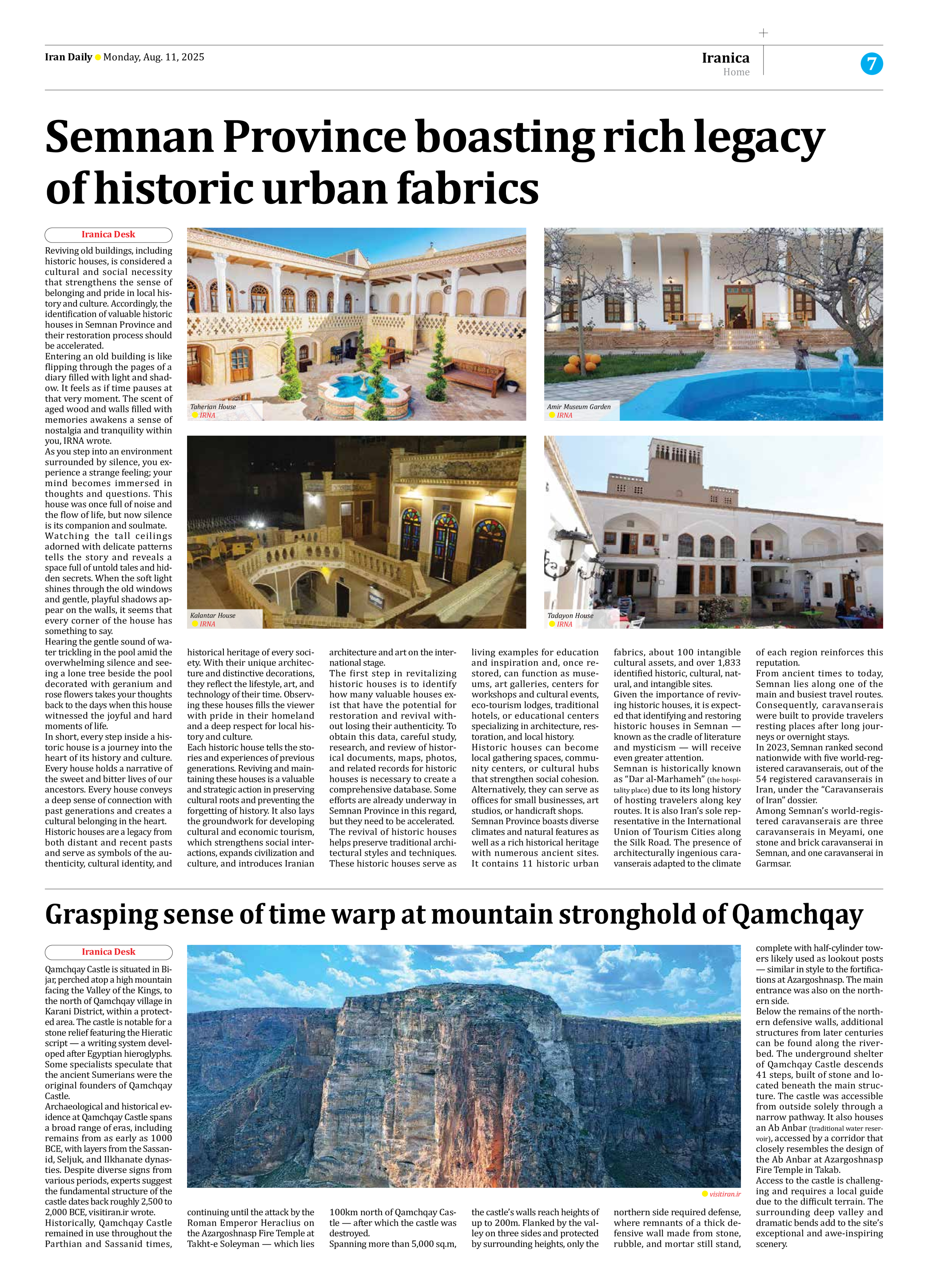
Qamchqay Castle is situated in Bijar, perched atop a high mountain facing the Valley of the Kings, to the north of Qamchqay village in Karani District, within a protected area. The castle is notable for a stone relief featuring the Hieratic script — a writing system developed after Egyptian hieroglyphs. Some specialists speculate that the ancient Sumerians were the original founders of Qamchqay Castle.
Archaeological and historical evidence at Qamchqay Castle spans a broad range of eras, including remains from as early as 1000 BCE, with layers from the Sassanid, Seljuk, and Ilkhanate dynasties. Despite diverse signs from various periods, experts suggest the fundamental structure of the castle dates back roughly 2,500 to 2,000 BCE, visitiran.ir wrote.
Historically, Qamchqay Castle remained in use throughout the Parthian and Sassanid times, continuing until the attack by the Roman Emperor Heraclius on the Azargoshnasp Fire Temple at Takht-e Soleyman — which lies 100km north of Qamchqay Castle — after which the castle was destroyed.
Spanning more than 5,000 sq.m, the castle’s walls reach heights of up to 200m. Flanked by the valley on three sides and protected by surrounding heights, only the northern side required defense, where remnants of a thick defensive wall made from stone, rubble, and mortar still stand, complete with half-cylinder towers likely used as lookout posts — similar in style to the fortifications at Azargoshnasp. The main entrance was also on the northern side.
Below the remains of the northern defensive walls, additional structures from later centuries can be found along the riverbed. The underground shelter of Qamchqay Castle descends 41 steps, built of stone and located beneath the main structure. The castle was accessible from outside solely through a narrow pathway. It also houses an Ab Anbar (traditional water reservoir), accessed by a corridor that closely resembles the design of the Ab Anbar at Azargoshnasp Fire Temple in Takab.
Access to the castle is challenging and requires a local guide due to the difficult terrain. The surrounding deep valley and dramatic bends add to the site’s exceptional and awe-inspiring scenery.