







Semnan Province boasting rich legacy of historic urban fabrics
Reviving old buildings, including historic houses, is considered a cultural and social necessity that strengthens the sense of belonging and pride in local history and culture. Accordingly, the identification of valuable historic houses in Semnan Province and their restoration process should be accelerated.
Entering an old building is like flipping through the pages of a diary filled with light and shadow. It feels as if time pauses at that very moment. The scent of aged wood and walls filled with memories awakens a sense of nostalgia and tranquility within you, IRNA wrote.
As you step into an environment surrounded by silence, you experience a strange feeling; your mind becomes immersed in thoughts and questions. This house was once full of noise and the flow of life, but now silence is its companion and soulmate.
Watching the tall ceilings adorned with delicate patterns tells the story and reveals a space full of untold tales and hidden secrets. When the soft light shines through the old windows and gentle, playful shadows appear on the walls, it seems that every corner of the house has something to say.
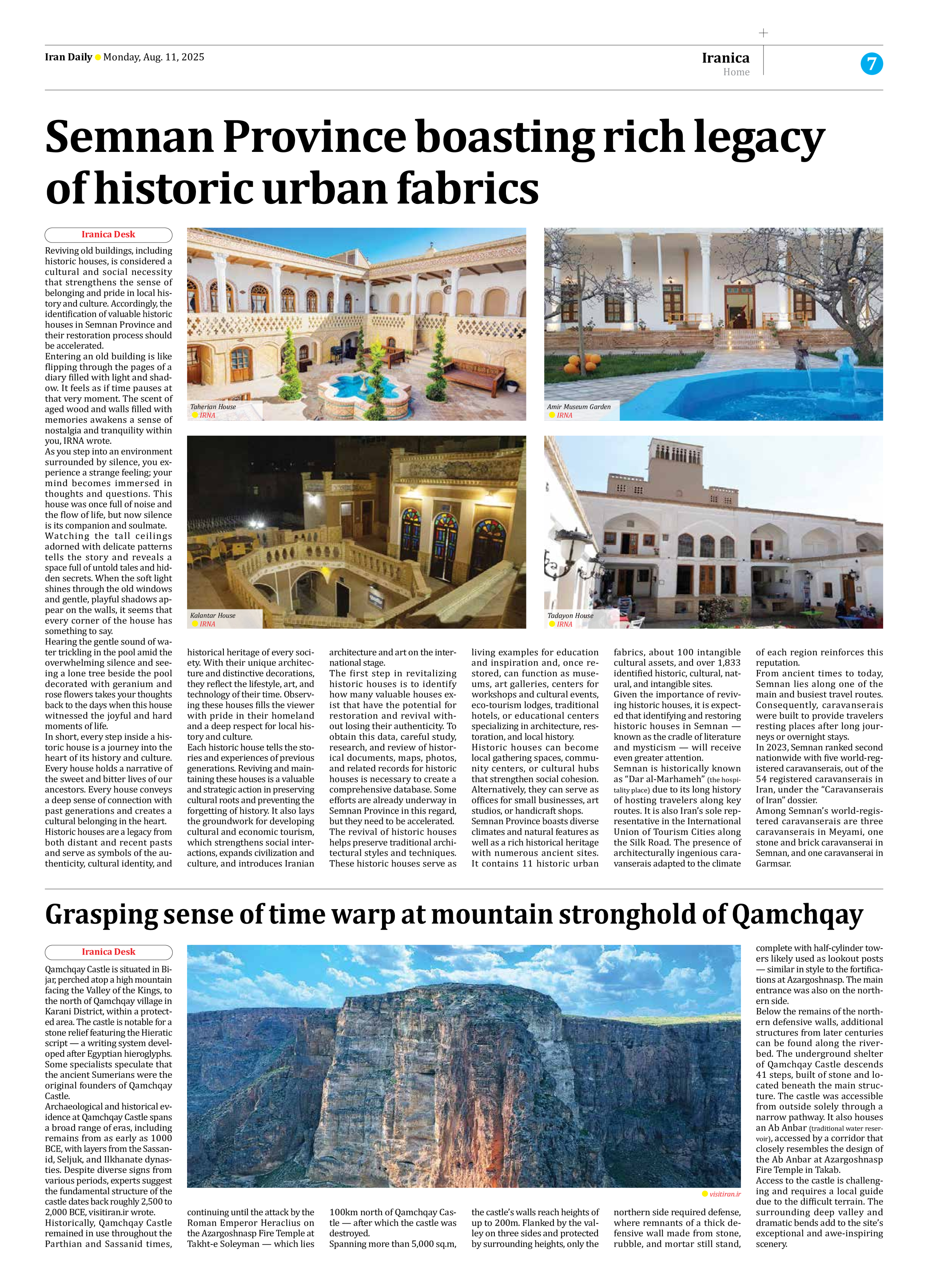
Hearing the gentle sound of water trickling in the pool amid the overwhelming silence and seeing a lone tree beside the pool decorated with geranium and rose flowers takes your thoughts back to the days when this house witnessed the joyful and hard moments of life.
In short, every step inside a historic house is a journey into the heart of its history and culture. Every house holds a narrative of the sweet and bitter lives of our ancestors. Every house conveys a deep sense of connection with past generations and creates a cultural belonging in the heart.
Historic houses are a legacy from both distant and recent pasts and serve as symbols of the authenticity, cultural identity, and historical heritage of every society. With their unique architecture and distinctive decorations, they reflect the lifestyle, art, and technology of their time. Observing these houses fills the viewer with pride in their homeland and a deep respect for local history and culture.
Each historic house tells the stories and experiences of previous generations. Reviving and maintaining these houses is a valuable and strategic action in preserving cultural roots and preventing the forgetting of history. It also lays the groundwork for developing cultural and economic tourism, which strengthens social interactions, expands civilization and culture, and introduces Iranian architecture and art on the international stage.
The first step in revitalizing historic houses is to identify how many valuable houses exist that have the potential for restoration and revival without losing their authenticity. To obtain this data, careful study, research, and review of historical documents, maps, photos, and related records for historic houses is necessary to create a comprehensive database. Some efforts are already underway in Semnan Province in this regard, but they need to be accelerated.
The revival of historic houses helps preserve traditional architectural styles and techniques. These historic houses serve as living examples for education and inspiration and, once restored, can function as museums, art galleries, centers for workshops and cultural events, eco-tourism lodges, traditional hotels, or educational centers specializing in architecture, restoration, and local history.
Historic houses can become local gathering spaces, community centers, or cultural hubs that strengthen social cohesion. Alternatively, they can serve as offices for small businesses, art studios, or handicraft shops.
Semnan Province boasts diverse climates and natural features as well as a rich historical heritage with numerous ancient sites. It contains 11 historic urban fabrics, about 100 intangible cultural assets, and over 1,833 identified historic, cultural, natural, and intangible sites.
Given the importance of reviving historic houses, it is expected that identifying and restoring historic houses in Semnan — known as the cradle of literature and mysticism — will receive even greater attention.
Semnan is historically known as “Dar al-Marhameh” (the hospitality place) due to its long history of hosting travelers along key routes. It is also Iran’s sole representative in the International Union of Tourism Cities along the Silk Road. The presence of architecturally ingenious caravanserais adapted to the climate of each region reinforces this reputation.
From ancient times to today, Semnan lies along one of the main and busiest travel routes. Consequently, caravanserais were built to provide travelers resting places after long journeys or overnight stays.
In 2023, Semnan ranked second nationwide with five world-registered caravanserais, out of the 54 registered caravanserais in Iran, under the “Caravanserais of Iran” dossier.
Among Semnan’s world-registered caravanserais are three caravanserais in Meyami, one stone and brick caravanserai in Semnan, and one caravanserai in Garmsar.