





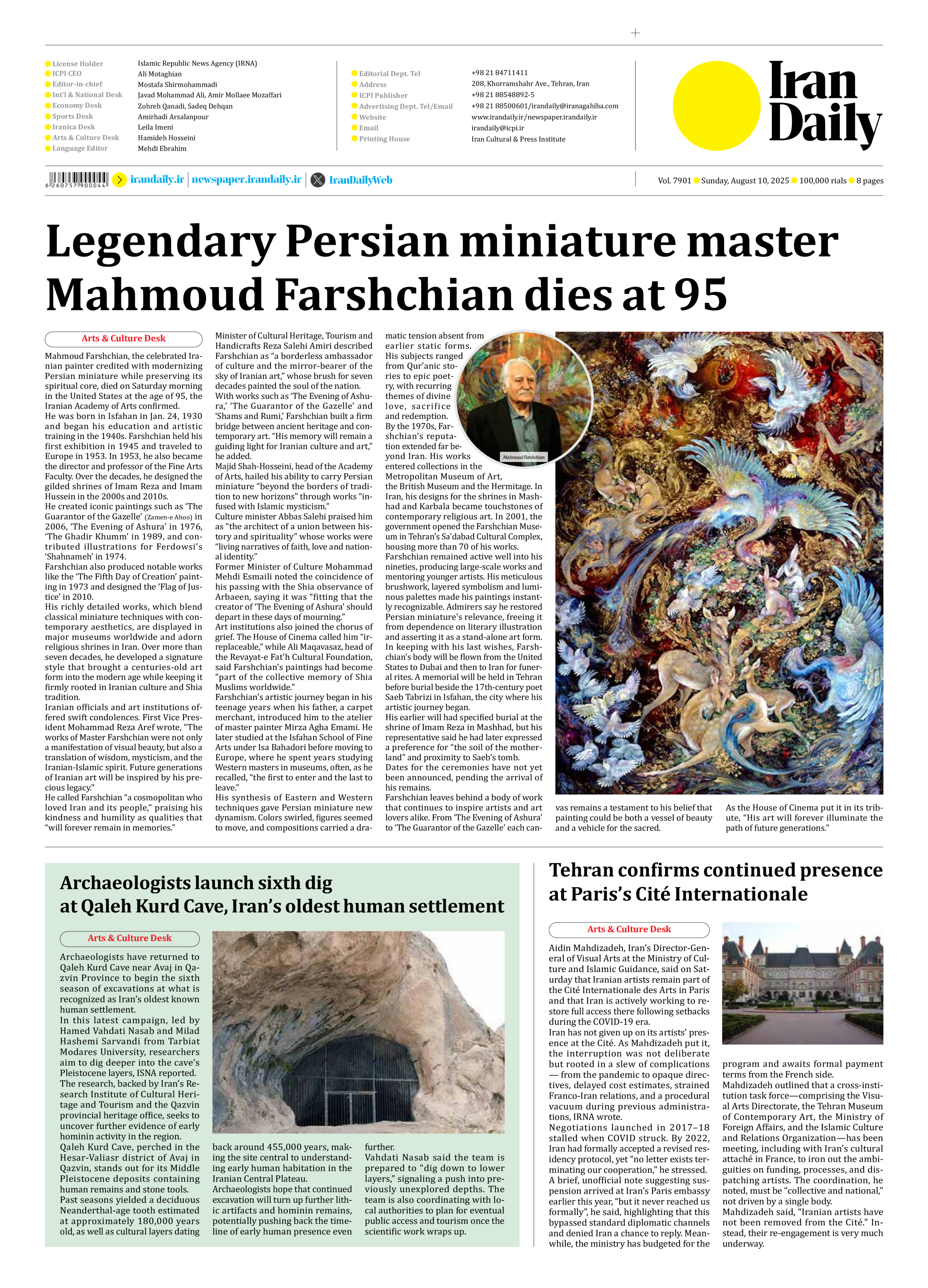


Legendary Persian miniature master Mahmoud Farshchian dies at 95
Mahmoud Farshchian, the celebrated Iranian painter credited with modernizing Persian miniature while preserving its spiritual core, died on Saturday morning in the United States at the age of 95, the Iranian Academy of Arts confirmed.
He was born in Isfahan in Jan. 24, 1930 and began his education and artistic training in the 1940s. Farshchian held his first exhibition in 1945 and traveled to Europe in 1953. In 1953, he also became the director and professor of the Fine Arts Faculty. Over the decades, he designed the gilded shrines of Imam Reza and Imam Hussein in the 2000s and 2010s.
He created iconic paintings such as ‘The Guarantor of the Gazelle’ (Zamen-e Ahoo) in 2006, ‘The Evening of Ashura’ in 1976, ‘The Ghadir Khumm’ in 1989, and contributed illustrations for Ferdowsi’s ‘Shahnameh’ in 1974.
Farshchian also produced notable works like the ‘The Fifth Day of Creation’ painting in 1973 and designed the ‘Flag of Justice’ in 2010.
His richly detailed works, which blend classical miniature techniques with contemporary aesthetics, are displayed in major museums worldwide and adorn religious shrines in Iran. Over more than seven decades, he developed a signature style that brought a centuries-old art form into the modern age while keeping it firmly rooted in Iranian culture and Shia tradition.
Iranian officials and art institutions offered swift condolences. First Vice President Mohammad Reza Aref wrote, “The works of Master Farshchian were not only a manifestation of visual beauty, but also a translation of wisdom, mysticism, and the Iranian-Islamic spirit. Future generations of Iranian art will be inspired by his precious legacy.”
He called Farshchian “a cosmopolitan who loved Iran and its people,” praising his kindness and humility as qualities that “will forever remain in memories.”
Minister of Cultural Heritage, Tourism and Handicrafts Reza Salehi Amiri described Farshchian as “a borderless ambassador of culture and the mirror-bearer of the sky of Iranian art,” whose brush for seven decades painted the soul of the nation.
With works such as ‘The Evening of Ashura,’ ‘The Guarantor of the Gazelle’ and ‘Shams and Rumi,’ Farshchian built a firm bridge between ancient heritage and contemporary art. “His memory will remain a guiding light for Iranian culture and art,” he added.
Majid Shah-Hosseini, head of the Academy of Arts, hailed his ability to carry Persian miniature “beyond the borders of tradition to new horizons” through works “infused with Islamic mysticism.”
Culture minister Abbas Salehi praised him as “the architect of a union between history and spirituality” whose works were “living narratives of faith, love and national identity.”
Former Minister of Culture Mohammad Mehdi Esmaili noted the coincidence of his passing with the Shia observance of Arbaeen, saying it was “fitting that the creator of ‘The Evening of Ashura’ should depart in these days of mourning.”
Art institutions also joined the chorus of grief. The House of Cinema called him “irreplaceable,” while Ali Maqavasaz, head of the Revayat-e Fat'h Cultural Foundation, said Farshchian’s paintings had become “part of the collective memory of Shia Muslims worldwide.”
Farshchian’s artistic journey began in his teenage years when his father, a carpet merchant, introduced him to the atelier of master painter Mirza Agha Emami. He later studied at the Isfahan School of Fine Arts under Isa Bahadori before moving to Europe, where he spent years studying Western masters in museums, often, as he recalled, “the first to enter and the last to leave.”
His synthesis of Eastern and Western techniques gave Persian miniature new dynamism. Colors swirled, figures seemed to move, and compositions carried a dramatic tension absent from earlier static forms. His subjects ranged from Qur’anic stories to epic poetry, with recurring themes of divine love, sacrifice and redemption.
By the 1970s, Farshchian’s reputation extended far beyond Iran. His works entered collections in the Metropolitan Museum of Art, the British Museum and the Hermitage. In Iran, his designs for the shrines in Mashhad and Karbala became touchstones of contemporary religious art. In 2001, the government opened the Farshchian Museum in Tehran’s Sa’dabad Cultural Complex, housing more than 70 of his works.
Farshchian remained active well into his nineties, producing large-scale works and mentoring younger artists. His meticulous brushwork, layered symbolism and luminous palettes made his paintings instantly recognizable. Admirers say he restored Persian miniature’s relevance, freeing it from dependence on literary illustration and asserting it as a stand-alone art form.
In keeping with his last wishes, Farshchian’s body will be flown from the United States to Dubai and then to Iran for funeral rites. A memorial will be held in Tehran before burial beside the 17th-century poet Saeb Tabrizi in Isfahan, the city where his artistic journey began.
His earlier will had specified burial at the shrine of Imam Reza in Mashhad, but his representative said he had later expressed a preference for “the soil of the motherland” and proximity to Saeb’s tomb.
Dates for the ceremonies have not yet been announced, pending the arrival of his remains.
Farshchian leaves behind a body of work that continues to inspire artists and art lovers alike. From ‘The Evening of Ashura’ to ‘The Guarantor of the Gazelle’ each canvas remains a testament to his belief that painting could be both a vessel of beauty and a vehicle for the sacred.
As the House of Cinema put it in its tribute, “His art will forever illuminate the path of future generations.”