





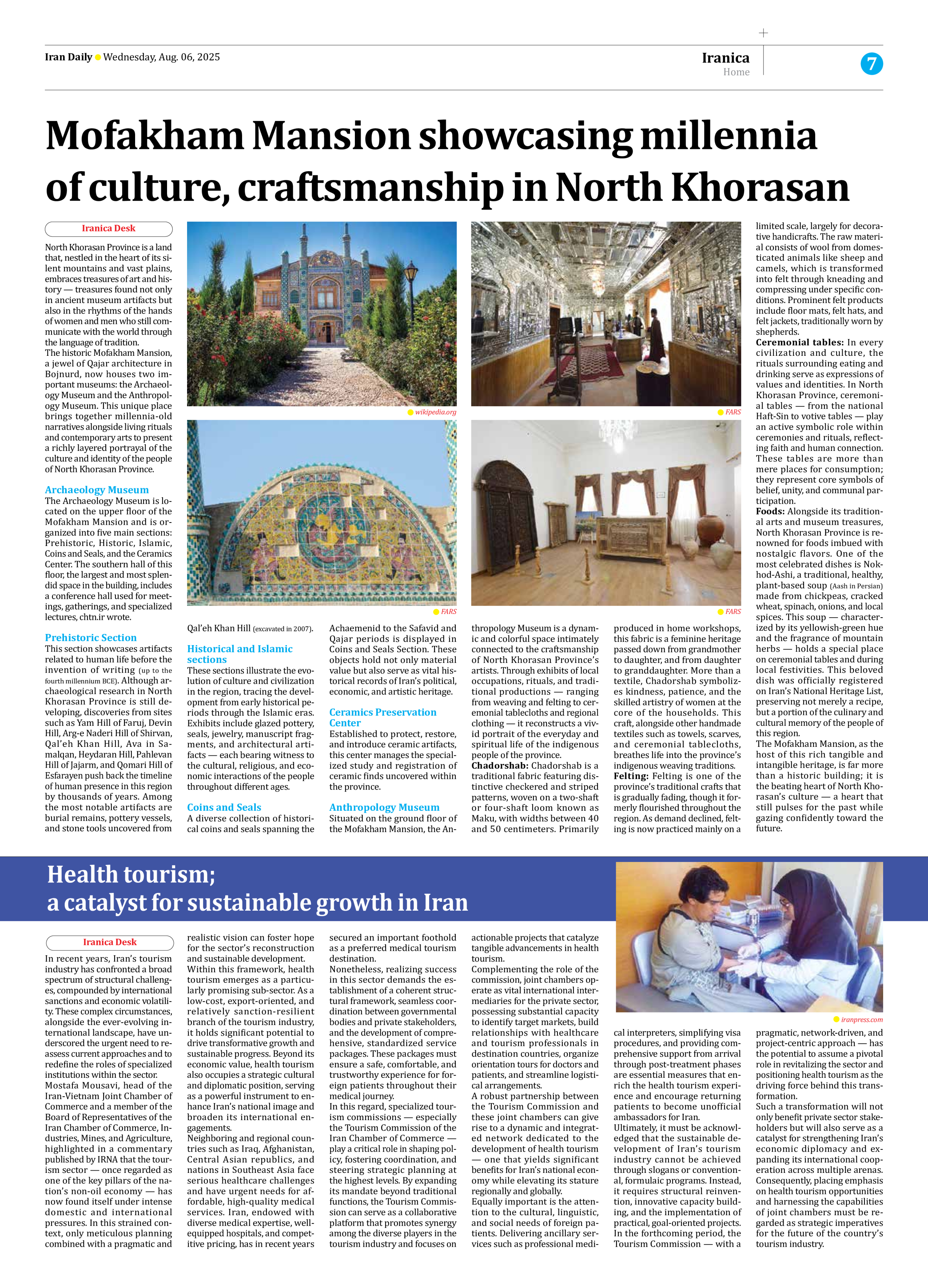


Health tourism; a catalyst for sustainable growth in Iran
In recent years, Iran’s tourism industry has confronted a broad spectrum of structural challenges, compounded by international sanctions and economic volatility. These complex circumstances, alongside the ever-evolving international landscape, have underscored the urgent need to reassess current approaches and to redefine the roles of specialized institutions within the sector.
Mostafa Mousavi, head of the Iran-Vietnam Joint Chamber of Commerce and a member of the Board of Representatives of the Iran Chamber of Commerce, Industries, Mines, and Agriculture, highlighted in a commentary published by IRNA that the tourism sector — once regarded as one of the key pillars of the nation’s non-oil economy — has now found itself under intense domestic and international pressures. In this strained context, only meticulous planning combined with a pragmatic and realistic vision can foster hope for the sector’s reconstruction and sustainable development.
Within this framework, health tourism emerges as a particularly promising sub-sector. As a low-cost, export-oriented, and relatively sanction-resilient branch of the tourism industry, it holds significant potential to drive transformative growth and sustainable progress. Beyond its economic value, health tourism also occupies a strategic cultural and diplomatic position, serving as a powerful instrument to enhance Iran’s national image and broaden its international engagements.
Neighboring and regional countries such as Iraq, Afghanistan, Central Asian republics, and nations in Southeast Asia face serious healthcare challenges and have urgent needs for affordable, high-quality medical services. Iran, endowed with diverse medical expertise, well-equipped hospitals, and competitive pricing, has in recent years secured an important foothold as a preferred medical tourism destination.
Nonetheless, realizing success in this sector demands the establishment of a coherent structural framework, seamless coordination between governmental bodies and private stakeholders, and the development of comprehensive, standardized service packages. These packages must ensure a safe, comfortable, and trustworthy experience for foreign patients throughout their medical journey.
In this regard, specialized tourism commissions — especially the Tourism Commission of the Iran Chamber of Commerce — play a critical role in shaping policy, fostering coordination, and steering strategic planning at the highest levels. By expanding its mandate beyond traditional functions, the Tourism Commission can serve as a collaborative platform that promotes synergy among the diverse players in the tourism industry and focuses on actionable projects that catalyze tangible advancements in health tourism.
Complementing the role of the commission, joint chambers operate as vital international intermediaries for the private sector, possessing substantial capacity to identify target markets, build relationships with healthcare and tourism professionals in destination countries, organize orientation tours for doctors and patients, and streamline logistical arrangements.
A robust partnership between the Tourism Commission and these joint chambers can give rise to a dynamic and integrated network dedicated to the development of health tourism — one that yields significant benefits for Iran’s national economy while elevating its stature regionally and globally.
Equally important is the attention to the cultural, linguistic, and social needs of foreign patients. Delivering ancillary services such as professional medical interpreters, simplifying visa procedures, and providing comprehensive support from arrival through post-treatment phases are essential measures that enrich the health tourism experience and encourage returning patients to become unofficial ambassadors for Iran.
Ultimately, it must be acknowledged that the sustainable development of Iran’s tourism industry cannot be achieved through slogans or conventional, formulaic programs. Instead, it requires structural reinvention, innovative capacity building, and the implementation of practical, goal-oriented projects. In the forthcoming period, the Tourism Commission — with a pragmatic, network-driven, and project-centric approach — has the potential to assume a pivotal role in revitalizing the sector and positioning health tourism as the driving force behind this transformation.
Such a transformation will not only benefit private sector stakeholders but will also serve as a catalyst for strengthening Iran’s economic diplomacy and expanding its international cooperation across multiple arenas. Consequently, placing emphasis on health tourism opportunities and harnessing the capabilities of joint chambers must be regarded as strategic imperatives for the future of the country’s tourism industry.