







Mofakham Mansion showcasing millennia of culture, craftsmanship in North Khorasan
North Khorasan Province is a land that, nestled in the heart of its silent mountains and vast plains, embraces treasures of art and history — treasures found not only in ancient museum artifacts but also in the rhythms of the hands of women and men who still communicate with the world through the language of tradition.
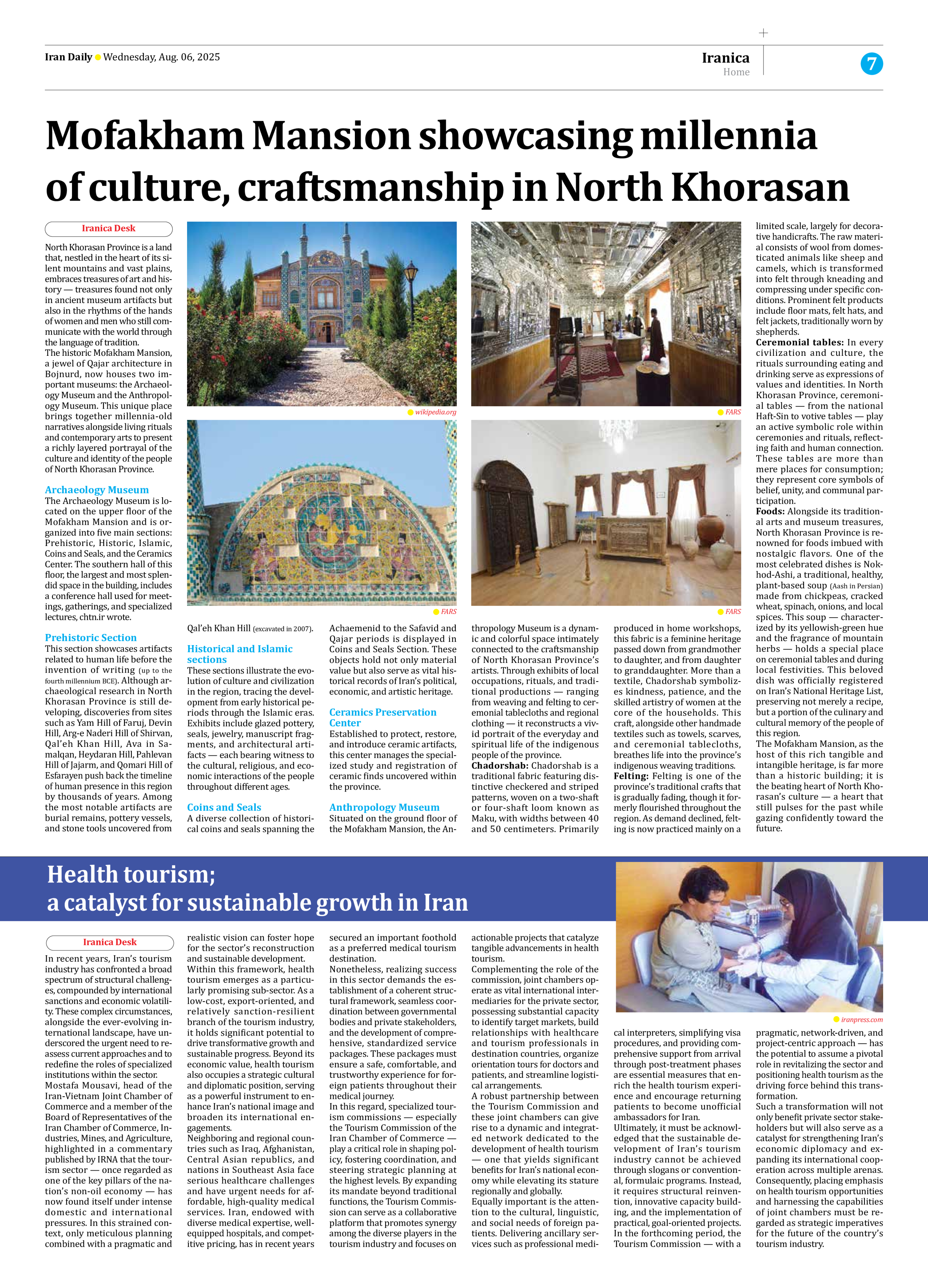
The historic Mofakham Mansion, a jewel of Qajar architecture in Bojnurd, now houses two important museums: the Archaeology Museum and the Anthropology Museum. This unique place brings together millennia-old narratives alongside living rituals and contemporary arts to present a richly layered portrayal of the culture and identity of the people of North Khorasan Province.
Archaeology Museum
The Archaeology Museum is located on the upper floor of the Mofakham Mansion and is organized into five main sections: Prehistoric, Historic, Islamic, Coins and Seals, and the Ceramics Center. The southern hall of this floor, the largest and most splendid space in the building, includes a conference hall used for meetings, gatherings, and specialized lectures, chtn.ir wrote.
Prehistoric Section
This section showcases artifacts related to human life before the invention of writing (up to the fourth millennium BCE). Although archaeological research in North Khorasan Province is still developing, discoveries from sites such as Yam Hill of Faruj, Devin Hill, Arg-e Naderi Hill of Shirvan, Qal’eh Khan Hill, Ava in Samalqan, Heydaran Hill, Pahlevan Hill of Jajarm, and Qomari Hill of Esfarayen push back the timeline of human presence in this region by thousands of years. Among the most notable artifacts are burial remains, pottery vessels, and stone tools uncovered from Qal’eh Khan Hill (excavated in 2007).
Historical and Islamic sections
These sections illustrate the evolution of culture and civilization in the region, tracing the development from early historical periods through the Islamic eras. Exhibits include glazed pottery, seals, jewelry, manuscript fragments, and architectural artifacts — each bearing witness to the cultural, religious, and economic interactions of the people throughout different ages.
Coins and Seals
A diverse collection of historical coins and seals spanning the Achaemenid to the Safavid and Qajar periods is displayed in Coins and Seals Section. These objects hold not only material value but also serve as vital historical records of Iran’s political, economic, and artistic heritage.
Ceramics Preservation Center
Established to protect, restore, and introduce ceramic artifacts, this center manages the specialized study and registration of ceramic finds uncovered within the province.
Anthropology Museum
Situated on the ground floor of the Mofakham Mansion, the Anthropology Museum is a dynamic and colorful space intimately connected to the craftsmanship of North Khorasan Province’s artists. Through exhibits of local occupations, rituals, and traditional productions — ranging from weaving and felting to ceremonial tablecloths and regional clothing — it reconstructs a vivid portrait of the everyday and spiritual life of the indigenous people of the province.
Chadorshab: Chadorshab is a traditional fabric featuring distinctive checkered and striped patterns, woven on a two-shaft or four-shaft loom known as Maku, with widths between 40 and 50 centimeters. Primarily produced in home workshops, this fabric is a feminine heritage passed down from grandmother to daughter, and from daughter to granddaughter. More than a textile, Chadorshab symbolizes kindness, patience, and the skilled artistry of women at the core of the households. This craft, alongside other handmade textiles such as towels, scarves, and ceremonial tablecloths, breathes life into the province’s indigenous weaving traditions.
Felting: Felting is one of the province’s traditional crafts that is gradually fading, though it formerly flourished throughout the region. As demand declined, felting is now practiced mainly on a limited scale, largely for decorative handicrafts. The raw material consists of wool from domesticated animals like sheep and camels, which is transformed into felt through kneading and compressing under specific conditions. Prominent felt products include floor mats, felt hats, and felt jackets, traditionally worn by shepherds.
Ceremonial tables: In every civilization and culture, the rituals surrounding eating and drinking serve as expressions of values and identities. In North Khorasan Province, ceremonial tables — from the national Haft-Sin to votive tables — play an active symbolic role within ceremonies and rituals, reflecting faith and human connection.
These tables are more than mere places for consumption; they represent core symbols of belief, unity, and communal participation.
Foods: Alongside its traditional arts and museum treasures, North Khorasan Province is renowned for foods imbued with nostalgic flavors. One of the most celebrated dishes is Nokhod-Ashi, a traditional, healthy, plant-based soup (Aash in Persian) made from chickpeas, cracked wheat, spinach, onions, and local spices. This soup — characterized by its yellowish-green hue and the fragrance of mountain herbs — holds a special place on ceremonial tables and during local festivities. This beloved dish was officially registered on Iran’s National Heritage List, preserving not merely a recipe, but a portion of the culinary and cultural memory of the people of this region.
The Mofakham Mansion, as the host of this rich tangible and intangible heritage, is far more than a historic building; it is the beating heart of North Khorasan’s culture — a heart that still pulses for the past while gazing confidently toward the future.