







Echoes of culture, nature in Deh Bala village of Yazd Province
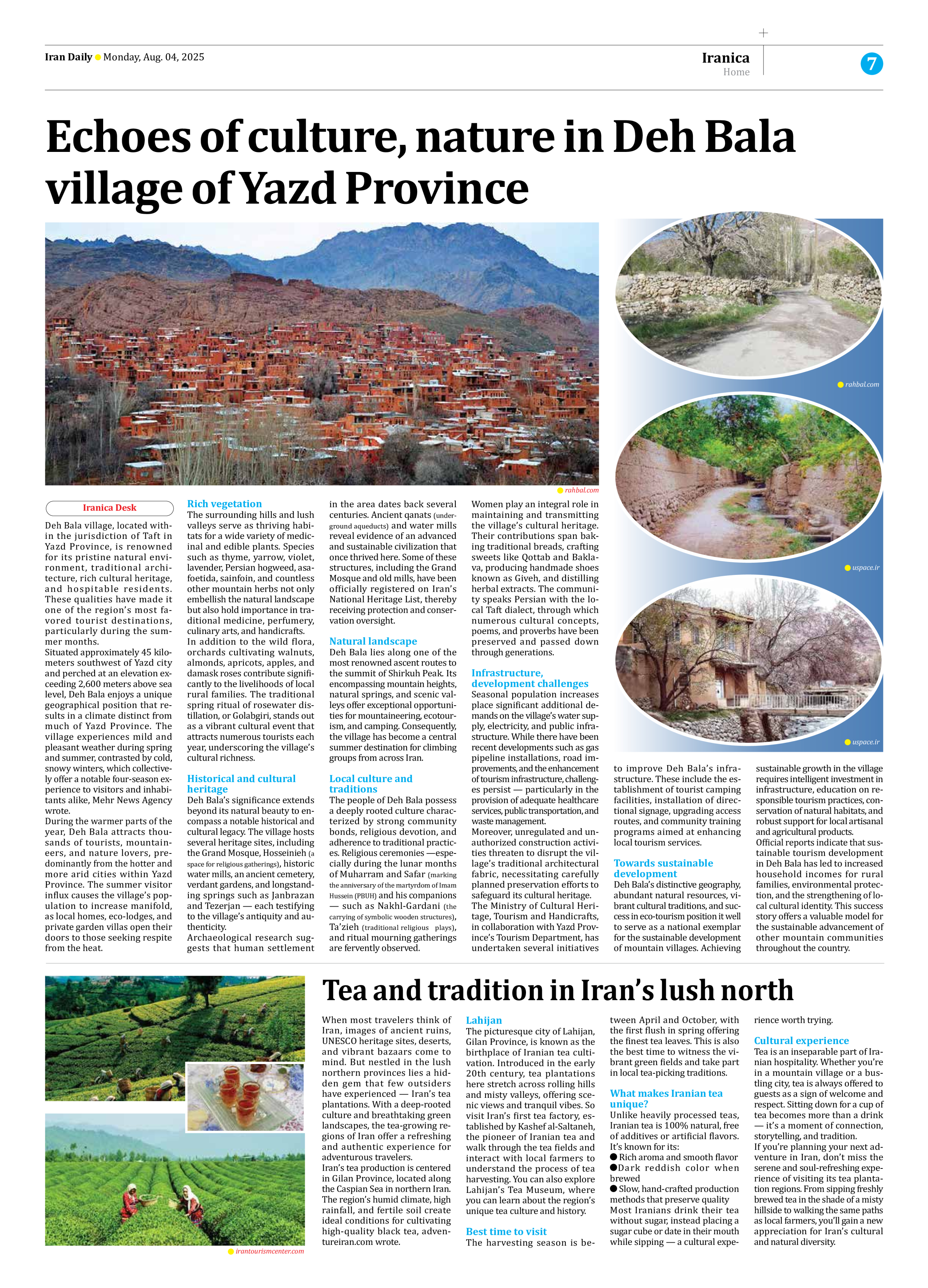
Deh Bala village, located within the jurisdiction of Taft in Yazd Province, is renowned for its pristine natural environment, traditional architecture, rich cultural heritage, and hospitable residents. These qualities have made it one of the region’s most favored tourist destinations, particularly during the summer months.
Situated approximately 45 kilometers southwest of Yazd city and perched at an elevation exceeding 2,600 meters above sea level, Deh Bala enjoys a unique geographical position that results in a climate distinct from much of Yazd Province. The village experiences mild and pleasant weather during spring and summer, contrasted by cold, snowy winters, which collectively offer a notable four-season experience to visitors and inhabitants alike, Mehr News Agency wrote.
During the warmer parts of the year, Deh Bala attracts thousands of tourists, mountaineers, and nature lovers, predominantly from the hotter and more arid cities within Yazd Province. The summer visitor influx causes the village’s population to increase manifold, as local homes, eco-lodges, and private garden villas open their doors to those seeking respite from the heat.
Rich vegetation
The surrounding hills and lush valleys serve as thriving habitats for a wide variety of medicinal and edible plants. Species such as thyme, yarrow, violet, lavender, Persian hogweed, asafoetida, sainfoin, and countless other mountain herbs not only embellish the natural landscape but also hold importance in traditional medicine, perfumery, culinary arts, and handicrafts.
In addition to the wild flora, orchards cultivating walnuts, almonds, apricots, apples, and damask roses contribute significantly to the livelihoods of local rural families. The traditional spring ritual of rosewater distillation, or Golabgiri, stands out as a vibrant cultural event that attracts numerous tourists each year, underscoring the village’s cultural richness.
Historical and cultural heritage
Deh Bala’s significance extends beyond its natural beauty to encompass a notable historical and cultural legacy. The village hosts several heritage sites, including the Grand Mosque, Hosseinieh (a space for religious gatherings), historic water mills, an ancient cemetery, verdant gardens, and longstanding springs such as Janbrazan and Tezerjan — each testifying to the village’s antiquity and authenticity.
Archaeological research suggests that human settlement in the area dates back several centuries. Ancient qanats (underground aqueducts) and water mills reveal evidence of an advanced and sustainable civilization that once thrived here. Some of these structures, including the Grand Mosque and old mills, have been officially registered on Iran’s National Heritage List, thereby receiving protection and conservation oversight.
Natural landscape
Deh Bala lies along one of the most renowned ascent routes to the summit of Shirkuh Peak. Its encompassing mountain heights, natural springs, and scenic valleys offer exceptional opportunities for mountaineering, ecotourism, and camping. Consequently, the village has become a central summer destination for climbing groups from across Iran.
Local culture and traditions
The people of Deh Bala possess a deeply rooted culture characterized by strong community bonds, religious devotion, and adherence to traditional practices. Religious ceremonies —especially during the lunar months of Muharram and Safar (marking the anniversary of the martyrdom of Imam Hussein (PBUH) and his companions — such as Nakhl-Gardani (the carrying of symbolic wooden structures), Ta’zieh (traditional religious plays), and ritual mourning gatherings are fervently observed.
Women play an integral role in maintaining and transmitting the village’s cultural heritage. Their contributions span baking traditional breads, crafting sweets like Qottab and Baklava, producing handmade shoes known as Giveh, and distilling herbal extracts. The community speaks Persian with the local Taft dialect, through which numerous cultural concepts, poems, and proverbs have been preserved and passed down through generations.
Infrastructure, development challenges
Seasonal population increases place significant additional demands on the village’s water supply, electricity, and public infrastructure. While there have been recent developments such as gas pipeline installations, road improvements, and the enhancement of tourism infrastructure, challenges persist — particularly in the provision of adequate healthcare services, public transportation, and waste management.
Moreover, unregulated and unauthorized construction activities threaten to disrupt the village’s traditional architectural fabric, necessitating carefully planned preservation efforts to safeguard its cultural heritage.
The Ministry of Cultural Heritage, Tourism and Handicrafts, in collaboration with Yazd Province’s Tourism Department, has undertaken several initiatives to improve Deh Bala’s infrastructure. These include the establishment of tourist camping facilities, installation of directional signage, upgrading access routes, and community training programs aimed at enhancing local tourism services.
Towards sustainable development
Deh Bala’s distinctive geography, abundant natural resources, vibrant cultural traditions, and success in eco-tourism position it well to serve as a national exemplar for the sustainable development of mountain villages. Achieving sustainable growth in the village requires intelligent investment in infrastructure, education on responsible tourism practices, conservation of natural habitats, and robust support for local artisanal and agricultural products.
Official reports indicate that sustainable tourism development in Deh Bala has led to increased household incomes for rural families, environmental protection, and the strengthening of local cultural identity. This success story offers a valuable model for the sustainable advancement of other mountain communities throughout the country.