







GSI: Only 2% of national mineral reserves explored
Mining to secure 300%-plus value-added return
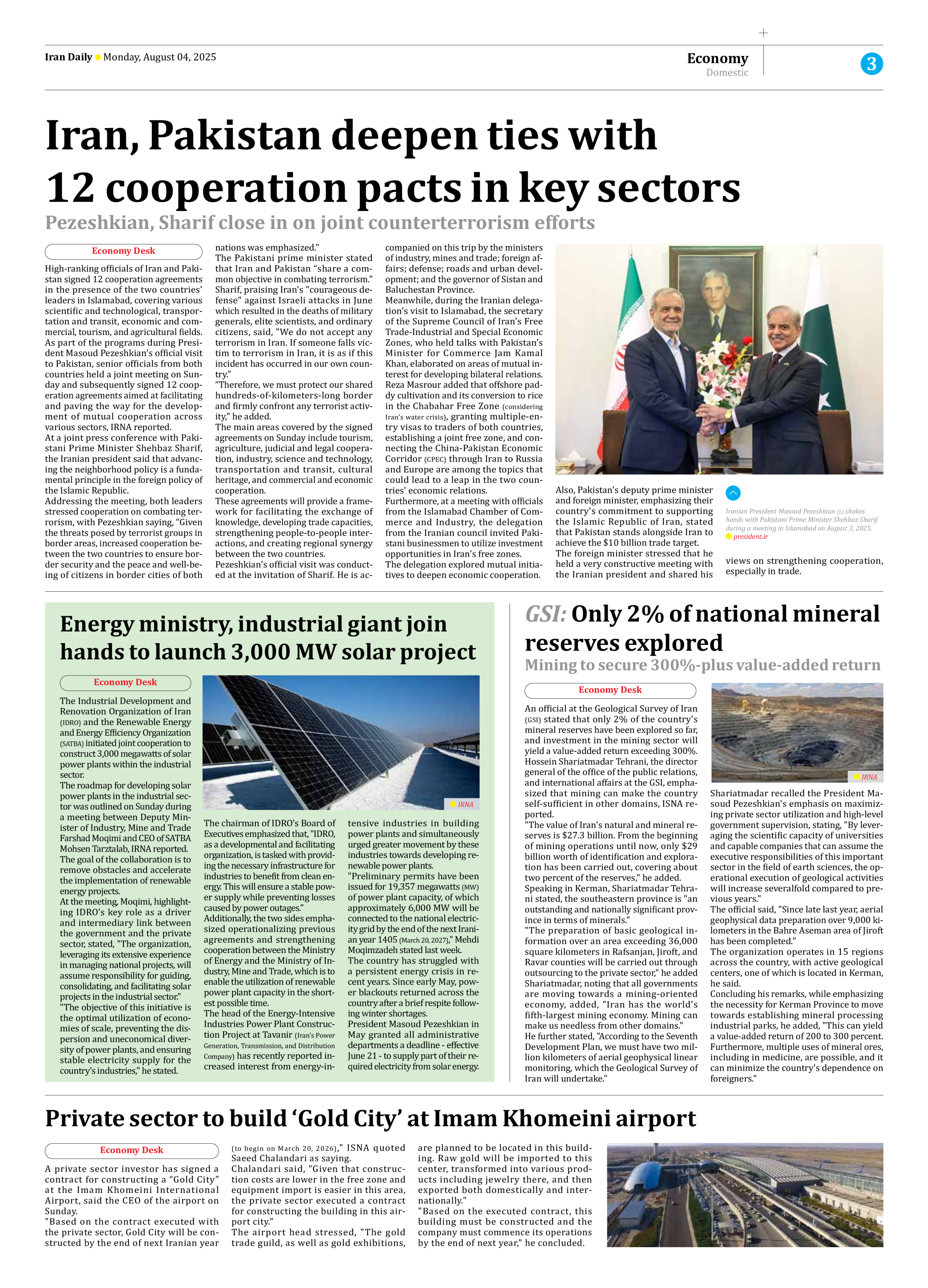
An official at the Geological Survey of Iran (GSI) stated that only 2% of the country's mineral reserves have been explored so far, and investment in the mining sector will yield a value-added return exceeding 300%.
Hossein Shariatmadar Tehrani, the director general of the office of the public relations, and international affairs at the GSI, emphasized that mining can make the country self-sufficient in other domains, ISNA reported.
"The value of Iran's natural and mineral reserves is $27.3 billion. From the beginning of mining operations until now, only $29 billion worth of identification and exploration has been carried out, covering about two percent of the reserves," he added.
Speaking in Kerman, Shariatmadar Tehrani stated, the southeastern province is "an outstanding and nationally significant province in terms of minerals."
"The preparation of basic geological information over an area exceeding 36,000 square kilometers in Rafsanjan, Jiroft, and Ravar counties will be carried out through outsourcing to the private sector," he added
Shariatmadar, noting that all governments are moving towards a mining-oriented economy, added, "Iran has the world's fifth-largest mining economy. Mining can make us needless from other domains."
He further stated, "According to the Seventh Development Plan, we must have two million kilometers of aerial geophysical linear monitoring, which the Geological Survey of Iran will undertake."
Shariatmadar recalled the President Masoud Pezeshkian's emphasis on maximizing private sector utilization and high-level government supervision, stating, "By leveraging the scientific capacity of universities and capable companies that can assume the executive responsibilities of this important sector in the field of earth sciences, the operational execution of geological activities will increase severalfold compared to previous years."
The official said, "Since late last year, aerial geophysical data preparation over 9,000 kilometers in the Bahre Aseman area of Jiroft has been completed."
The organization operates in 15 regions across the country, with active geological centers, one of which is located in Kerman, he said.
Concluding his remarks, while emphasizing the necessity for Kerman Province to move towards establishing mineral processing industrial parks, he added, "This can yield a value-added return of 200 to 300 percent. Furthermore, multiple uses of mineral ores, including in medicine, are possible, and it can minimize the country's dependence on foreigners."