







Iran, Pakistan deepen ties with 12 cooperation pacts in key sectors
Pezeshkian, Sharif close in on joint counterterrorism efforts
High-ranking officials of Iran and Pakistan signed 12 cooperation agreements in the presence of the two countries' leaders in Islamabad, covering various scientific and technological, transportation and transit, economic and commercial, tourism, and agricultural fields.
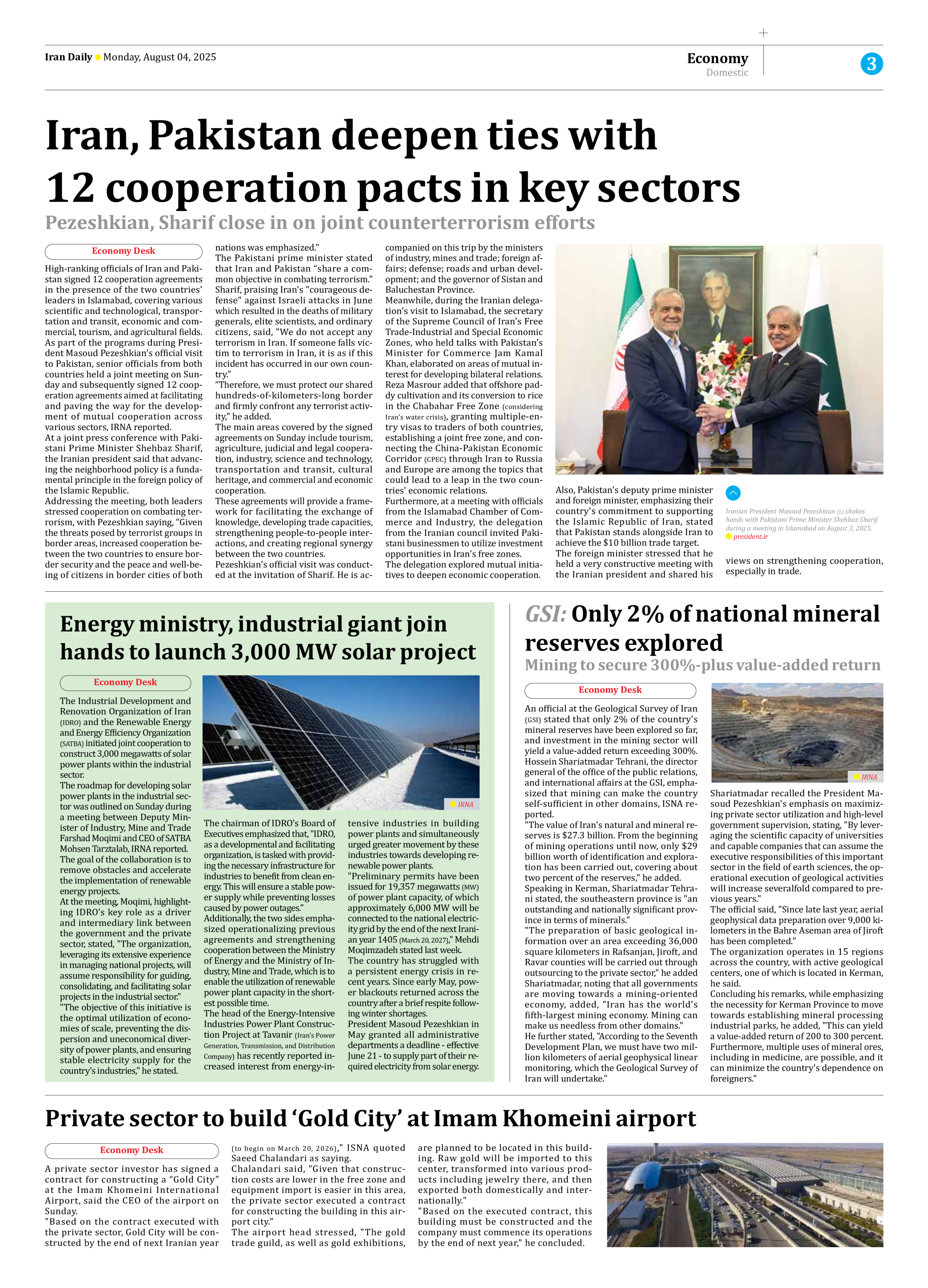
As part of the programs during President Masoud Pezeshkian's official visit to Pakistan, senior officials from both countries held a joint meeting on Sunday and subsequently signed 12 cooperation agreements aimed at facilitating and paving the way for the development of mutual cooperation across various sectors, IRNA reported.
At a joint press conference with Pakistani Prime Minister Shehbaz Sharif, the Iranian president said that advancing the neighborhood policy is a fundamental principle in the foreign policy of the Islamic Republic.
Addressing the meeting, both leaders stressed cooperation on combating terrorism, with Pezeshkian saying, “Given the threats posed by terrorist groups in border areas, increased cooperation between the two countries to ensure border security and the peace and well-being of citizens in border cities of both nations was emphasized."
The Pakistani prime minister stated that Iran and Pakistan “share a common objective in combating terrorism.”
Sharif, praising Iran's "courageous defense" against Israeli attacks in June which resulted in the deaths of military generals, elite scientists, and ordinary citizens, said, "We do not accept any terrorism in Iran. If someone falls victim to terrorism in Iran, it is as if this incident has occurred in our own country.”
“Therefore, we must protect our shared hundreds-of-kilometers-long border and firmly confront any terrorist activity," he added.
The main areas covered by the signed agreements on Sunday include tourism, agriculture, judicial and legal cooperation, industry, science and technology, transportation and transit, cultural heritage, and commercial and economic cooperation.
These agreements will provide a framework for facilitating the exchange of knowledge, developing trade capacities, strengthening people-to-people interactions, and creating regional synergy between the two countries.
Pezeshkian's official visit was conducted at the invitation of Sharif. He is accompanied on this trip by the ministers of industry, mines and trade; foreign affairs; defense; roads and urban development; and the governor of Sistan and Baluchestan Province.
Meanwhile, during the Iranian delegation’s visit to Islamabad, the secretary of the Supreme Council of Iran’s Free Trade-Industrial and Special Economic Zones, who held talks with Pakistan’s Minister for Commerce Jam Kamal Khan, elaborated on areas of mutual interest for developing bilateral relations.
Reza Masrour added that offshore paddy cultivation and its conversion to rice in the Chabahar Free Zone (considering Iran's water crisis), granting multiple-entry visas to traders of both countries, establishing a joint free zone, and connecting the China-Pakistan Economic Corridor (CPEC) through Iran to Russia and Europe are among the topics that could lead to a leap in the two countries' economic relations.
Furthermore, at a meeting with officials from the Islamabad Chamber of Commerce and Industry, the delegation from the Iranian council invited Pakistani businessmen to utilize investment opportunities in Iran's free zones.
The delegation explored mutual initiatives to deepen economic cooperation.
Also, Pakistan's deputy prime minister and foreign minister, emphasizing their country's commitment to supporting the Islamic Republic of Iran, stated that Pakistan stands alongside Iran to achieve the $10 billion trade target.
The foreign minister stressed that he held a very constructive meeting with the Iranian president and shared his views on strengthening cooperation, especially in trade.