







Tehran calls on Tokyo to join global campaign to abolish WMDs
Iran’s Foreign Minister Abbas Araghchi called on Japan to join Tehran in leading a global movement to abolish weapons of mass destruction (WMDs) as part of concerted efforts aimed at maintaining peace and promoting disarmament.
Araghchi made the plea in an opinion piece submitted to The Asahi Shimbun and other Japanese media prior to the 80th anniversary of the US atomic bombings of the Japanese cities of Hiroshima and Nagasaki.
“Japan and Iran must lead a global movement for the total abolition of all WMDs: nuclear, chemical and biological,” he wrote.
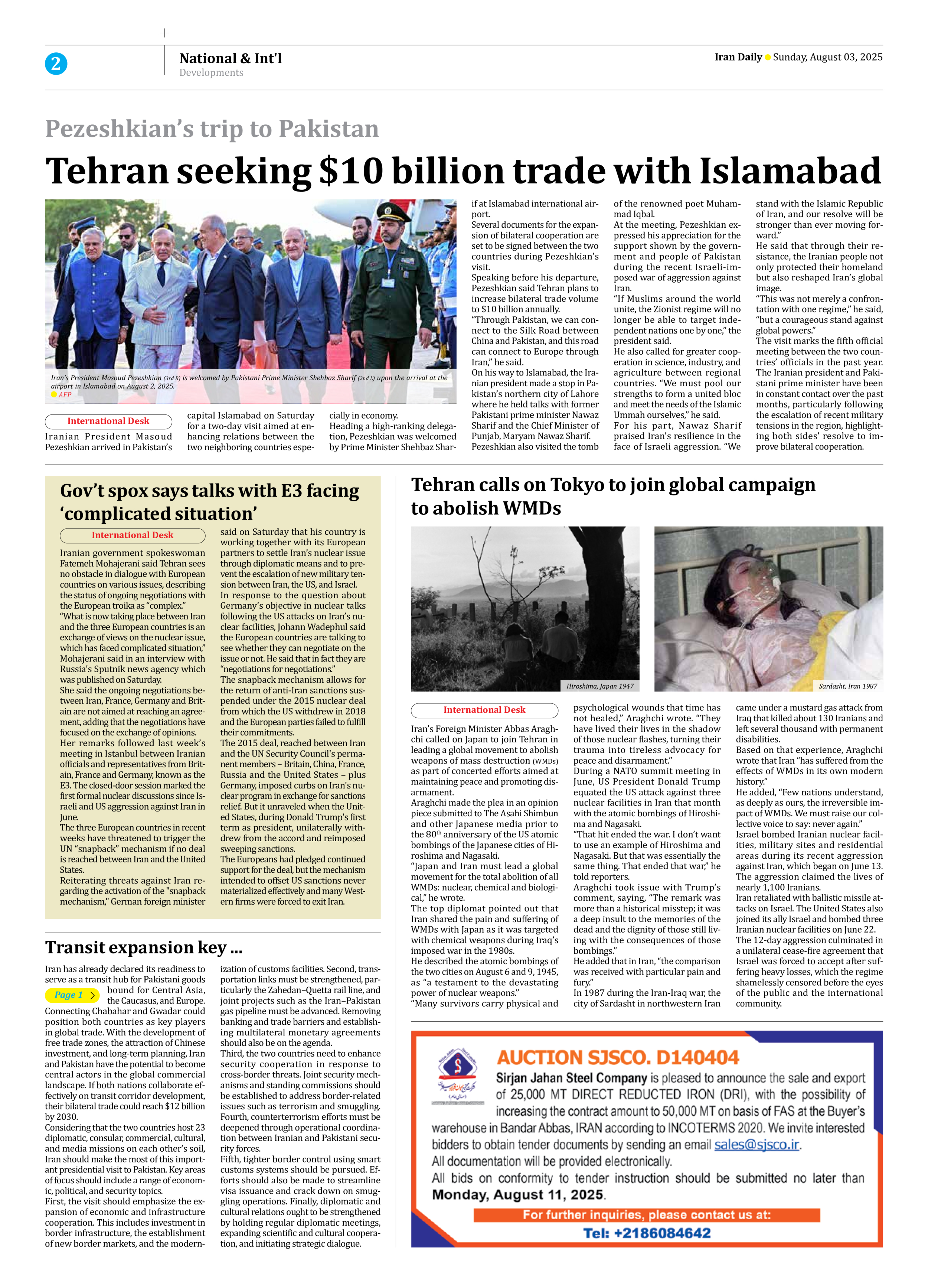
The top diplomat pointed out that Iran shared the pain and suffering of WMDs with Japan as it was targeted with chemical weapons during Iraq’s imposed war in the 1980s.
He described the atomic bombings of the two cities on August 6 and 9, 1945, as “a testament to the devastating power of nuclear weapons.”
“Many survivors carry physical and psychological wounds that time has not healed,” Araghchi wrote. “They have lived their lives in the shadow of those nuclear flashes, turning their trauma into tireless advocacy for peace and disarmament.”
During a NATO summit meeting in June, US President Donald Trump equated the US attack against three nuclear facilities in Iran that month with the atomic bombings of Hiroshima and Nagasaki.
“That hit ended the war. I don’t want to use an example of Hiroshima and Nagasaki. But that was essentially the same thing. That ended that war,” he told reporters.
Araghchi took issue with Trump’s comment, saying, “The remark was more than a historical misstep; it was a deep insult to the memories of the dead and the dignity of those still living with the consequences of those bombings.”
He added that in Iran, “the comparison was received with particular pain and fury.”
In 1987 during the Iran-Iraq war, the city of Sardasht in northwestern Iran came under a mustard gas attack from Iraq that killed about 130 Iranians and left several thousand with permanent disabilities.
Based on that experience, Araghchi wrote that Iran “has suffered from the effects of WMDs in its own modern history.”
He added, “Few nations understand, as deeply as ours, the irreversible impact of WMDs. We must raise our collective voice to say: never again.”
Israel bombed Iranian nuclear facilities, military sites and residential areas during its recent aggression against Iran, which began on June 13. The aggression claimed the lives of nearly 1,100 Iranians.
Iran retaliated with ballistic missile attacks on Israel. The United States also joined its ally Israel and bombed three Iranian nuclear facilities on June 22.
The 12-day aggression culminated in a unilateral cease-fire agreement that Israel was forced to accept after suffering heavy losses, which the regime shamelessly censored before the eyes of the public and the international community.