







UNESCO welcomes Hawraman for living cultural significance
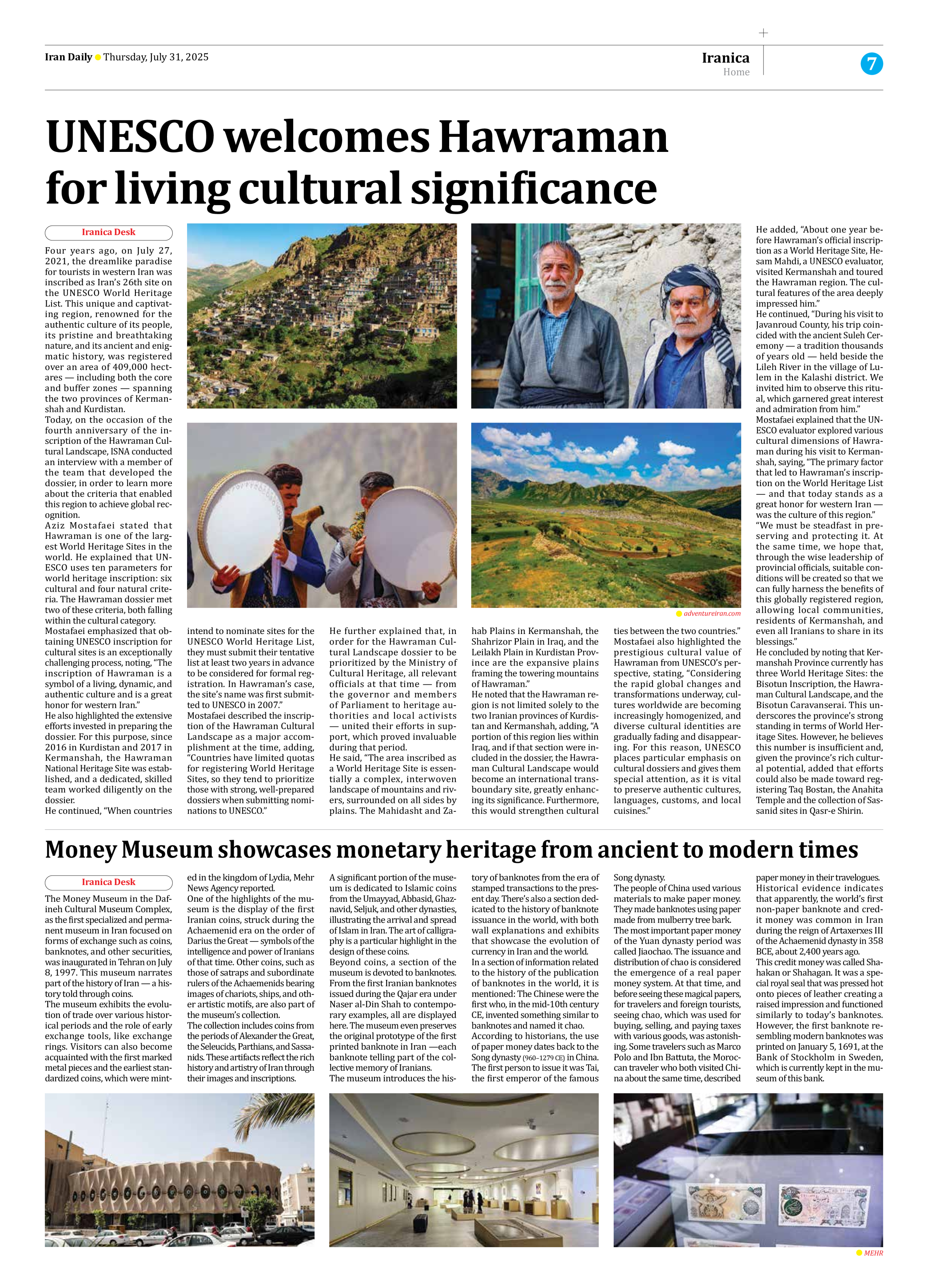
Four years ago, on July 27, 2021, the dreamlike paradise for tourists in western Iran was inscribed as Iran’s 26th site on the UNESCO World Heritage List. This unique and captivating region, renowned for the authentic culture of its people, its pristine and breathtaking nature, and its ancient and enigmatic history, was registered over an area of 409,000 hectares — including both the core and buffer zones — spanning the two provinces of Kermanshah and Kurdistan.
Today, on the occasion of the fourth anniversary of the inscription of the Hawraman Cultural Landscape, ISNA conducted an interview with a member of the team that developed the dossier, in order to learn more about the criteria that enabled this region to achieve global recognition.
Aziz Mostafaei stated that Hawraman is one of the largest World Heritage Sites in the world. He explained that UNESCO uses ten parameters for world heritage inscription: six cultural and four natural criteria. The Hawraman dossier met two of these criteria, both falling within the cultural category.
Mostafaei emphasized that obtaining UNESCO inscription for cultural sites is an exceptionally challenging process, noting, “The inscription of Hawraman is a symbol of a living, dynamic, and authentic culture and is a great honor for western Iran.”
He also highlighted the extensive efforts invested in preparing the dossier. For this purpose, since 2016 in Kurdistan and 2017 in Kermanshah, the Hawraman National Heritage Site was established, and a dedicated, skilled team worked diligently on the dossier.
He continued, “When countries intend to nominate sites for the UNESCO World Heritage List, they must submit their tentative list at least two years in advance to be considered for formal registration. In Hawraman’s case, the site’s name was first submitted to UNESCO in 2007.”
Mostafaei described the inscription of the Hawraman Cultural Landscape as a major accomplishment at the time, adding, “Countries have limited quotas for registering World Heritage Sites, so they tend to prioritize those with strong, well-prepared dossiers when submitting nominations to UNESCO.”
He further explained that, in order for the Hawraman Cultural Landscape dossier to be prioritized by the Ministry of Cultural Heritage, all relevant officials at that time — from the governor and members of Parliament to heritage authorities and local activists — united their efforts in support, which proved invaluable during that period.
He said, “The area inscribed as a World Heritage Site is essentially a complex, interwoven landscape of mountains and rivers, surrounded on all sides by plains. The Mahidasht and Zahab Plains in Kermanshah, the Shahrizor Plain in Iraq, and the Leilakh Plain in Kurdistan Province are the expansive plains framing the towering mountains of Hawraman.”
He noted that the Hawraman region is not limited solely to the two Iranian provinces of Kurdistan and Kermanshah, adding, “A portion of this region lies within Iraq, and if that section were included in the dossier, the Hawraman Cultural Landscape would become an international transboundary site, greatly enhancing its significance. Furthermore, this would strengthen cultural ties between the two countries.”
Mostafaei also highlighted the prestigious cultural value of Hawraman from UNESCO’s perspective, stating, “Considering the rapid global changes and transformations underway, cultures worldwide are becoming increasingly homogenized, and diverse cultural identities are gradually fading and disappearing. For this reason, UNESCO places particular emphasis on cultural dossiers and gives them special attention, as it is vital to preserve authentic cultures, languages, customs, and local cuisines.”
He added, “About one year before Hawraman’s official inscription as a World Heritage Site, Hesam Mahdi, a UNESCO evaluator, visited Kermanshah and toured the Hawraman region. The cultural features of the area deeply impressed him.”
He continued, “During his visit to Javanroud County, his trip coincided with the ancient Suleh Ceremony — a tradition thousands of years old — held beside the Lileh River in the village of Lulem in the Kalashi district. We invited him to observe this ritual, which garnered great interest and admiration from him.”
Mostafaei explained that the UNESCO evaluator explored various cultural dimensions of Hawraman during his visit to Kermanshah, saying, “The primary factor that led to Hawraman’s inscription on the World Heritage List — and that today stands as a great honor for western Iran — was the culture of this region.”
“We must be steadfast in preserving and protecting it. At the same time, we hope that, through the wise leadership of provincial officials, suitable conditions will be created so that we can fully harness the benefits of this globally registered region, allowing local communities, residents of Kermanshah, and even all Iranians to share in its blessings.”
He concluded by noting that Kermanshah Province currently has three World Heritage Sites: the Bisotun Inscription, the Hawraman Cultural Landscape, and the Bisotun Caravanserai. This underscores the province’s strong standing in terms of World Heritage Sites. However, he believes this number is insufficient and, given the province’s rich cultural potential, added that efforts could also be made toward registering Taq Bostan, the Anahita Temple and the collection of Sassanid sites in Qasr-e Shirin.