







Copy in clipboard...
A journey through historic Deyr-e Gachin Caravanserai near Qom
Deyr-e Gachin Caravanserai is situated eighty kilometers northeast of Qom. Renowned as the mother of Iranian caravanserais, this ancient monument was built along the Silk Road and the historic route connecting Rey to Qom. Today, it lies within the boundaries of Kavir National Park. The caravanserai has been officially registered on Iran’s National Heritage List.
The construction of Deyr-e Gachin dates back to the Sassanid era, with repairs carried out during the Seljuk, Safavid, and Qajar periods. Historical texts indicate that it has also been known by other names, including Ardeshir and Deyr-e Kaj. Among these, the name Ardeshir suggests a possible connection to Ardeshir I, the Sassanid king. Nearby, other historical structures such as the Rock Castle of Mohammadabad Kaj and Qaleh Goli can be found in the vicinity of Deyr-e Gachin.
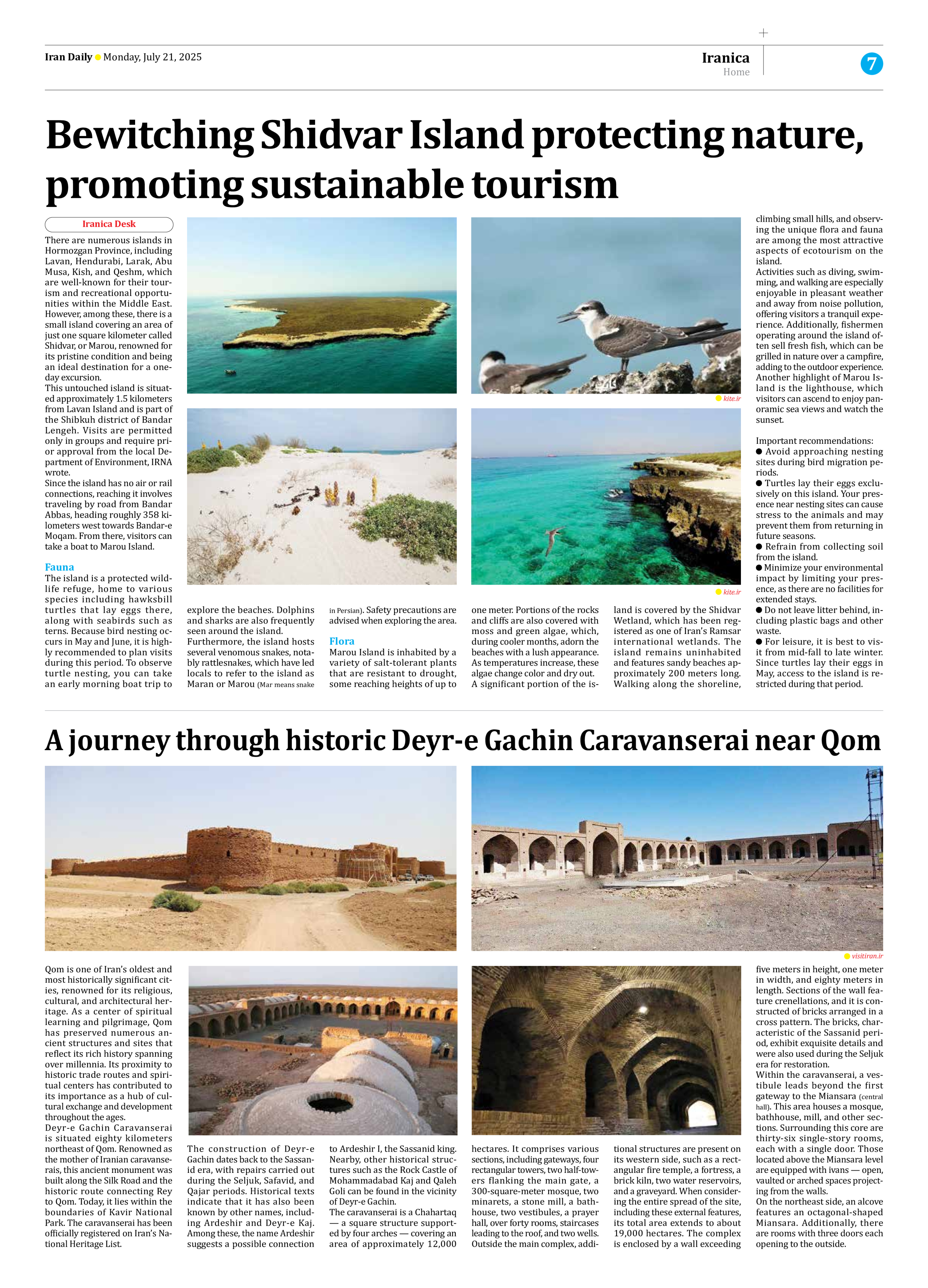
The caravanserai is a Chahartaq — a square structure supported by four arches — covering an area of approximately 12,000 hectares. It comprises various sections, including gateways, four rectangular towers, two half-towers flanking the main gate, a 300-square-meter mosque, two minarets, a stone mill, a bathhouse, two vestibules, a prayer hall, over forty rooms, staircases leading to the roof, and two wells.
Outside the main complex, additional structures are present on its western side, such as a rectangular fire temple, a fortress, a brick kiln, two water reservoirs, and a graveyard. When considering the entire spread of the site, including these external features, its total area extends to about 19,000 hectares. The complex is enclosed by a wall exceeding five meters in height, one meter in width, and eighty meters in length. Sections of the wall feature crenellations, and it is constructed of bricks arranged in a cross pattern. The bricks, characteristic of the Sassanid period, exhibit exquisite details and were also used during the Seljuk era for restoration.
Within the caravanserai, a vestibule leads beyond the first gateway to the Miansara (central hall). This area houses a mosque, bathhouse, mill, and other sections. Surrounding this core are thirty-six single-story rooms, each with a single door. Those located above the Miansara level are equipped with ivans — open, vaulted or arched spaces projecting from the walls.
On the northeast side, an alcove features an octagonal-shaped Miansara. Additionally, there are rooms with three doors each opening to the outside.