





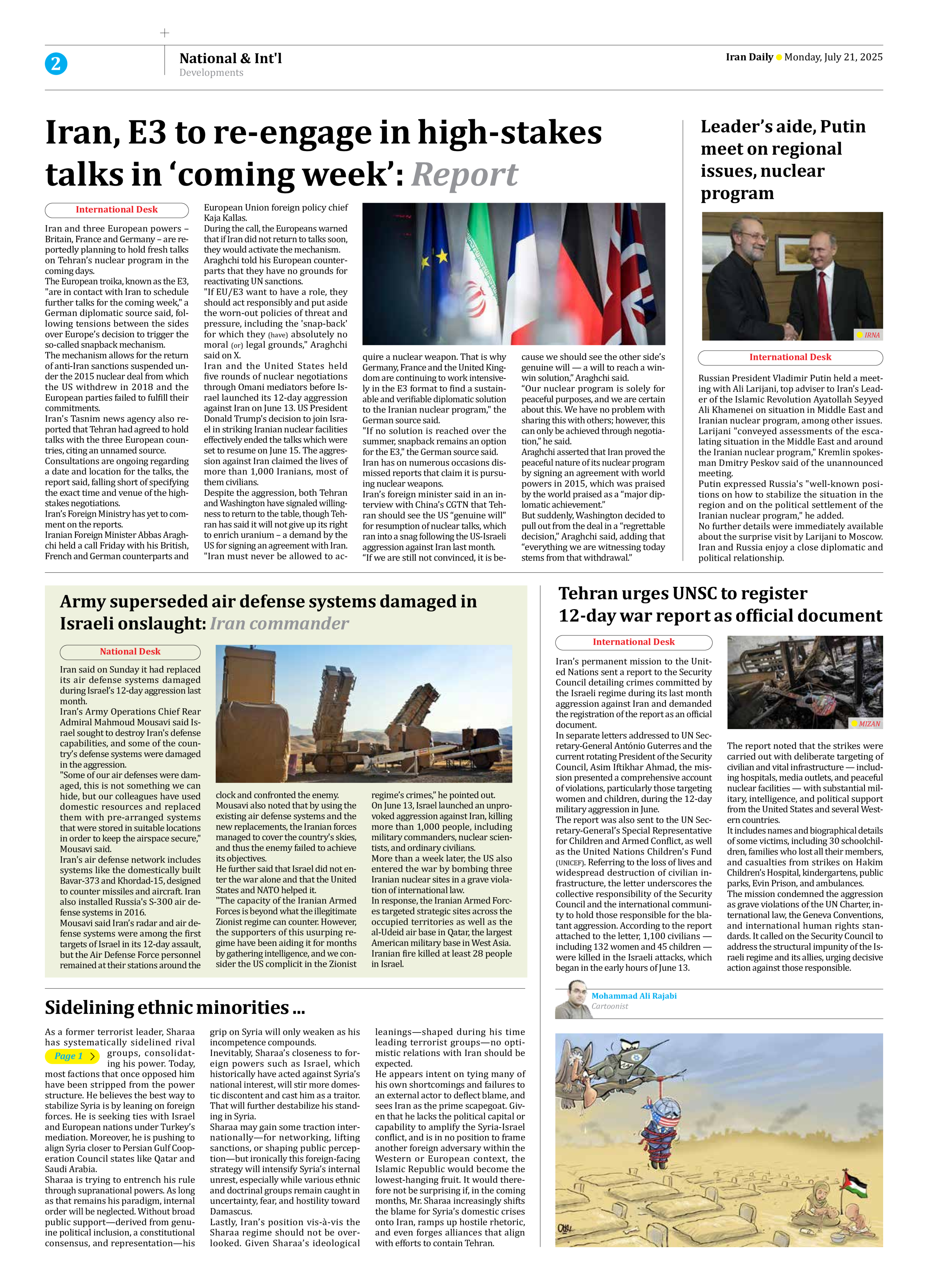


Iran, E3 to re-engage in high-stakes talks in ‘coming week’: Report
Iran and three European powers – Britain, France and Germany – are reportedly planning to hold fresh talks on Tehran’s nuclear program in the coming days.
The European troika, known as the E3, "are in contact with Iran to schedule further talks for the coming week," a German diplomatic source said, following tensions between the sides over Europe’s decision to trigger the so-called snapback mechanism.
The mechanism allows for the return of anti-Iran sanctions suspended under the 2015 nuclear deal from which the US withdrew in 2018 and the European parties failed to fulfill their commitments.
Iran's Tasnim news agency also reported that Tehran had agreed to hold talks with the three European countries, citing an unnamed source.
Consultations are ongoing regarding a date and location for the talks, the report said, falling short of specifying the exact time and venue of the high-stakes negotiations.
Iran’s Foreign Ministry has yet to comment on the reports.
Iranian Foreign Minister Abbas Araghchi held a call Friday with his British, French and German counterparts and European Union foreign policy chief Kaja Kallas.
During the call, the Europeans warned that if Iran did not return to talks soon, they would activate the mechanism.
Araghchi told his European counterparts that they have no grounds for reactivating UN sanctions.
"If EU/E3 want to have a role, they should act responsibly and put aside the worn-out policies of threat and pressure, including the 'snap-back' for which they (have) absolutely no moral (or) legal grounds," Araghchi said on X.
Iran and the United States held five rounds of nuclear negotiations through Omani mediators before Israel launched its 12-day aggression against Iran on June 13. US President Donald Trump's decision to join Israel in striking Iranian nuclear facilities effectively ended the talks which were set to resume on June 15. The aggression against Iran claimed the lives of more than 1,000 Iranians, most of them civilians.
Despite the aggression, both Tehran and Washington have signaled willingness to return to the table, though Tehran has said it will not give up its right to enrich uranium – a demand by the US for signing an agreement with Iran.
"Iran must never be allowed to acquire a nuclear weapon. That is why Germany, France and the United Kingdom are continuing to work intensively in the E3 format to find a sustainable and verifiable diplomatic solution to the Iranian nuclear program," the German source said.
"If no solution is reached over the summer, snapback remains an option for the E3," the German source said.
Iran has on numerous occasions dismissed reports that claim it is pursuing nuclear weapons.
Iran’s foreign minister said in an interview with China’s CGTN that Tehran should see the US “genuine will" for resumption of nuclear talks, which ran into a snag following the US-Israeli aggression against Iran last month.
“If we are still not convinced, it is because we should see the other side’s genuine will — a will to reach a win-win solution,” Araghchi said.
“Our nuclear program is solely for peaceful purposes, and we are certain about this. We have no problem with sharing this with others; however, this can only be achieved through negotiation,” he said.
Araghchi asserted that Iran proved the peaceful nature of its nuclear program by signing an agreement with world powers in 2015, which was praised by the world praised as a “major diplomatic achievement.”
But suddenly, Washington decided to pull out from the deal in a “regrettable decision,” Araghchi said, adding that “everything we are witnessing today stems from that withdrawal.”