





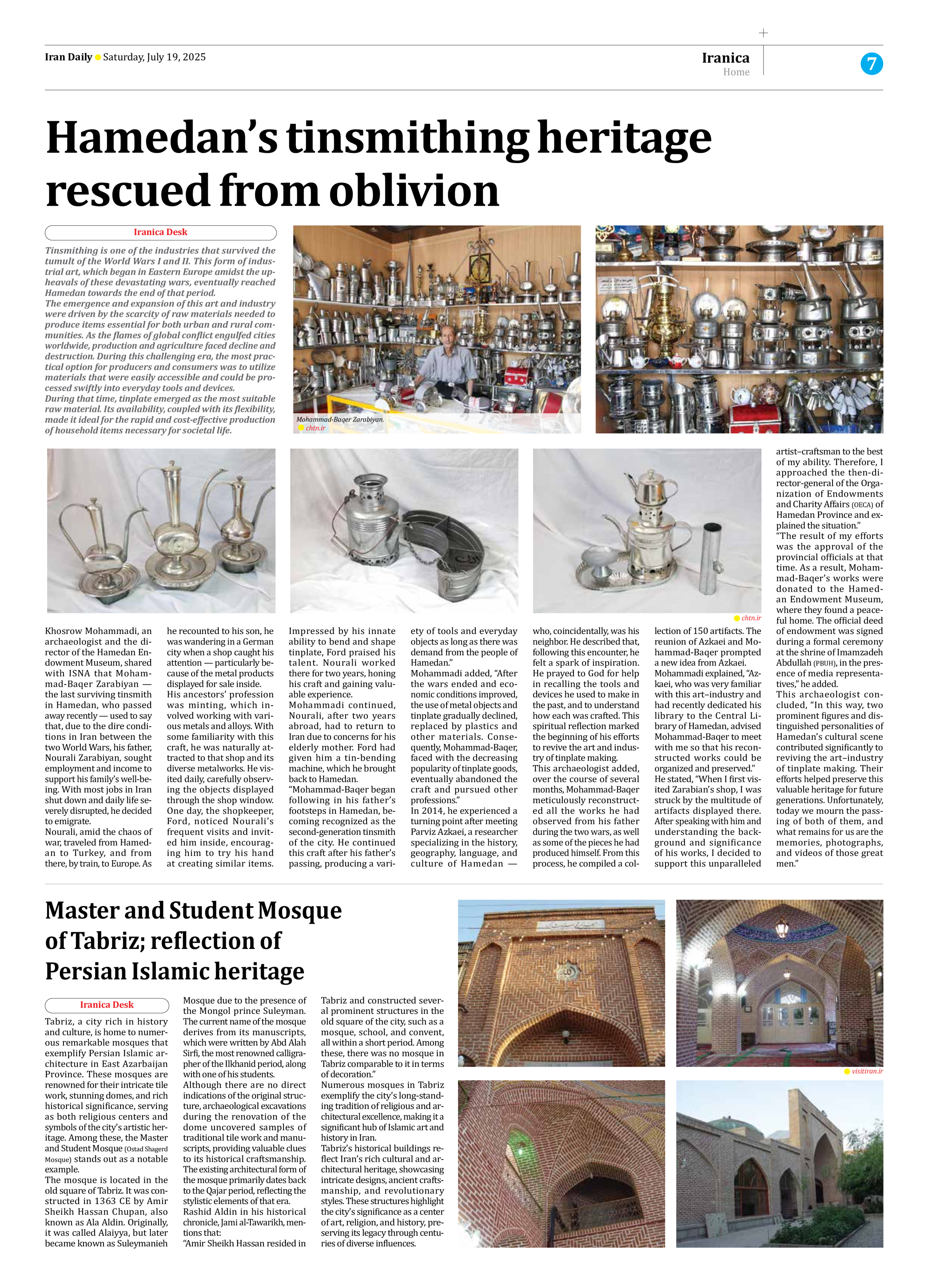


Master and Student Mosque of Tabriz; reflection of Persian Islamic heritage
Tabriz, a city rich in history and culture, is home to numerous remarkable mosques that exemplify Persian Islamic architecture in East Azarbaijan Province. These mosques are renowned for their intricate tile work, stunning domes, and rich historical significance, serving as both religious centers and symbols of the city’s artistic heritage. Among these, the Master and Student Mosque (Ostad Shagerd Mosque) stands out as a notable example.
The mosque is located in the old square of Tabriz. It was constructed in 1363 CE by Amir Sheikh Hassan Chupan, also known as Ala Aldin. Originally, it was called Alaiyya, but later became known as Suleymanieh Mosque due to the presence of the Mongol prince Suleyman. The current name of the mosque derives from its manuscripts, which were written by Abd Alah Sirfi, the most renowned calligrapher of the Ilkhanid period, along with one of his students.
Although there are no direct indications of the original structure, archaeological excavations during the renovation of the dome uncovered samples of traditional tile work and manuscripts, providing valuable clues to its historical craftsmanship. The existing architectural form of the mosque primarily dates back to the Qajar period, reflecting the stylistic elements of that era.
Rashid Aldin in his historical chronicle, Jami al-Tawarikh, mentions that:
“Amir Sheikh Hassan resided in Tabriz and constructed several prominent structures in the old square of the city, such as a mosque, school, and convent, all within a short period. Among these, there was no mosque in Tabriz comparable to it in terms of decoration.”
Numerous mosques in Tabriz exemplify the city’s long-standing tradition of religious and architectural excellence, making it a significant hub of Islamic art and history in Iran.
Tabriz’s historical buildings reflect Iran’s rich cultural and architectural heritage, showcasing intricate designs, ancient craftsmanship, and revolutionary styles. These structures highlight the city’s significance as a center of art, religion, and history, preserving its legacy through centuries of diverse influences.