







Hamedan’s tinsmithing heritage rescued from oblivion
Tinsmithing is one of the industries that survived the tumult of the World Wars I and II. This form of industrial art, which began in Eastern Europe amidst the upheavals of these devastating wars, eventually reached Hamedan towards the end of that period. The emergence and expansion of this art and industry were driven by the scarcity of raw materials needed to produce items essential for both urban and rural communities. As the flames of global conflict engulfed cities worldwide, production and agriculture faced decline and destruction. During this challenging era, the most practical option for producers and consumers was to utilize materials that were easily accessible and could be processed swiftly into everyday tools and devices. During that time, tinplate emerged as the most suitable raw material. Its availability, coupled with its flexibility, made it ideal for the rapid and cost-effective production of household items necessary for societal life.
Khosrow Mohammadi, an archaeologist and the director of the Hamedan Endowment Museum, shared with ISNA that Mohammad-Baqer Zarabiyan — the last surviving tinsmith in Hamedan, who passed away recently — used to say that, due to the dire conditions in Iran between the two World Wars, his father, Nourali Zarabiyan, sought employment and income to support his family’s well-being. With most jobs in Iran shut down and daily life severely disrupted, he decided to emigrate.
Nourali, amid the chaos of war, traveled from Hamedan to Turkey, and from there, by train, to Europe. As he recounted to his son, he was wandering in a German city when a shop caught his attention — particularly because of the metal products displayed for sale inside.
His ancestors’ profession was minting, which involved working with various metals and alloys. With some familiarity with this craft, he was naturally attracted to that shop and its diverse metalworks. He visited daily, carefully observing the objects displayed through the shop window. One day, the shopkeeper, Ford, noticed Nourali’s frequent visits and invited him inside, encouraging him to try his hand at creating similar items. Impressed by his innate ability to bend and shape tinplate, Ford praised his talent. Nourali worked there for two years, honing his craft and gaining valuable experience.
Mohammadi continued, Nourali, after two years abroad, had to return to Iran due to concerns for his elderly mother. Ford had given him a tin-bending machine, which he brought back to Hamedan.
“Mohammad-Baqer began following in his father’s footsteps in Hamedan, becoming recognized as the second-generation tinsmith of the city. He continued this craft after his father’s passing, producing a variety of tools and everyday objects as long as there was demand from the people of Hamedan.”
Mohammadi added, “After the wars ended and economic conditions improved, the use of metal objects and tinplate gradually declined, replaced by plastics and other materials. Consequently, Mohammad-Baqer, faced with the decreasing popularity of tinplate goods, eventually abandoned the craft and pursued other professions.”
In 2014, he experienced a turning point after meeting Parviz Azkaei, a researcher specializing in the history, geography, language, and culture of Hamedan — who, coincidentally, was his neighbor. He described that, following this encounter, he felt a spark of inspiration. He prayed to God for help in recalling the tools and devices he used to make in the past, and to understand how each was crafted. This spiritual reflection marked the beginning of his efforts to revive the art and industry of tinplate making.
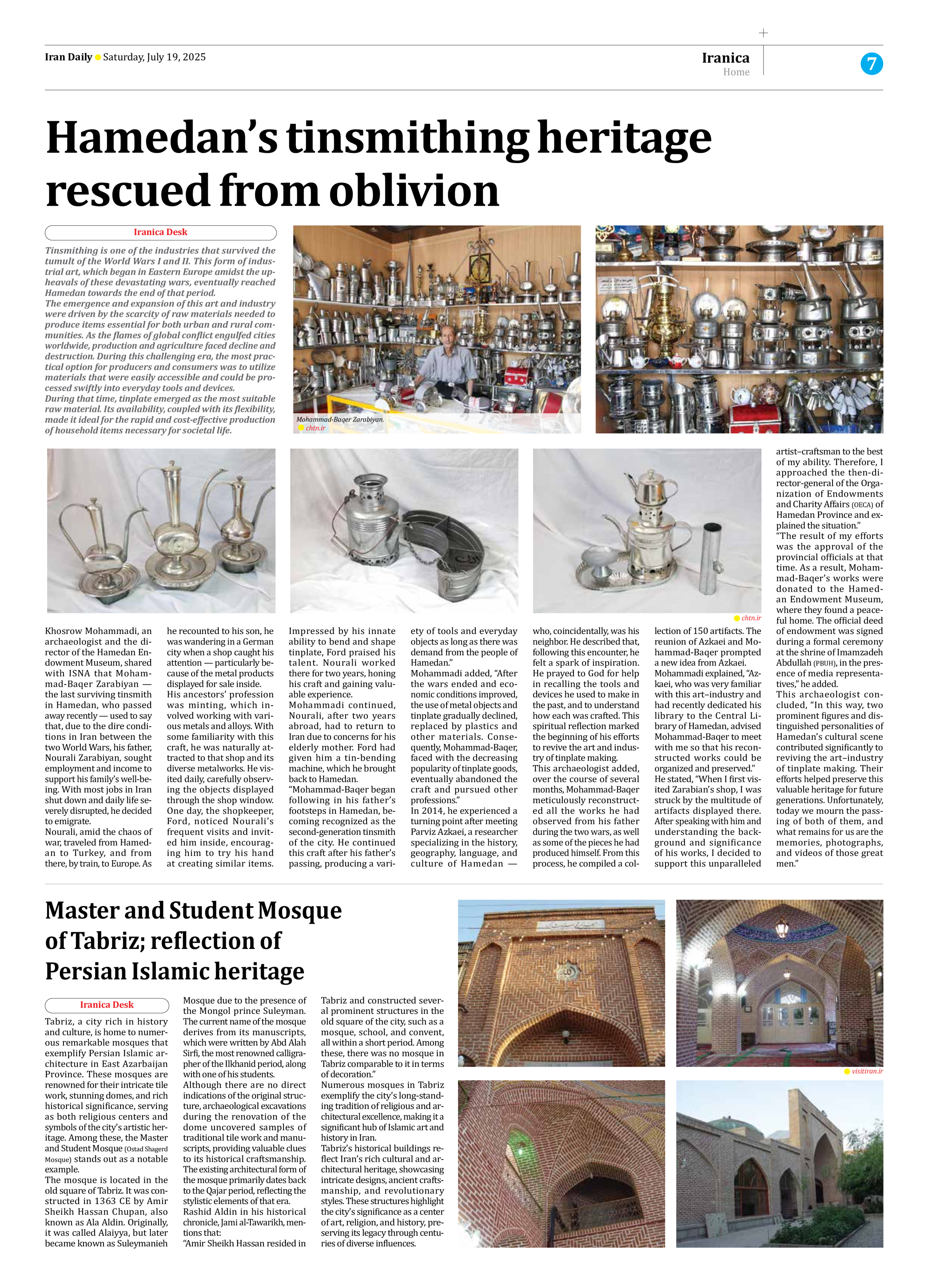
This archaeologist added, over the course of several months, Mohammad-Baqer meticulously reconstructed all the works he had observed from his father during the two wars, as well as some of the pieces he had produced himself. From this process, he compiled a collection of 150 artifacts. The reunion of Azkaei and Mohammad-Baqer prompted a new idea from Azkaei.
Mohammadi explained, “Azkaei, who was very familiar with this art–industry and had recently dedicated his library to the Central Library of Hamedan, advised Mohammad-Baqer to meet with me so that his reconstructed works could be organized and preserved.”
He stated, “When I first visited Zarabian’s shop, I was struck by the multitude of artifacts displayed there. After speaking with him and understanding the background and significance of his works, I decided to support this unparalleled artist–craftsman to the best of my ability. Therefore, I approached the then-director-general of the Organization of Endowments and Charity Affairs (OECA) of Hamedan Province and explained the situation.”
“The result of my efforts was the approval of the provincial officials at that time. As a result, Mohammad-Baqer’s works were donated to the Hamedan Endowment Museum, where they found a peaceful home. The official deed of endowment was signed during a formal ceremony at the shrine of Imamzadeh Abdullah (PBUH), in the presence of media representatives,” he added.
This archaeologist concluded, “In this way, two prominent figures and distinguished personalities of Hamedan’s cultural scene contributed significantly to reviving the art–industry of tinplate making. Their efforts helped preserve this valuable heritage for future generations. Unfortunately, today we mourn the passing of both of them, and what remains for us are the memories, photographs, and videos of those great men.”