





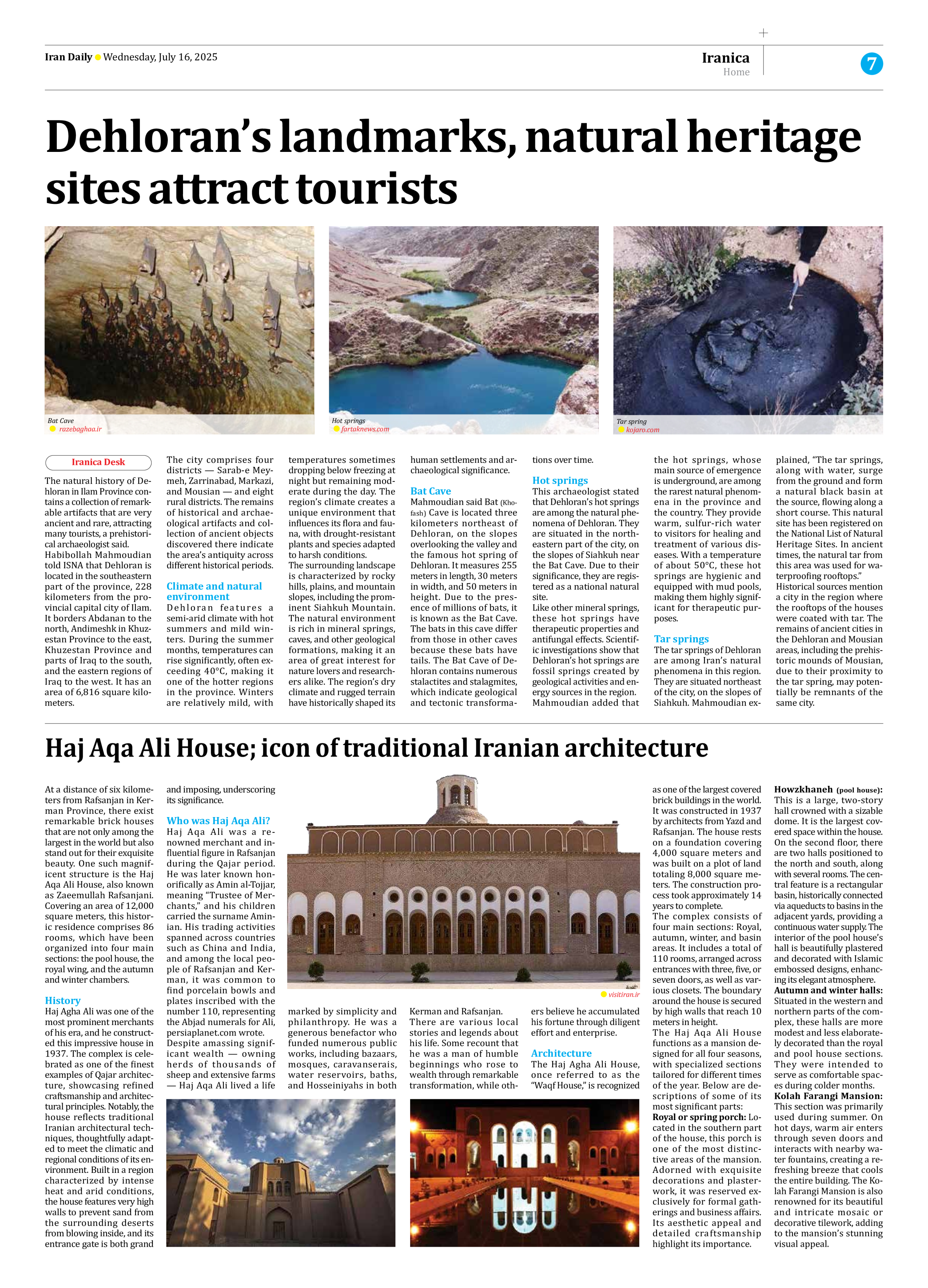


Haj Aqa Ali House; icon of traditional Iranian architecture
At a distance of six kilometers from Rafsanjan in Kerman Province, there exist remarkable brick houses that are not only among the largest in the world but also stand out for their exquisite beauty. One such magnificent structure is the Haj Aqa Ali House, also known as Zaeemullah Rafsanjani. Covering an area of 12,000 square meters, this historic residence comprises 86 rooms, which have been organized into four main sections: the pool house, the royal wing, and the autumn and winter chambers.
History
Haj Agha Ali was one of the most prominent merchants of his era, and he constructed this impressive house in 1937. The complex is celebrated as one of the finest examples of Qajar architecture, showcasing refined craftsmanship and architectural principles. Notably, the house reflects traditional Iranian architectural techniques, thoughtfully adapted to meet the climatic and regional conditions of its environment. Built in a region characterized by intense heat and arid conditions, the house features very high walls to prevent sand from the surrounding deserts from blowing inside, and its entrance gate is both grand and imposing, underscoring its significance.
Who was Haj Aqa Ali?
Haj Aqa Ali was a renowned merchant and influential figure in Rafsanjan during the Qajar period. He was later known honorifically as Amin al-Tojjar, meaning “Trustee of Merchants,” and his children carried the surname Aminian. His trading activities spanned across countries such as China and India, and among the local people of Rafsanjan and Kerman, it was common to find porcelain bowls and plates inscribed with the number 110, representing the Abjad numerals for Ali, persiaplanet.com wrote.
Despite amassing significant wealth — owning herds of thousands of sheep and extensive farms — Haj Aqa Ali lived a life marked by simplicity and philanthropy. He was a generous benefactor who funded numerous public works, including bazaars, mosques, caravanserais, water reservoirs, baths, and Hosseiniyahs in both Kerman and Rafsanjan.
There are various local stories and legends about his life. Some recount that he was a man of humble beginnings who rose to wealth through remarkable transformation, while others believe he accumulated his fortune through diligent effort and enterprise.
Architecture
The Haj Agha Ali House, once referred to as the “Waqf House,” is recognized as one of the largest covered brick buildings in the world. It was constructed in 1937 by architects from Yazd and Rafsanjan. The house rests on a foundation covering 4,000 square meters and was built on a plot of land totaling 8,000 square meters. The construction process took approximately 14 years to complete.
The complex consists of four main sections: Royal, autumn, winter, and basin areas. It includes a total of 110 rooms, arranged across entrances with three, five, or seven doors, as well as various closets. The boundary around the house is secured by high walls that reach 10 meters in height.
The Haj Aqa Ali House functions as a mansion designed for all four seasons, with specialized sections tailored for different times of the year. Below are descriptions of some of its most significant parts:
Royal or spring porch: Located in the southern part of the house, this porch is one of the most distinctive areas of the mansion. Adorned with exquisite decorations and plasterwork, it was reserved exclusively for formal gatherings and business affairs. Its aesthetic appeal and detailed craftsmanship highlight its importance.
Howzkhaneh (pool house): This is a large, two-story hall crowned with a sizable dome. It is the largest covered space within the house. On the second floor, there are two halls positioned to the north and south, along with several rooms. The central feature is a rectangular basin, historically connected via aqueducts to basins in the adjacent yards, providing a continuous water supply. The interior of the pool house’s hall is beautifully plastered and decorated with Islamic embossed designs, enhancing its elegant atmosphere.
Autumn and winter halls: Situated in the western and northern parts of the complex, these halls are more modest and less elaborately decorated than the royal and pool house sections. They were intended to serve as comfortable spaces during colder months.
Kolah Farangi Mansion: This section was primarily used during summer. On hot days, warm air enters through seven doors and interacts with nearby water fountains, creating a refreshing breeze that cools the entire building. The Kolah Farangi Mansion is also renowned for its beautiful and intricate mosaic or decorative tilework, adding to the mansion’s stunning visual appeal.