







Dehloran’s landmarks, natural heritage sites attract tourists
The natural history of Dehloran in Ilam Province contains a collection of remarkable artifacts that are very ancient and rare, attracting many tourists, a prehistorical archaeologist said.
Habibollah Mahmoudian told ISNA that Dehloran is located in the southeastern part of the province, 228 kilometers from the provincial capital city of Ilam. It borders Abdanan to the north, Andimeshk in Khuzestan Province to the east, Khuzestan Province and parts of Iraq to the south, and the eastern regions of Iraq to the west. It has an area of 6,816 square kilometers.
The city comprises four districts — Sarab-e Meymeh, Zarrinabad, Markazi, and Mousian — and eight rural districts. The remains of historical and archaeological artifacts and collection of ancient objects discovered there indicate the area’s antiquity across different historical periods.
Climate and natural environment
Dehloran features a semi-arid climate with hot summers and mild winters. During the summer months, temperatures can rise significantly, often exceeding 40°C, making it one of the hotter regions in the province. Winters are relatively mild, with temperatures sometimes dropping below freezing at night but remaining moderate during the day. The region’s climate creates a unique environment that influences its flora and fauna, with drought-resistant plants and species adapted to harsh conditions.
The surrounding landscape is characterized by rocky hills, plains, and mountain slopes, including the prominent Siahkuh Mountain. The natural environment is rich in mineral springs, caves, and other geological formations, making it an area of great interest for nature lovers and researchers alike. The region’s dry climate and rugged terrain have historically shaped its human settlements and archaeological significance.
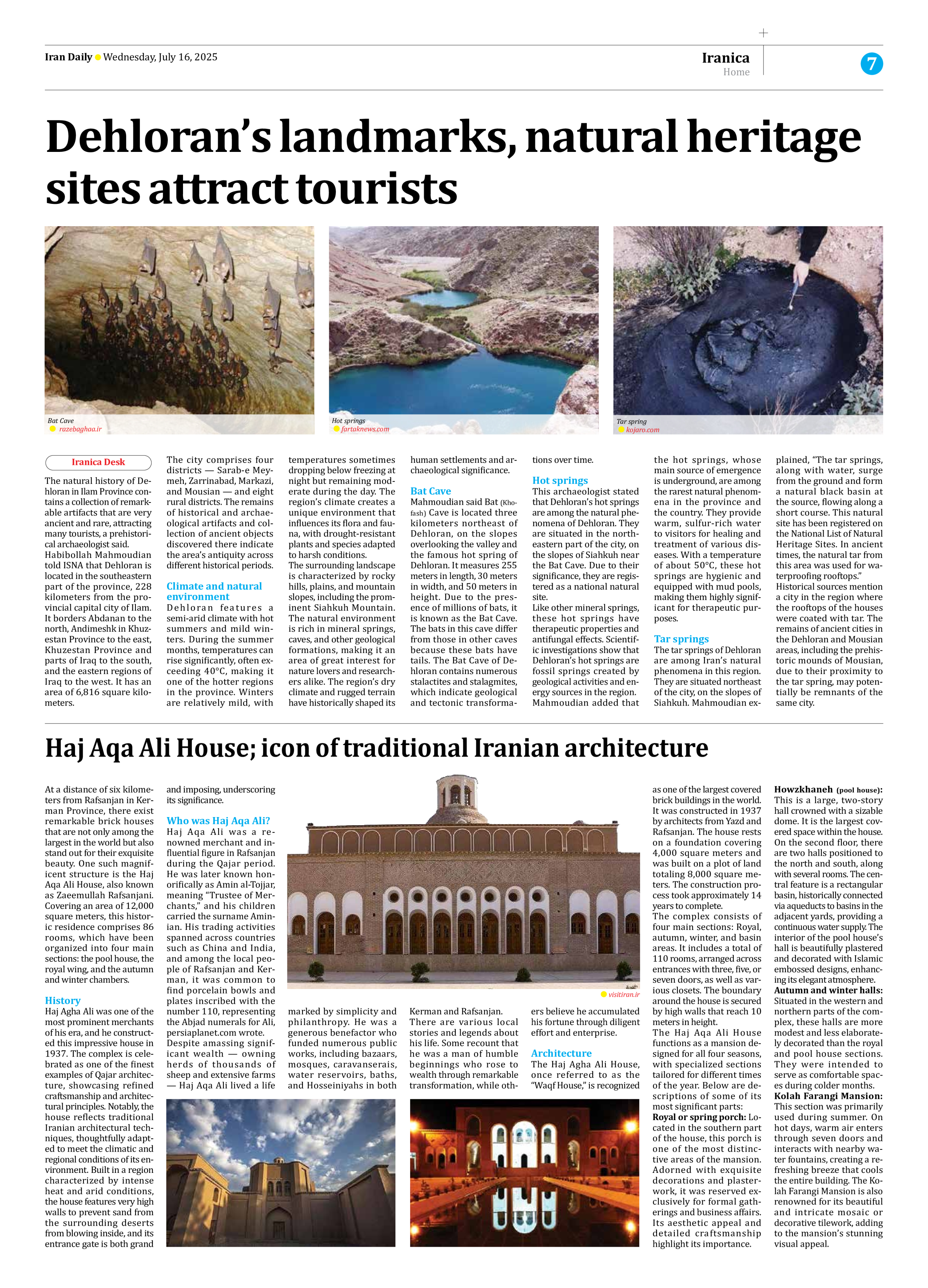
Bat Cave
Mahmoudian said Bat (Khofash) Cave is located three kilometers northeast of Dehloran, on the slopes overlooking the valley and the famous hot spring of Dehloran. It measures 255 meters in length, 30 meters in width, and 50 meters in height. Due to the presence of millions of bats, it is known as the Bat Cave. The bats in this cave differ from those in other caves because these bats have tails. The Bat Cave of Dehloran contains numerous stalactites and stalagmites, which indicate geological and tectonic transformations over time.
Hot springs
This archaeologist stated that Dehloran’s hot springs are among the natural phenomena of Dehloran. They are situated in the northeastern part of the city, on the slopes of Siahkuh near the Bat Cave. Due to their significance, they are registered as a national natural site.
Like other mineral springs, these hot springs have therapeutic properties and antifungal effects. Scientific investigations show that Dehloran’s hot springs are fossil springs created by geological activities and energy sources in the region.
Mahmoudian added that the hot springs, whose main source of emergence is underground, are among the rarest natural phenomena in the province and the country. They provide warm, sulfur-rich water to visitors for healing and treatment of various diseases. With a temperature of about 50°C, these hot springs are hygienic and equipped with mud pools, making them highly significant for therapeutic purposes.
Tar springs
The tar springs of Dehloran are among Iran’s natural phenomena in this region. They are situated northeast of the city, on the slopes of Siahkuh. Mahmoudian explained, “The tar springs, along with water, surge from the ground and form a natural black basin at the source, flowing along a short course. This natural site has been registered on the National List of Natural Heritage Sites. In ancient times, the natural tar from this area was used for waterproofing rooftops.”
Historical sources mention a city in the region where the rooftops of the houses were coated with tar. The remains of ancient cities in the Dehloran and Mousian areas, including the prehistoric mounds of Mousian, due to their proximity to the tar spring, may potentially be remnants of the same city.