





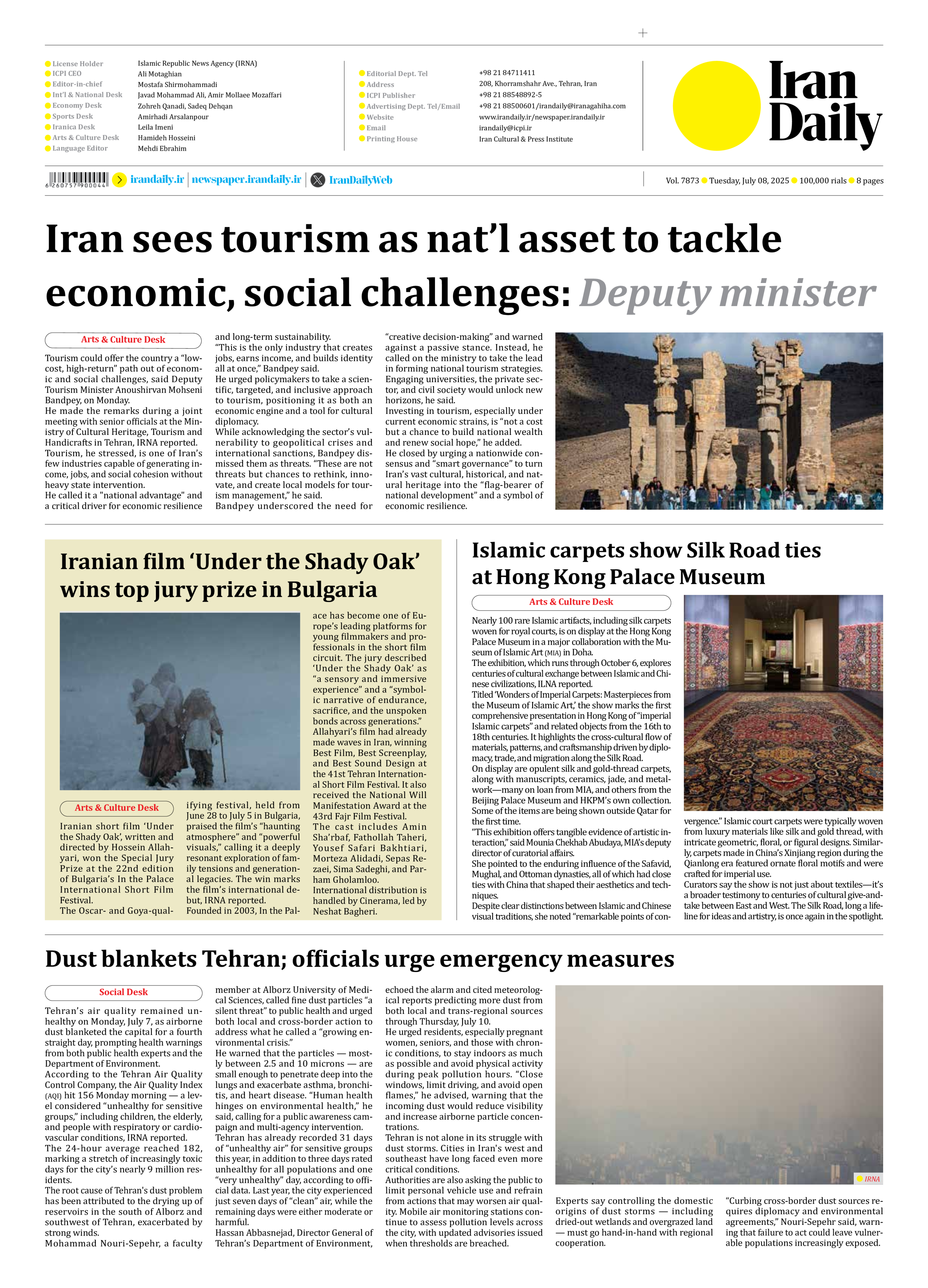


Dust blankets Tehran; officials urge emergency measures
Tehran’s air quality remained unhealthy on Monday, July 7, as airborne dust blanketed the capital for a fourth straight day, prompting health warnings from both public health experts and the Department of Environment.
According to the Tehran Air Quality Control Company, the Air Quality Index (AQI) hit 156 Monday morning — a level considered “unhealthy for sensitive groups,” including children, the elderly, and people with respiratory or cardiovascular conditions, IRNA reported.
The 24-hour average reached 182, marking a stretch of increasingly toxic days for the city’s nearly 9 million residents.
The root cause of Tehran's dust problem has been attributed to the drying up of reservoirs in the south of Alborz and southwest of Tehran, exacerbated by strong winds.
Mohammad Nouri-Sepehr, a faculty member at Alborz University of Medical Sciences, called fine dust particles “a silent threat” to public health and urged both local and cross-border action to address what he called a “growing environmental crisis.”
He warned that the particles — mostly between 2.5 and 10 microns — are small enough to penetrate deep into the lungs and exacerbate asthma, bronchitis, and heart disease. “Human health hinges on environmental health,” he said, calling for a public awareness campaign and multi-agency intervention.
Tehran has already recorded 31 days of “unhealthy air” for sensitive groups this year, in addition to three days rated unhealthy for all populations and one “very unhealthy” day, according to official data. Last year, the city experienced just seven days of “clean” air, while the remaining days were either moderate or harmful.
Hassan Abbasnejad, Director General of Tehran’s Department of Environment, echoed the alarm and cited meteorological reports predicting more dust from both local and trans-regional sources through Thursday, July 10.
He urged residents, especially pregnant women, seniors, and those with chronic conditions, to stay indoors as much as possible and avoid physical activity during peak pollution hours. “Close windows, limit driving, and avoid open flames,” he advised, warning that the incoming dust would reduce visibility and increase airborne particle concentrations.
Tehran is not alone in its struggle with dust storms. Cities in Iran's west and southeast have long faced even more critical conditions.
Authorities are also asking the public to limit personal vehicle use and refrain from actions that may worsen air quality. Mobile air monitoring stations continue to assess pollution levels across the city, with updated advisories issued when thresholds are breached.
Experts say controlling the domestic origins of dust storms — including dried-out wetlands and overgrazed land — must go hand-in-hand with regional cooperation.
“Curbing cross-border dust sources requires diplomacy and environmental agreements,” Nouri-Sepehr said, warning that failure to act could leave vulnerable populations increasingly exposed.