







Significance of Masuleh’s Alam Bandi ritual as a religious heritage
The lunar month of Muharram is one of the most sacred and revered periods in the Islamic calendar. It serves as a time for reflection, remembrance, and deep reverence for Imam Hussein (PBUH) and his companions’ martyrdom at Karbala. Ashura, the tenth day of Muharram, holds immense significance as it commemorates the day when Imam Hussein (PBUH) and his followers sacrificed their lives fighting against tyranny, injustice, and oppression. This day stands not only as a symbol of sacrifice and martyrdom but also as a powerful reminder of resistance, steadfastness, and the ongoing struggle for justice. Throughout this sacred month, mourning rituals and ceremonies are performed across the Muslim world, expressing love and devotion to Ahl al-Bayt (PBUH), the family of Prophet Muhammad (PBUH), and highlighting the importance of upholding Islamic values, standing against oppression, and promoting moral integrity. These observances serve to keep alive the legacy of Imam Hussein (PBUH) and the spirit of Ashura, inspiring generations anew, chtn.ir wrote.
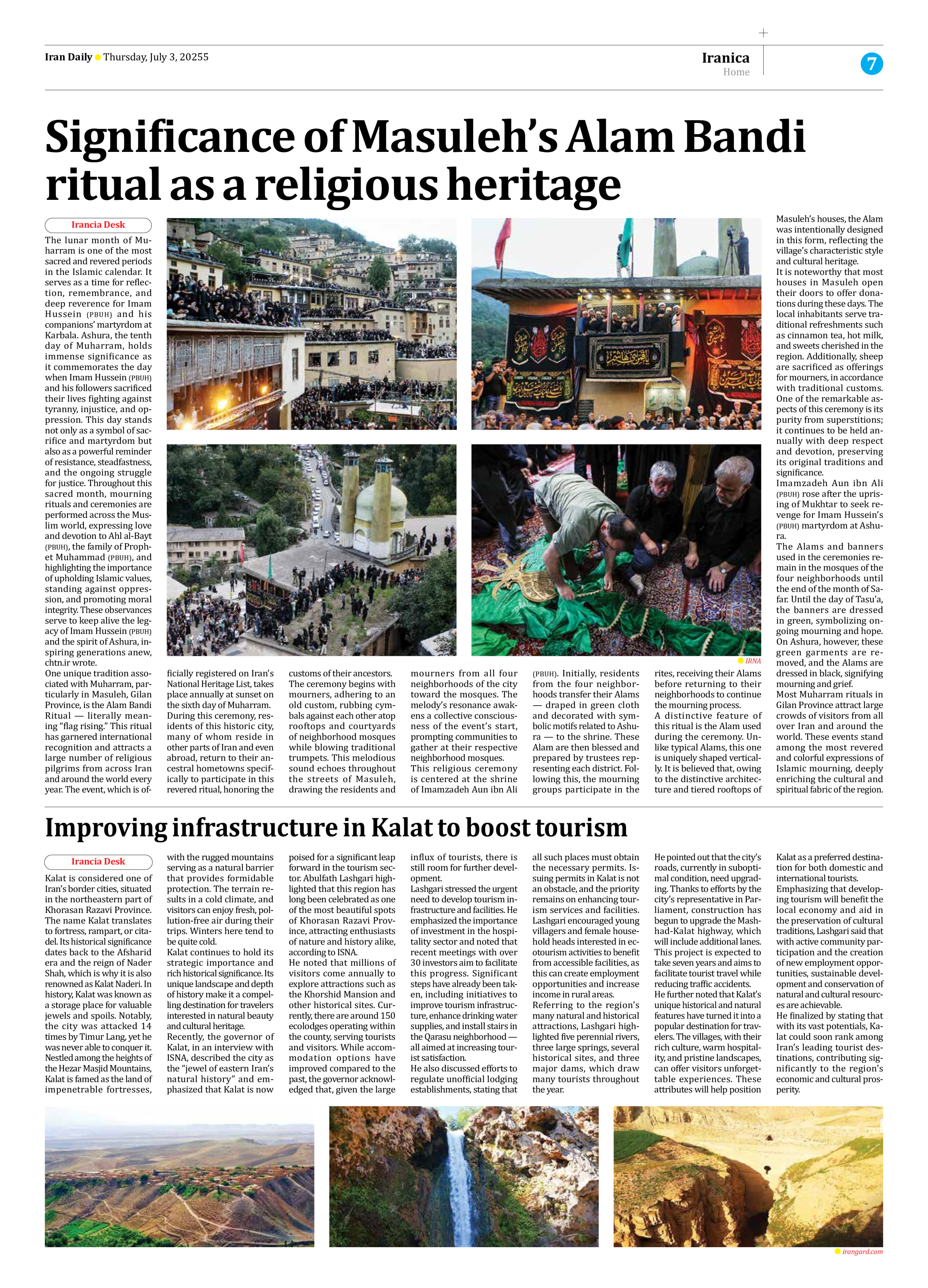
One unique tradition associated with Muharram, particularly in Masuleh, Gilan Province, is the Alam Bandi Ritual — literally meaning “flag rising.” This ritual has garnered international recognition and attracts a large number of religious pilgrims from across Iran and around the world every year. The event, which is officially registered on Iran’s National Heritage List, takes place annually at sunset on the sixth day of Muharram.
During this ceremony, residents of this historic city, many of whom reside in other parts of Iran and even abroad, return to their ancestral hometowns specifically to participate in this revered ritual, honoring the customs of their ancestors.
The ceremony begins with mourners, adhering to an old custom, rubbing cymbals against each other atop rooftops and courtyards of neighborhood mosques while blowing traditional trumpets. This melodious sound echoes throughout the streets of Masuleh, drawing the residents and mourners from all four neighborhoods of the city toward the mosques. The melody’s resonance awakens a collective consciousness of the event’s start, prompting communities to gather at their respective neighborhood mosques.
This religious ceremony is centered at the shrine of Imamzadeh Aun ibn Ali (PBUH). Initially, residents from the four neighborhoods transfer their Alams — draped in green cloth and decorated with symbolic motifs related to Ashura — to the shrine. These Alam are then blessed and prepared by trustees representing each district. Following this, the mourning groups participate in the rites, receiving their Alams before returning to their neighborhoods to continue the mourning process.
A distinctive feature of this ritual is the Alam used during the ceremony. Unlike typical Alams, this one is uniquely shaped vertically. It is believed that, owing to the distinctive architecture and tiered rooftops of Masuleh’s houses, the Alam was intentionally designed in this form, reflecting the village’s characteristic style and cultural heritage.
It is noteworthy that most houses in Masuleh open their doors to offer donations during these days. The local inhabitants serve traditional refreshments such as cinnamon tea, hot milk, and sweets cherished in the region. Additionally, sheep are sacrificed as offerings for mourners, in accordance with traditional customs. One of the remarkable aspects of this ceremony is its purity from superstitions; it continues to be held annually with deep respect and devotion, preserving its original traditions and significance.
Imamzadeh Aun ibn Ali (PBUH) rose after the uprising of Mukhtar to seek revenge for Imam Hussein’s (PBUH) martyrdom at Ashura.
The Alams and banners used in the ceremonies remain in the mosques of the four neighborhoods until the end of the month of Safar. Until the day of Tasu’a, the banners are dressed in green, symbolizing ongoing mourning and hope. On Ashura, however, these green garments are removed, and the Alams are dressed in black, signifying mourning and grief.
Most Muharram rituals in Gilan Province attract large crowds of visitors from all over Iran and around the world. These events stand among the most revered and colorful expressions of Islamic mourning, deeply enriching the cultural and spiritual fabric of the region.