







Strategic importance of Kordasht village in Jolfa
Strategically, Kordasht village in Jolfa, East Azarbaijan Province, held a significant role in Iran’s history and served as a witness to the bravery of Iranian troops against Russian soldiers during the Qajar dynasty. This region was of immense military importance due to its proximity to the borders and its natural defenses. Furthermore, Abbas Mirza, the Qajarian crown prince, designated this area as a key garrison to oppose Russian invasions, highlighting its strategic military value.
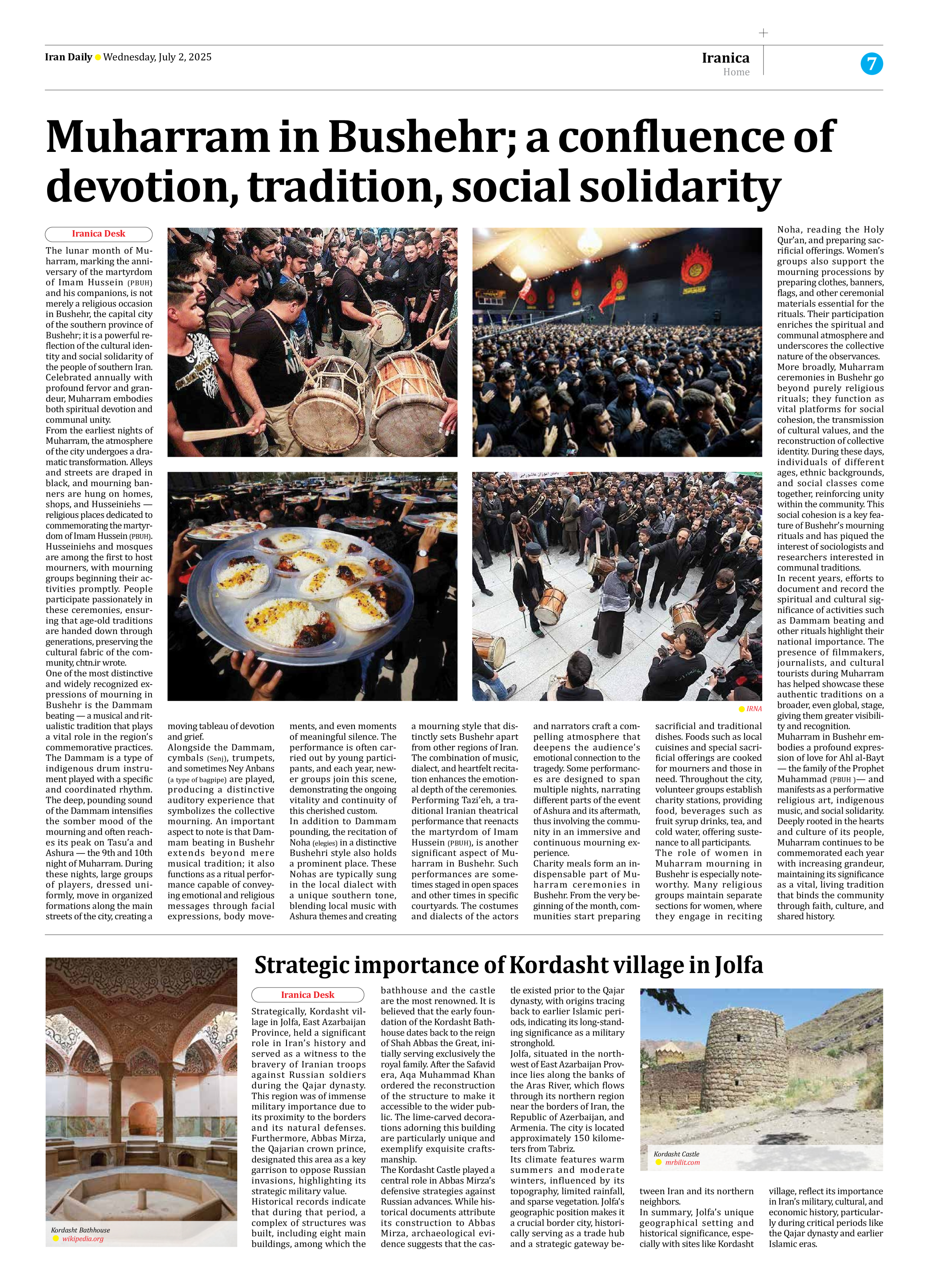
Historical records indicate that during that period, a complex of structures was built, including eight main buildings, among which the bathhouse and the castle are the most renowned. It is believed that the early foundation of the Kordasht Bathhouse dates back to the reign of Shah Abbas the Great, initially serving exclusively the royal family. After the Safavid era, Aqa Muhammad Khan ordered the reconstruction of the structure to make it accessible to the wider public. The lime-carved decorations adorning this building are particularly unique and exemplify exquisite craftsmanship.
The Kordasht Castle played a central role in Abbas Mirza’s defensive strategies against Russian advances. While historical documents attribute its construction to Abbas Mirza, archaeological evidence suggests that the castle existed prior to the Qajar dynasty, with origins tracing back to earlier Islamic periods, indicating its long-standing significance as a military stronghold.
Jolfa, situated in the northwest of East Azarbaijan Province lies along the banks of the Aras River, which flows through its northern region near the borders of Iran, the Republic of Azerbaijan, and Armenia. The city is located approximately 150 kilometers from Tabriz.
Its climate features warm summers and moderate winters, influenced by its topography, limited rainfall, and sparse vegetation. Jolfa’s geographic position makes it a crucial border city, historically serving as a trade hub and a strategic gateway between Iran and its northern neighbors.
In summary, Jolfa’s unique geographical setting and historical significance, especially with sites like Kordasht village, reflect its importance in Iran’s military, cultural, and economic history, particularly during critical periods like the Qajar dynasty and earlier Islamic eras.