







Veep casts reconstruction, modernization as key post-war priorities
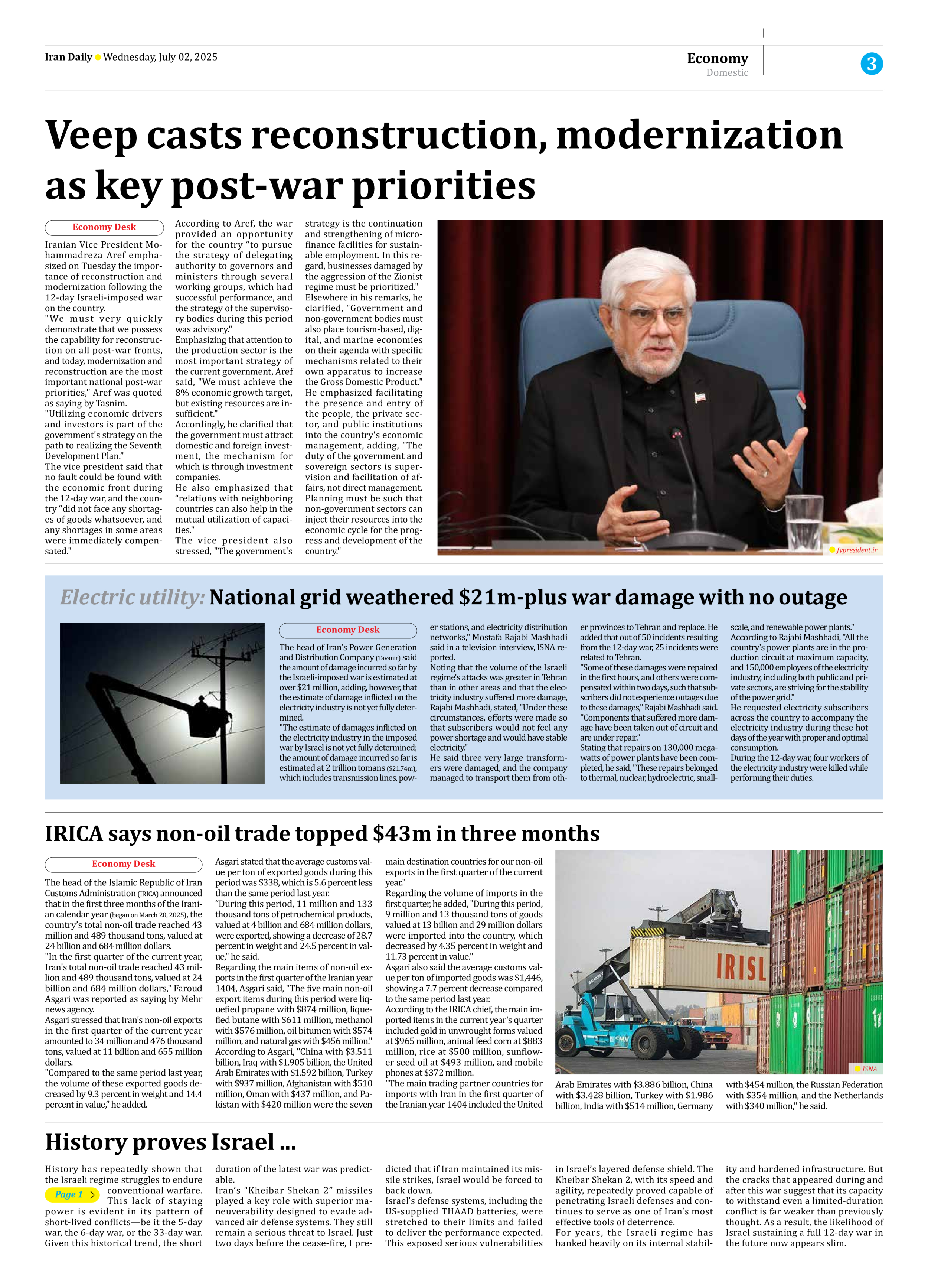
Iranian Vice President Mohammadreza Aref emphasized on Tuesday the importance of reconstruction and modernization following the 12-day Israeli-imposed war on the country.
"We must very quickly demonstrate that we possess the capability for reconstruction on all post-war fronts, and today, modernization and reconstruction are the most important national post-war priorities," Aref was quoted as saying by Tasnim.
"Utilizing economic drivers and investors is part of the government's strategy on the path to realizing the Seventh Development Plan.”
The vice president said that no fault could be found with the economic front during the 12-day war, and the country “did not face any shortages of goods whatsoever, and any shortages in some areas were immediately compensated."
According to Aref, the war provided an opportunity for the country “to pursue the strategy of delegating authority to governors and ministers through several working groups, which had successful performance, and the strategy of the supervisory bodies during this period was advisory."
Emphasizing that attention to the production sector is the most important strategy of the current government, Aref said, "We must achieve the 8% economic growth target, but existing resources are insufficient."
Accordingly, he clarified that the government must attract domestic and foreign investment, the mechanism for which is through investment companies.
He also emphasized that “relations with neighboring countries can also help in the mutual utilization of capacities."
The vice president also stressed, "The government's strategy is the continuation and strengthening of microfinance facilities for sustainable employment. In this regard, businesses damaged by the aggression of the Zionist regime must be prioritized."
Elsewhere in his remarks, he clarified, "Government and non-government bodies must also place tourism-based, digital, and marine economies on their agenda with specific mechanisms related to their own apparatus to increase the Gross Domestic Product."
He emphasized facilitating the presence and entry of the people, the private sector, and public institutions into the country's economic management, adding, "The duty of the government and sovereign sectors is supervision and facilitation of affairs, not direct management. Planning must be such that non-government sectors can inject their resources into the economic cycle for the progress and development of the country."