





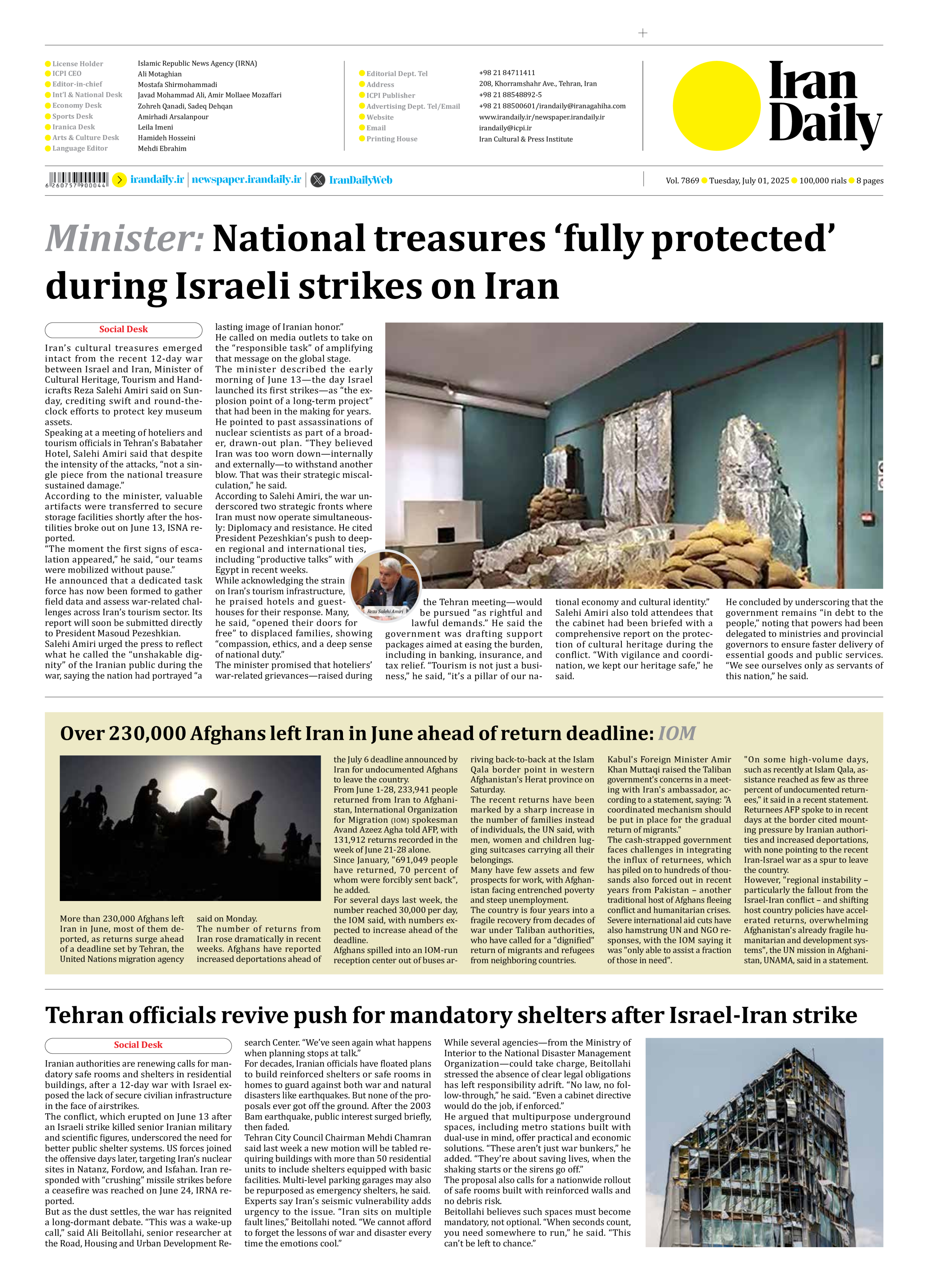


Tehran officials revive push for mandatory shelters after Israel-Iran strike
Iranian authorities are renewing calls for mandatory safe rooms and shelters in residential buildings, after a 12-day war with Israel exposed the lack of secure civilian infrastructure in the face of airstrikes.
The conflict, which erupted on June 13 after an Israeli strike killed senior Iranian military and scientific figures, underscored the need for better public shelter systems. US forces joined the offensive days later, targeting Iran’s nuclear sites in Natanz, Fordow, and Isfahan. Iran responded with “crushing” missile strikes before a ceasefire was reached on June 24, IRNA reported.
But as the dust settles, the war has reignited a long-dormant debate. “This was a wake-up call,” said Ali Beitollahi, senior researcher at the Road, Housing and Urban Development Research Center. “We’ve seen again what happens when planning stops at talk.”
For decades, Iranian officials have floated plans to build reinforced shelters or safe rooms in homes to guard against both war and natural disasters like earthquakes. But none of the proposals ever got off the ground. After the 2003 Bam earthquake, public interest surged briefly, then faded.
Tehran City Council Chairman Mehdi Chamran said last week a new motion will be tabled requiring buildings with more than 50 residential units to include shelters equipped with basic facilities. Multi-level parking garages may also be repurposed as emergency shelters, he said.
Experts say Iran’s seismic vulnerability adds urgency to the issue. “Iran sits on multiple fault lines,” Beitollahi noted. “We cannot afford to forget the lessons of war and disaster every time the emotions cool.”
While several agencies—from the Ministry of Interior to the National Disaster Management Organization—could take charge, Beitollahi stressed the absence of clear legal obligations has left responsibility adrift. “No law, no follow-through,” he said. “Even a cabinet directive would do the job, if enforced.”
He argued that multipurpose underground spaces, including metro stations built with dual-use in mind, offer practical and economic solutions. “These aren’t just war bunkers,” he added. “They’re about saving lives, when the shaking starts or the sirens go off.”
The proposal also calls for a nationwide rollout of safe rooms built with reinforced walls and no debris risk.
Beitollahi believes such spaces must become mandatory, not optional. “When seconds count, you need somewhere to run,” he said. “This can’t be left to chance.”