







Minister: National treasures ‘fully protected’ during Israeli strikes on Iran
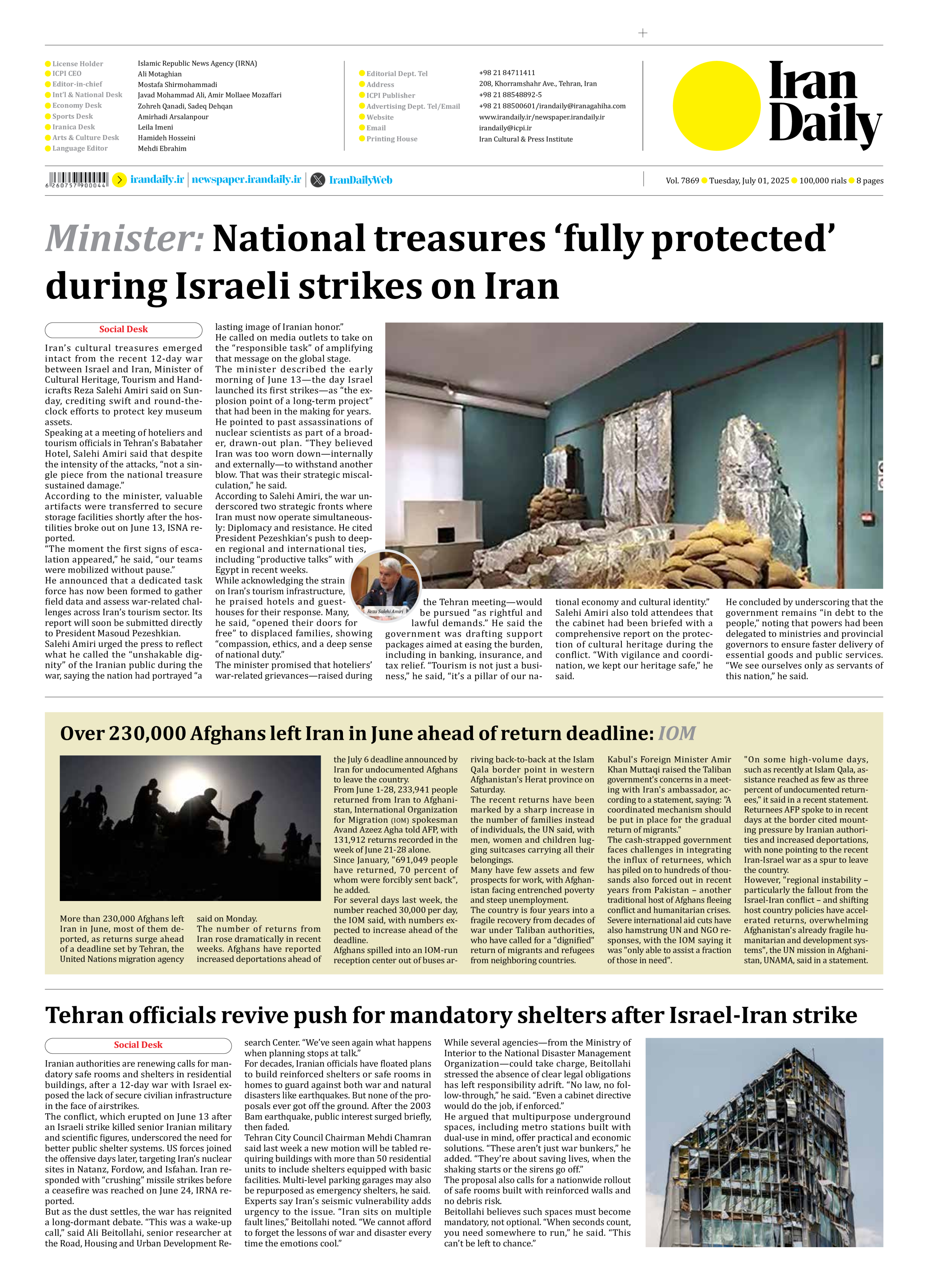
Iran’s cultural treasures emerged intact from the recent 12-day war between Israel and Iran, Minister of Cultural Heritage, Tourism and Handicrafts Reza Salehi Amiri said on Sunday, crediting swift and round-the-clock efforts to protect key museum assets.
Speaking at a meeting of hoteliers and tourism officials in Tehran’s Babataher Hotel, Salehi Amiri said that despite the intensity of the attacks, “not a single piece from the national treasure sustained damage.”
According to the minister, valuable artifacts were transferred to secure storage facilities shortly after the hostilities broke out on June 13, ISNA reported.
“The moment the first signs of escalation appeared,” he said, “our teams were mobilized without pause.”
He announced that a dedicated task force has now been formed to gather field data and assess war-related challenges across Iran’s tourism sector. Its report will soon be submitted directly to President Masoud Pezeshkian.
Salehi Amiri urged the press to reflect what he called the “unshakable dignity” of the Iranian public during the war, saying the nation had portrayed “a lasting image of Iranian honor.”
He called on media outlets to take on the “responsible task” of amplifying that message on the global stage.
The minister described the early morning of June 13—the day Israel launched its first strikes—as “the explosion point of a long-term project” that had been in the making for years.
He pointed to past assassinations of nuclear scientists as part of a broader, drawn-out plan. “They believed Iran was too worn down—internally and externally—to withstand another blow. That was their strategic miscalculation,” he said.
According to Salehi Amiri, the war underscored two strategic fronts where Iran must now operate simultaneously: Diplomacy and resistance. He cited President Pezeshkian’s push to deepen regional and international ties, including “productive talks” with Egypt in recent weeks.
While acknowledging the strain on Iran’s tourism infrastructure, he praised hotels and guesthouses for their response. Many, he said, “opened their doors for free” to displaced families, showing “compassion, ethics, and a deep sense of national duty.”
The minister promised that hoteliers’ war-related grievances—raised during the Tehran meeting—would be pursued “as rightful and lawful demands.” He said the government was drafting support packages aimed at easing the burden, including in banking, insurance, and tax relief. “Tourism is not just a business,” he said, “it’s a pillar of our national economy and cultural identity.”
Salehi Amiri also told attendees that the cabinet had been briefed with a comprehensive report on the protection of cultural heritage during the conflict. “With vigilance and coordination, we kept our heritage safe,” he said.
He concluded by underscoring that the government remains “in debt to the people,” noting that powers had been delegated to ministries and provincial governors to ensure faster delivery of essential goods and public services. “We see ourselves only as servants of this nation,” he said.