







Ministry of Economy drafts post-war support packages for industries, businesses
In line with supporting large industries and businesses in compensating for the repercussions of the 12-day war with the Israeli regime, the Ministry of Economy, in cooperation with the Reconstruction Headquarters and coordination with the Plan and Budget Organization, formulated support packages for approval by the government.
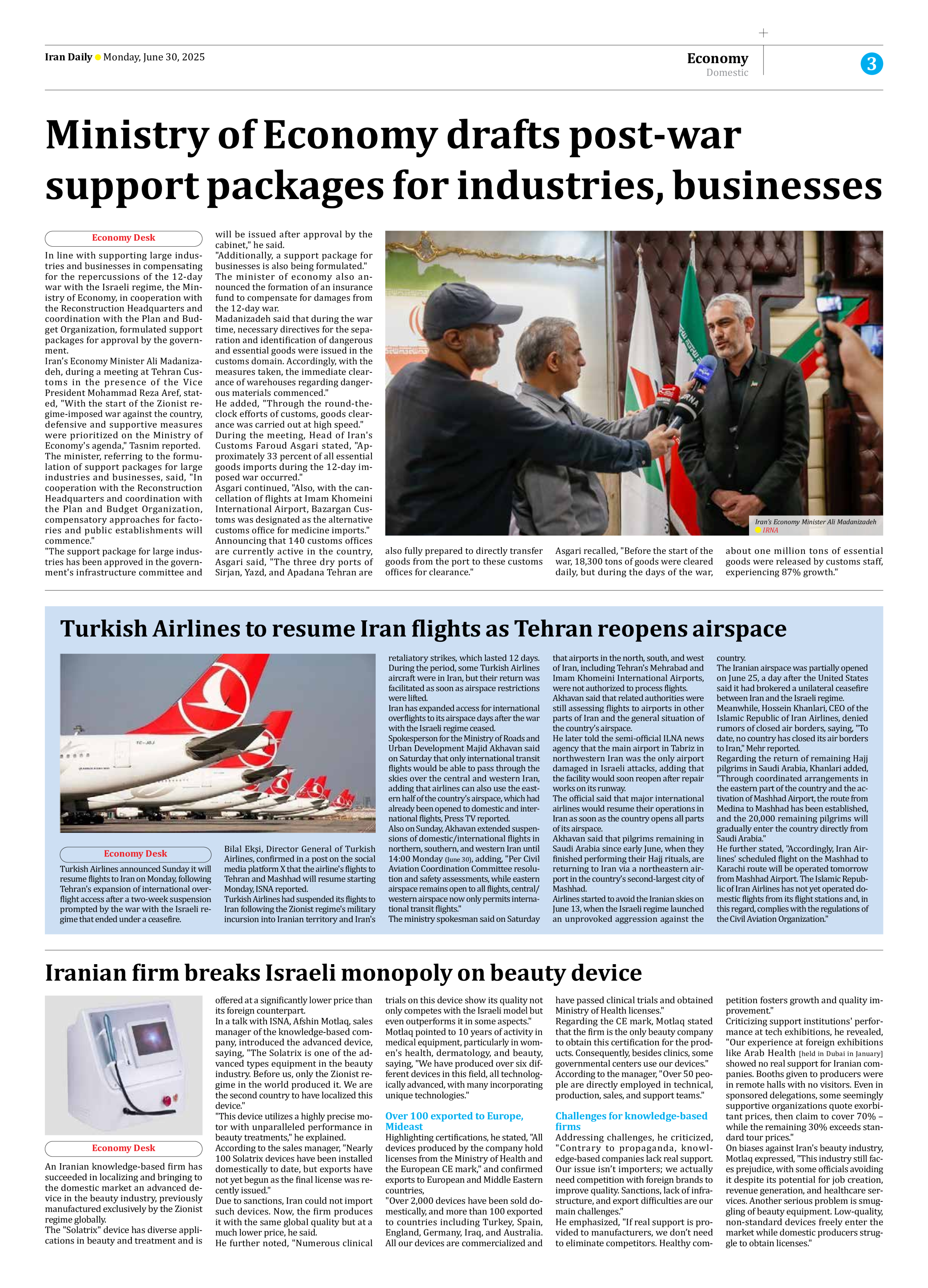
Iran’s Economy Minister Ali Madanizadeh, during a meeting at Tehran Customs in the presence of the Vice President Mohammad Reza Aref, stated, "With the start of the Zionist regime-imposed war against the country, defensive and supportive measures were prioritized on the Ministry of Economy's agenda," Tasnim reported.
The minister, referring to the formulation of support packages for large industries and businesses, said, "In cooperation with the Reconstruction Headquarters and coordination with the Plan and Budget Organization, compensatory approaches for factories and public establishments will commence."
"The support package for large industries has been approved in the government's infrastructure committee and will be issued after approval by the cabinet," he said.
"Additionally, a support package for businesses is also being formulated."
The minister of economy also announced the formation of an insurance fund to compensate for damages from the 12-day war.
Madanizadeh said that during the war time, necessary directives for the separation and identification of dangerous and essential goods were issued in the customs domain. Accordingly, with the measures taken, the immediate clearance of warehouses regarding dangerous materials commenced."
He added, "Through the round-the-clock efforts of customs, goods clearance was carried out at high speed."
During the meeting, Head of Iran's Customs Faroud Asgari stated, "Approximately 33 percent of all essential goods imports during the 12-day imposed war occurred."
Asgari continued, "Also, with the cancellation of flights at Imam Khomeini International Airport, Bazargan Customs was designated as the alternative customs office for medicine imports."
Announcing that 140 customs offices are currently active in the country, Asgari said, "The three dry ports of Sirjan, Yazd, and Apadana Tehran are also fully prepared to directly transfer goods from the port to these customs offices for clearance."
Asgari recalled, "Before the start of the war, 18,300 tons of goods were cleared daily, but during the days of the war, about one million tons of essential goods were released by customs staff, experiencing 87% growth."