







From collections to communities
Revised ethics code charts new course for museums
By Hamideh Hosseini
Staff writer
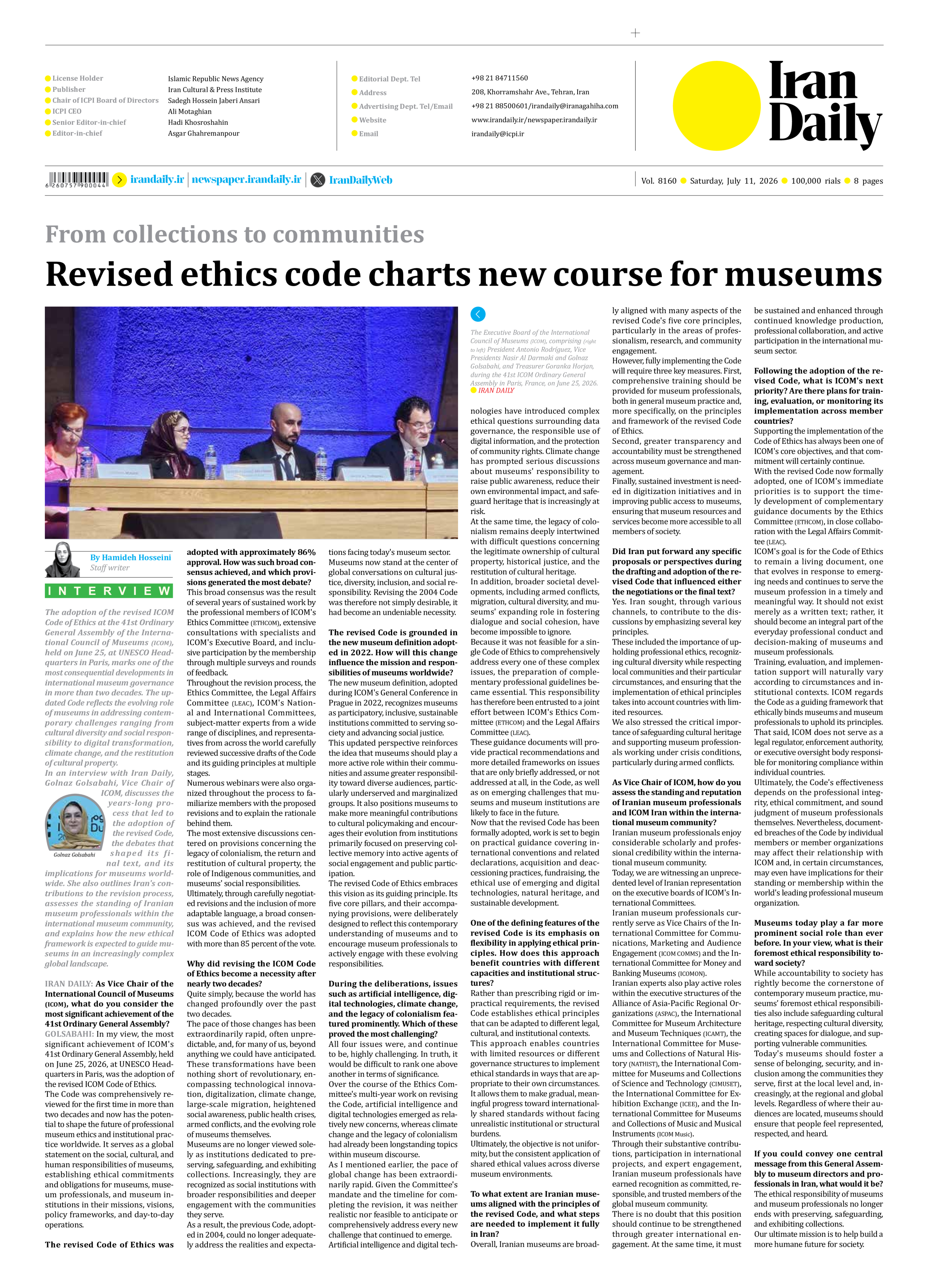
The adoption of the revised ICOM Code of Ethics at the 41st Ordinary General Assembly of the International Council of Museums (ICOM), held on June 25, at UNESCO Headquarters in Paris, marks one of the most consequential developments in international museum governance in more than two decades. The updated Code reflects the evolving role of museums in addressing contemporary challenges ranging from cultural diversity and social responsibility to digital transformation, climate change, and the restitution of cultural property.
In an interview with Iran Daily, Golnaz Golsabahi, Vice Chair of ICOM, discusses the years-long process that led to the adoption of the revised Code, the debates that shaped its final text, and its implications for museums worldwide. She also outlines Iran's contributions to the revision process, assesses the standing of Iranian museum professionals within the international museum community, and explains how the new ethical framework is expected to guide museums in an increasingly complex global landscape.
IRAN DAILY: As Vice Chair of the International Council of Museums (ICOM), what do you consider the most significant achievement of the 41st Ordinary General Assembly?
GOLSABAHI: In my view, the most significant achievement of ICOM's 41st Ordinary General Assembly, held on June 25, 2026, at UNESCO Headquarters in Paris, was the adoption of the revised ICOM Code of Ethics.
The Code was comprehensively reviewed for the first time in more than two decades and now has the potential to shape the future of professional museum ethics and institutional practice worldwide. It serves as a global statement on the social, cultural, and human responsibilities of museums, establishing ethical commitments and obligations for museums, museum professionals, and museum institutions in their missions, visions, policy frameworks, and day-to-day operations.
The revised Code of Ethics was adopted with approximately 86% approval. How was such broad consensus achieved, and which provisions generated the most debate?
This broad consensus was the result of several years of sustained work by the professional members of ICOM's Ethics Committee (ETHCOM), extensive consultations with specialists and ICOM's Executive Board, and inclusive participation by the membership through multiple surveys and rounds of feedback.
Throughout the revision process, the Ethics Committee, the Legal Affairs Committee (LEAC), ICOM's National and International Committees, subject-matter experts from a wide range of disciplines, and representatives from across the world carefully reviewed successive drafts of the Code and its guiding principles at multiple stages.
Numerous webinars were also organized throughout the process to familiarize members with the proposed revisions and to explain the rationale behind them.
The most extensive discussions centered on provisions concerning the legacy of colonialism, the return and restitution of cultural property, the role of Indigenous communities, and museums' social responsibilities.
Ultimately, through carefully negotiated revisions and the inclusion of more adaptable language, a broad consensus was achieved, and the revised ICOM Code of Ethics was adopted with more than 85 percent of the vote.
Why did revising the ICOM Code of Ethics become a necessity after nearly two decades?
Quite simply, because the world has changed profoundly over the past two decades.
The pace of those changes has been extraordinarily rapid, often unpredictable, and, for many of us, beyond anything we could have anticipated. These transformations have been nothing short of revolutionary, encompassing technological innovation, digitalization, climate change, large-scale migration, heightened social awareness, public health crises, armed conflicts, and the evolving role of museums themselves.
Museums are no longer viewed solely as institutions dedicated to preserving, safeguarding, and exhibiting collections. Increasingly, they are recognized as social institutions with broader responsibilities and deeper engagement with the communities they serve.
As a result, the previous Code, adopted in 2004, could no longer adequately address the realities and expectations facing today's museum sector.
Museums now stand at the center of global conversations on cultural justice, diversity, inclusion, and social responsibility. Revising the 2004 Code was therefore not simply desirable, it had become an undeniable necessity.
The revised Code is grounded in the new museum definition adopted in 2022. How will this change influence the mission and responsibilities of museums worldwide?
The new museum definition, adopted during ICOM's General Conference in Prague in 2022, recognizes museums as participatory, inclusive, sustainable institutions committed to serving society and advancing social justice.
This updated perspective reinforces the idea that museums should play a more active role within their communities and assume greater responsibility toward diverse audiences, particularly underserved and marginalized groups. It also positions museums to make more meaningful contributions to cultural policymaking and encourages their evolution from institutions primarily focused on preserving collective memory into active agents of social engagement and public participation.
The revised Code of Ethics embraces this vision as its guiding principle. Its five core pillars, and their accompanying provisions, were deliberately designed to reflect this contemporary understanding of museums and to encourage museum professionals to actively engage with these evolving responsibilities.
During the deliberations, issues such as artificial intelligence, digital technologies, climate change, and the legacy of colonialism featured prominently. Which of these proved the most challenging?
All four issues were, and continue to be, highly challenging. In truth, it would be difficult to rank one above another in terms of significance.
Over the course of the Ethics Committee's multi-year work on revising the Code, artificial intelligence and digital technologies emerged as relatively new concerns, whereas climate change and the legacy of colonialism had already been longstanding topics within museum discourse.
As I mentioned earlier, the pace of global change has been extraordinarily rapid. Given the Committee's mandate and the timeline for completing the revision, it was neither realistic nor feasible to anticipate or comprehensively address every new challenge that continued to emerge.
Artificial intelligence and digital technologies have introduced complex ethical questions surrounding data governance, the responsible use of digital information, and the protection of community rights. Climate change has prompted serious discussions about museums' responsibility to raise public awareness, reduce their own environmental impact, and safeguard heritage that is increasingly at risk.
At the same time, the legacy of colonialism remains deeply intertwined with difficult questions concerning the legitimate ownership of cultural property, historical justice, and the restitution of cultural heritage.
In addition, broader societal developments, including armed conflicts, migration, cultural diversity, and museums' expanding role in fostering dialogue and social cohesion, have become impossible to ignore.
Because it was not feasible for a single Code of Ethics to comprehensively address every one of these complex issues, the preparation of complementary professional guidelines became essential. This responsibility has therefore been entrusted to a joint effort between ICOM's Ethics Committee (ETHCOM) and the Legal Affairs Committee (LEAC).
These guidance documents will provide practical recommendations and more detailed frameworks on issues that are only briefly addressed, or not addressed at all, in the Code, as well as on emerging challenges that museums and museum institutions are likely to face in the future.
Now that the revised Code has been formally adopted, work is set to begin on practical guidance covering international conventions and related declarations, acquisition and deaccessioning practices, fundraising, the ethical use of emerging and digital technologies, natural heritage, and sustainable development.
One of the defining features of the revised Code is its emphasis on flexibility in applying ethical principles. How does this approach benefit countries with different capacities and institutional structures?
Rather than prescribing rigid or impractical requirements, the revised Code establishes ethical principles that can be adapted to different legal, cultural, and institutional contexts.
This approach enables countries with limited resources or different governance structures to implement ethical standards in ways that are appropriate to their own circumstances. It allows them to make gradual, meaningful progress toward internationally shared standards without facing unrealistic institutional or structural burdens.
Ultimately, the objective is not uniformity, but the consistent application of shared ethical values across diverse museum environments.
To what extent are Iranian museums aligned with the principles of the revised Code, and what steps are needed to implement it fully in Iran?
Overall, Iranian museums are broadly aligned with many aspects of the revised Code's five core principles, particularly in the areas of professionalism, research, and community engagement.
However, fully implementing the Code will require three key measures. First, comprehensive training should be provided for museum professionals, both in general museum practice and, more specifically, on the principles and framework of the revised Code of Ethics.
Second, greater transparency and accountability must be strengthened across museum governance and management.
Finally, sustained investment is needed in digitization initiatives and in improving public access to museums, ensuring that museum resources and services become more accessible to all members of society.
Did Iran put forward any specific proposals or perspectives during the drafting and adoption of the revised Code that influenced either the negotiations or the final text?
Yes. Iran sought, through various channels, to contribute to the discussions by emphasizing several key principles.
These included the importance of upholding professional ethics, recognizing cultural diversity while respecting local communities and their particular circumstances, and ensuring that the implementation of ethical principles takes into account countries with limited resources.
We also stressed the critical importance of safeguarding cultural heritage and supporting museum professionals working under crisis conditions, particularly during armed conflicts.
As Vice Chair of ICOM, how do you assess the standing and reputation of Iranian museum professionals and ICOM Iran within the international museum community?
Iranian museum professionals enjoy considerable scholarly and professional credibility within the international museum community.
Today, we are witnessing an unprecedented level of Iranian representation on the executive boards of ICOM's International Committees.
Iranian museum professionals currently serve as Vice Chairs of the International Committee for Communications, Marketing and Audience Engagement (ICOM COMMS) and the International Committee for Money and Banking Museums (ICOMON).
Iranian experts also play active roles within the executive structures of the Alliance of Asia-Pacific Regional Organizations (ASPAC), the International Committee for Museum Architecture and Museum Techniques (ICAMT), the International Committee for Museums and Collections of Natural History (NATHIST), the International Committee for Museums and Collections of Science and Technology (CIMUSET), the International Committee for Exhibition Exchange (ICEE), and the International Committee for Museums and Collections of Music and Musical Instruments (ICOM Music).
Through their substantive contributions, participation in international projects, and expert engagement, Iranian museum professionals have earned recognition as committed, responsible, and trusted members of the global museum community.
There is no doubt that this position should continue to be strengthened through greater international engagement. At the same time, it must be sustained and enhanced through continued knowledge production, professional collaboration, and active participation in the international museum sector.
Following the adoption of the revised Code, what is ICOM's next priority? Are there plans for training, evaluation, or monitoring its implementation across member countries?
Supporting the implementation of the Code of Ethics has always been one of ICOM's core objectives, and that commitment will certainly continue.
With the revised Code now formally adopted, one of ICOM's immediate priorities is to support the timely development of complementary guidance documents by the Ethics Committee (ETHCOM), in close collaboration with the Legal Affairs Committee (LEAC).
ICOM's goal is for the Code of Ethics to remain a living document, one that evolves in response to emerging needs and continues to serve the museum profession in a timely and meaningful way. It should not exist merely as a written text; rather, it should become an integral part of the everyday professional conduct and decision-making of museums and museum professionals.
Training, evaluation, and implementation support will naturally vary according to circumstances and institutional contexts. ICOM regards the Code as a guiding framework that ethically binds museums and museum professionals to uphold its principles.
That said, ICOM does not serve as a legal regulator, enforcement authority, or executive oversight body responsible for monitoring compliance within individual countries.
Ultimately, the Code's effectiveness depends on the professional integrity, ethical commitment, and sound judgment of museum professionals themselves. Nevertheless, documented breaches of the Code by individual members or member organizations may affect their relationship with ICOM and, in certain circumstances, may even have implications for their standing or membership within the world's leading professional museum organization.
Museums today play a far more prominent social role than ever before. In your view, what is their foremost ethical responsibility toward society?
While accountability to society has rightly become the cornerstone of contemporary museum practice, museums’ foremost ethical responsibilities also include safeguarding cultural heritage, respecting cultural diversity, creating spaces for dialogue, and supporting vulnerable communities.
Today's museums should foster a sense of belonging, security, and inclusion among the communities they serve, first at the local level and, increasingly, at the regional and global levels. Regardless of where their audiences are located, museums should ensure that people feel represented, respected, and heard.
If you could convey one central message from this General Assembly to museum directors and professionals in Iran, what would it be?
The ethical responsibility of museums and museum professionals no longer ends with preserving, safeguarding, and exhibiting collections.
Our ultimate mission is to help build a more humane future for society.