





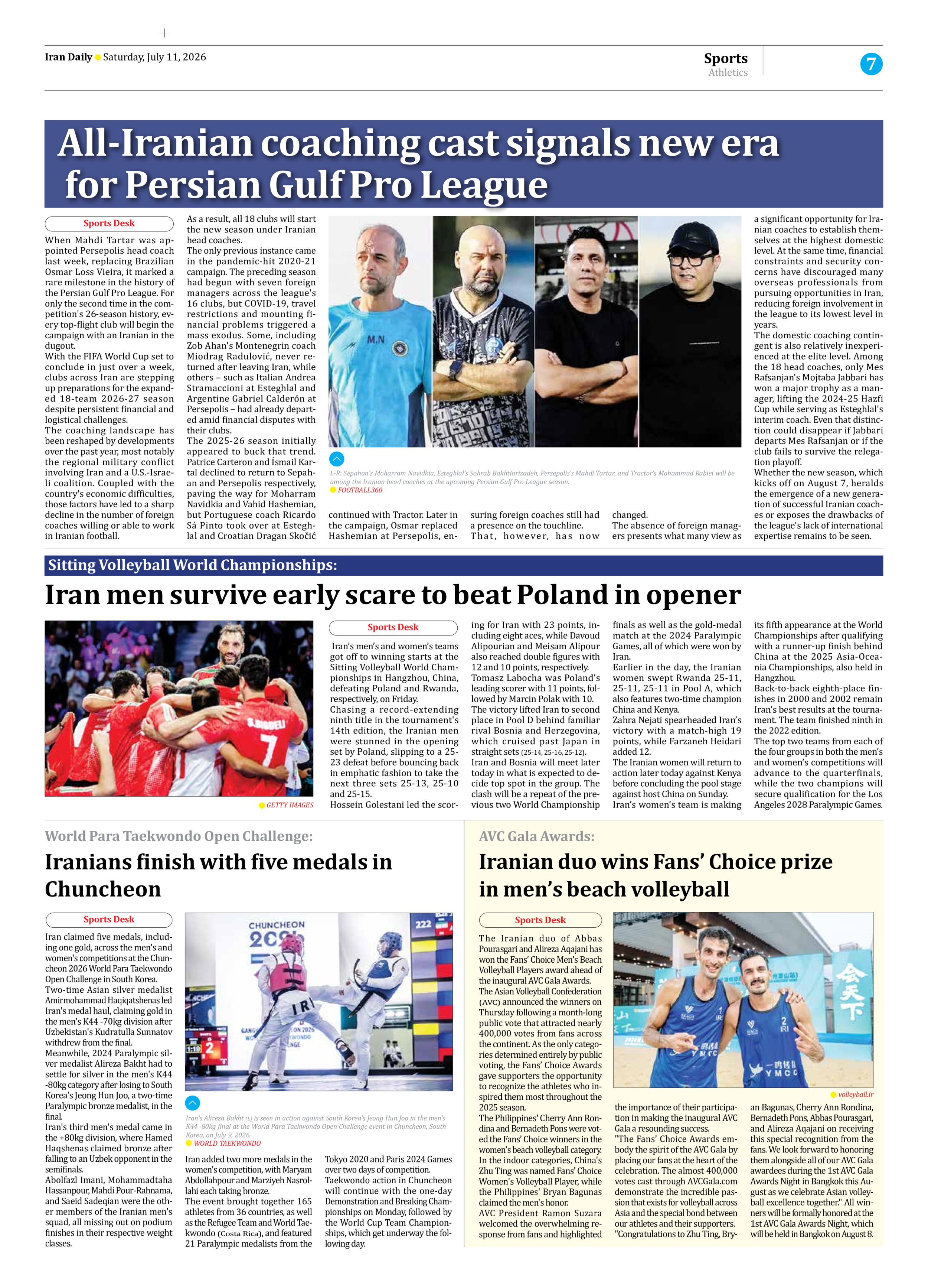


All-Iranian coaching cast signals new era for Persian Gulf Pro League
When Mahdi Tartar was appointed Persepolis head coach last week, replacing Brazilian Osmar Loss Vieira, it marked a rare milestone in the history of the Persian Gulf Pro League. For only the second time in the competition's 26-season history, every top-flight club will begin the campaign with an Iranian in the dugout.
With the FIFA World Cup set to conclude in just over a week, clubs across Iran are stepping up preparations for the expanded 18-team 2026-27 season despite persistent financial and logistical challenges.
The coaching landscape has been reshaped by developments over the past year, most notably the regional military conflict involving Iran and a U.S.-Israeli coalition. Coupled with the country's economic difficulties, those factors have led to a sharp decline in the number of foreign coaches willing or able to work in Iranian football.
As a result, all 18 clubs will start the new season under Iranian head coaches.
The only previous instance came in the pandemic-hit 2020-21 campaign. The preceding season had begun with seven foreign managers across the league's 16 clubs, but COVID-19, travel restrictions and mounting financial problems triggered a mass exodus. Some, including Zob Ahan's Montenegrin coach Miodrag Radulović, never returned after leaving Iran, while others – such as Italian Andrea Stramaccioni at Esteghlal and Argentine Gabriel Calderón at Persepolis – had already departed amid financial disputes with their clubs.
The 2025-26 season initially appeared to buck that trend. Patrice Carteron and İsmail Kartal declined to return to Sepahan and Persepolis respectively, paving the way for Moharram Navidkia and Vahid Hashemian, but Portuguese coach Ricardo Sá Pinto took over at Esteghlal and Croatian Dragan Skočić continued with Tractor. Later in the campaign, Osmar replaced Hashemian at Persepolis, ensuring foreign coaches still had a presence on the touchline.
That, however, has now changed.
The absence of foreign managers presents what many view as a significant opportunity for Iranian coaches to establish themselves at the highest domestic level. At the same time, financial constraints and security concerns have discouraged many overseas professionals from pursuing opportunities in Iran, reducing foreign involvement in the league to its lowest level in years.
The domestic coaching contingent is also relatively inexperienced at the elite level. Among the 18 head coaches, only Mes Rafsanjan's Mojtaba Jabbari has won a major trophy as a manager, lifting the 2024-25 Hazfi Cup while serving as Esteghlal's interim coach. Even that distinction could disappear if Jabbari departs Mes Rafsanjan or if the club fails to survive the relegation playoff.
Whether the new season, which kicks off on August 7, heralds the emergence of a new generation of successful Iranian coaches or exposes the drawbacks of the league's lack of international expertise remains to be seen.