







Intellectual paradigm of Iran’s martyred Leader in foreign policy
Rereading discourse of anti-hegemonic interactionism
By Rasoul Safarahang
Senior researcher at the Center for Middle East Strategic Studies
By Parisa Salimi
Researcher in regional studies
The foreign policy of every nation constitutes a comprehensive mirror of that nation’s identity, values, and strategic orientations within the international system. In the Islamic Republic of Iran, the Leadership, functioning as the supreme decision-making authority, executes a foundational role in the definition of principles, the determination of objectives, and the delineation of the foreign policy trajectory.
This piece, through the utilization of the speeches and correspondences of the martyred Leader Ayatollah Seyyed Ali Khamenei during the temporal interval spanning the Persian calendar years of 1368 to 1398 (roughly equivalent to 1989–2019), undertakes a rereading of his intellectual paradigm in the domain of foreign policy.
The principal argument of this piece is that the foreign policy discourse of Ayatollah Khamenei has been formulated around the axis of “anti-hegemonic interactionism”; a discourse that rests upon two pillars, namely the negative and the positive. This discourse, through its susceptibility to three factors — the personal characteristics of the Leader, the internal exigencies of the system, and the transformations of the international system — has evolved across four decades and, at each juncture, has encompassed divergent approaches, from sheer resistance to critical engagement, in accordance with prevailing conditions.
Through an examination of key components such as the anti-hegemony bloc, resistance economy, neighborhood diplomacy, the Look East policy, and hybrid deterrence, the author arrives at the conclusion that the intellectual paradigm under investigation in foreign policy offers a comprehensive and coherent strategy for the management of threats and the exploitation of opportunities within an environment filled with uncertainty and, simultaneously, by virtue of institutionalization from discourse, possesses the requisite flexibility to respond to the transformations of the international system.
Position of the Leadership
in Iran’s foreign policy
In the Islamic Establishment of Iran, the Leadership is not merely the ultimate decision-making institution in the macro-affairs of the country, but rather the symbol of the ideological continuity of the Islamic Revolution and the determining reference for the principles and frameworks of foreign policy.
This special status is rooted in three domains — religious, legal, and charismatic legitimacy — which empower the Leadership to function beyond managerial and executive exigencies as the “final arbiter” in the determination of objectives, priorities, and orientations of foreign policy. The significance of this status is of such magnitude that any comprehension of the foreign policy of the Islamic Republic, absent an understanding of the Leader’s intellectual paradigm, would remain incomplete and superficial.
The Islamic Republic perceives itself as the most prominent critic of the hegemonic system upon the international stage and ascribes to itself an inspirational and mobilizing role in the contemporary world; a role that acquires heightened relevance, particularly in relation to the Islamic world and freedom-seeking nations. This perspective, which, more than any other factor, is influenced by the role of the Leadership within this political unit, indicates that Iran’s foreign policy must be considered among identity-value policies.
Hence, the discourse of Ayatollah Seyyed Ali Khamenei in the domain of foreign policy constitutes a continuation of the path of Imam Khomeini, which has been reread and reproduced with the centrality of anti-hegemonic interactionism and under the influence of three key factors: first, his personal characteristics and civilizational view of Islam and its relation to the modern world; second, the internal exigencies of the Islamic Establishment, including the necessity of preserving revolutionary identity, responding to domestic demands, and ensuring national security; and third, the structural transformations of the international system, encompassing everything from the bipolar system of the Cold War to the contemporary multipolar order. This discourse, across four decades, while preserving fixed principles, has demonstrated considerable flexibility in methods and tactics.
Foundational principles and intellectual bedrocks of foreign policy
1. Triangle of dignity, wisdom, and expediency
The principles of “dignity, wisdom, and expediency” may be considered the fundamental and immutable triangle of the foreign policy of the Islamic Republic in the thought of Ayatollah Khamenei. These three principles, which are also foreseen in the country’s 20-Year Vision Document as the bases of Iran’s interaction with the world, provide a comprehensive framework for the regulation of foreign relations.
Dignity, in this view, signifies national honor and independence and is rooted in the teachings of the Holy Qur’an. Ayatollah Khamenei explains dignity in the following manner: “The Islamic society and establishment must not, in any of its international encounters, conduct itself in a way that culminates in the humiliation of Islam and Muslims.” Dignity functions as a red line that no expediency should permit to be transgressed. Within this framework, the Iranian nation will not yield to any power, and any retreat from principled stances is regarded as a violation of national dignity.
Wisdom signifies “acting sagaciously and judiciously”. Within this framework, no imprudence should be permitted in diplomatic statements or in anything pertaining to foreign policy. Wisdom, contrary to certain superficial interpretations, signifies not passivity or retreat, but rather the precise calculation of cost-benefit, understanding the time, and understanding the place in the international arena. This principle immunizes foreign policy against rashness and emotionalism and emphasizes the necessity of meticulous and long-term planning.
Expediency, which is defined in opposition to “personal expediency,” signifies the expediency of the Islamic Revolution and the comprehensive expediency of the country. In this view, if an action is in the expediency of the country and the Revolution, yet is not in my personal expediency, what importance does that possess? Expediency in this discourse does not signify sheer utilitarianism; rather, it signifies Revolutionary rationality, which weighs material and spiritual interests upon a single scale and regards the long-term preservation of principles as identical with expediency. These three principles, in practice, constitute a mandatory triangle for the framework of international communications, and no infringement upon them is acceptable.
2. Rejection of
dominator-dominated relations
One of the most fundamental principles of the foreign policy discourse of Ayatollah Khamenei is the rejection of any dominator-dominated relationship in the international arena. This principle, which is rooted in the Qur’anic teaching and Article 152 of the Constitution, operates as a foundational value in all dimensions of foreign policy.
From the perspective of Ayatollah Khamenei, the greatest injustice in the global community is the domination, the imposition of hegemony, and the division of the world’s countries into dominator and dominated by the powerful. On this basis, all countries that do not wish to be under domination and do not desire to exercise domination, irrespective of race or language, are considered friends of Iran. Conversely, any acceptance of domination implies submission and the encouragement of dominators, which, from an ethical standpoint, results in the humiliation of nations and the robbing of their identity; from a political standpoint, signifies the seizure of a nation’s destiny; and from an economic standpoint, constitutes the plunder of a country’s resources. The rejection of domination, in his discourse, is not merely a strategic principle but also an identity.
This perspective has transformed Iran’s foreign policy, from the very inception of the Islamic Revolution, into a counter-discourse against the global hegemonic system. Iran, as a country that neither accepts domination nor seeks domination itself, endeavors to exhibit a model of independent existence within the international system. This approach, which is defined as independence in opposition to political dependency, signifies, in practice, the adoption of independent stances even in the face of global consensus. In this sense, if all the world were to reach a consensus on a particular issue, yet that issue was incompatible with the foundations of the Islamic Republic, Iran would explicitly reject it and preserve its independent positions.
3. Semiotics of the discourse of anti-hegemonic interactionism
The central signifier of the foreign policy discourse of Ayatollah Khamenei must be sought in the concept of “anti-hegemonic interactionism”. The important point is that this discourse, contrary to initial perception, is not merely confrontational; rather, it is a combination of negation and affirmation. On one hand, it vehemently rejects any pursuit of domination and any acceptance of domination; on the other hand, it emphasizes constructive engagement with countries situated within the anti-hegemony chain. This duality, in effect, defines the anti-hegemonic identity of the Islamic Republic, which seeks the realization of its ideals not in passivity and isolation, but in critical engagement with the external world.
Within this framework, numerous concepts are identifiable as subsidiary signs of this discourse, each of which represents a portion of this intellectual paradigm. The preservation of territorial integrity and independence as identity-based and territorial red lines, the export of the Islamic Revolution as a transnational mission and the propagation of discourse, the unified Islamic ummah as an identity framework transcending the nation-state, dignity-wisdom-expediency as the strategic triangle of decision-making, principlism signifying adherence to foundations and non-compromise on principles, support for the oppressed as a justice-oriented and anti-hegemonic orientation, Islamic awakening as the vision for regional transformation, mutual
respect as the fundamental condition of interaction, criticism of international institutions signifying the rejection of existing unjust structures, non-alignment with the slogan of neither East nor West as strategic independence in balancing, resistance economy signifying de-dependency and self-sufficiency, and scientism signifying power-building through knowledge — all fall within this category.
4. Historical evolution of the
discourse across four decades
In the decade of the 1360s [roughly 1980s], the bipolar atmosphere of the Cold War, Iran’s international isolation following the Islamic Revolution, and the Iraqi war against Iran caused a confrontation-oriented discourse to prevail in the foreign policy arena. In this period, the slogan “neither East, nor West” was at its zenith, and the approach of combating the hegemonic system was presented as the sole option. Ayatollah Khamenei, as president and subsequently as leader, emphasized resistance, exposure, and support for the front of the oppressed. The prevailing atmosphere minimized the possibility of engagement with the West, and the priority was the survival of the Revolution against the coalitional threats of its adversaries.
After the cessation of the war and with the commencement of the reconstruction era in the decade of the 1370s [1990s], the foreign policy discourse underwent transformation. Although the principle of anti-hegemony remained intact, the interactionist approach became more prominent. In this period, emphasis on reconstruction, attraction of foreign investment, détente with Europe, and active participation in international institutions increased. Ayatollah Khamenei, with emphasis on dignity, wisdom, and expediency, opened the way for engagement with Europe as well as Asian and regional countries. Nevertheless, relations with the United States remained shrouded in othering, and America continued to be presented as the primary symbol of domination. Importantly, in this very decade, the concept of the export of the Revolution shifted from an outward-looking ideological project to an inward-looking approach based on modeling domestic progress.
The decade of the 1380s [2000s] must be regarded as the period of maximum confrontation. With the start of the Ahmadinejad administration, the confrontation-oriented discourse regained momentum. The referral of Iran’s nuclear file to the Security Council, the passage of six sanction resolutions, the intensification of anti-American and anti-Zionist rhetoric, and the strengthening of the Axis of Resistance all indicated a movement toward maximal antagonism. In this period, Ayatollah Khamenei emphasized resistance against bullying, inspiration for the Islamic world, Islamic awakening, and resistance economy. His discourse, during this interval, assumed a civilizational-confrontational strategy more than at any other time, and the West was presented not merely as a political rival, but as a modern ignorant civilization. This period witnessed the apex of othering of America and the West, and the slogans of “Death to America” and “Death to Israel,” as identity markers of the discourse, were at their peak.
With the start of the Rouhani administration in the decade of the 1390s [2010s], a new horizon emerged in foreign policy. The JCPOA nuclear agreement, as a watershed moment in engagement with the West, although defined within the framework of active resistance, simultaneously signified entry into a period of interaction. In this period, although Ayatollah Khamenei consented to the JCPOA, he repeatedly emphasized pessimism toward the West, distrust of European promises, and resistance economy as an alternative to dependency. Following the US withdrawal from the JCPOA, the discourse of resistance was reproduced with a new approach under the rubric of active resistance against sanctions, centered on the policy of looking Eastward, cooperation with China and Russia, and neighborhood diplomacy. At this juncture, the sign of Asia-centrism emerged as a new strategy, and the concept of interactionism with priority to the East and South acquired a special position.
5. Anti-hegemony bloc, othering, and coalition-building
One of the fundamental pillars of the foreign policy discourse of Ayatollah Khamenei is the concept of the anti-hegemony bloc. This concept, in addition to the othering it does with the hegemonic system, signifies coalition-building with countries and currents that are defined in opposition to that system. Within this framework, the world is divided into two principal parts: the dominator countries and the systems dependent upon them on one side, and the freedom-seeking, independent, and non-aligned countries on the other.
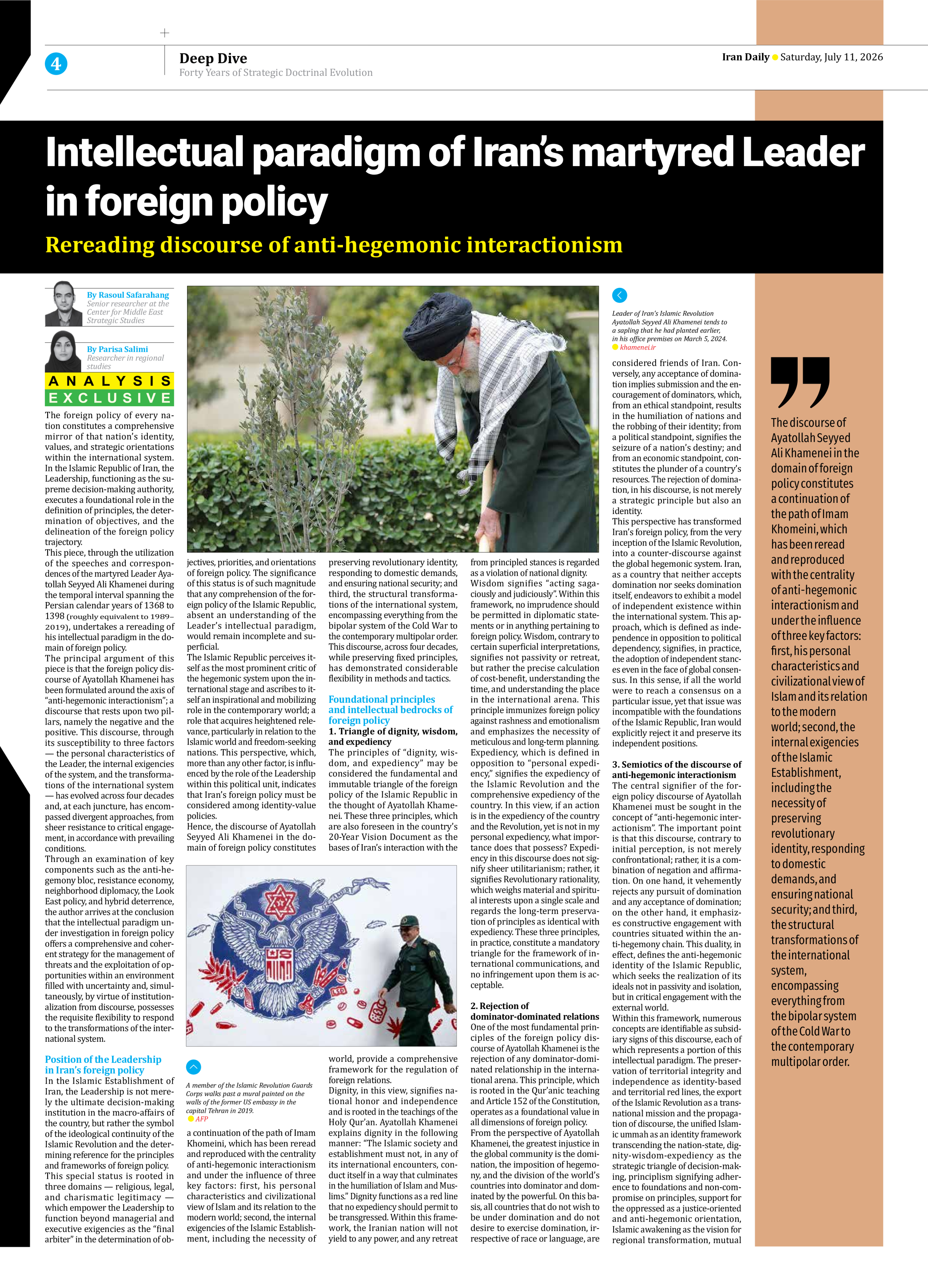
The prominent other of this discourse is the West, with America and Israel at its core. Ayatollah Khamenei, in this regard, explicitly introduced the network of global Zionism and the current government of the United States of America as the embodiment of enmity and domination. This othering is not a tactical and temporary matter, but rather an identity-based principle rooted in his perception of the nature of Western civilization.
He explains the cause of the deep and irreconcilable enmity of arrogance toward the Islamic Republic through two components of negation and affirmation: on one hand, the negation of exploitation, the negation of domination-acceptance, the negation of the humiliation of the nation by the world’s political powers, the negation of political dependency, the negation of the influence and interference in the country by the world’s dominant powers, and the negation of ethical secularism and libertinism; and on the other hand, the affirmation of national identity, Iranian identity, the affirmation of Islamic values, the defense of the world’s oppressed, and the endeavor to attain the zeniths of knowledge.
From his perspective, America is absolute evil, and relations with it constitute a master-servant relationship. The Middle East holds a special position in this context; for America, through discrimination, both supports dependent regimes and, under the pretext of democracy and human rights, attacks independent countries. This perspective regards any negotiation with America not as a strategic choice, but as naivete and submission to arrogance.
Nevertheless, the noteworthy point is that othering in his discourse is not uniform and unilayered. Based on a rereading of his statements, three levels of othering can be identified within this discourse. First, the identity-civilizational other, of which the West-America is an instance, and which is fundamentally considered non-interactable. America and Israel, as symbols of global arrogance and domination, stand in fundamental opposition to the identity and values of the Islamic Republic, and any engagement with them signifies compromise on principles. This level constitutes the red line of foreign policy.
Second, the strategic-competitive other, of which some regional countries are instances and which are interactable and even transformable. For example, the relationship with Saudi Arabia demonstrated the flexibility of the discourse in confronting changing conditions.
Third, the situational-temporary other, of which some European countries are instances. At this level, othering is defined on the basis of behavior, not identity. For example, European countries during the JCPOA period were considered interactable others, but with the US withdrawal and Europe’s hesitation in fulfilling its commitments, they transformed into untrustworthy others. This level indicates his situational view of international relations.
This typology demonstrates that his discourse, despite its emphasis on principles, possesses considerable flexibility in confronting international realities, and othering therein is not absolute, but rather highly dependent on the type of behavior and strategic calculations. In contrast to the dominator countries, his discourse emphasizes coalition and convergence with freedom-seeking and independent countries.
This coalition-building is pursued at three levels. First, convergence with the Islamic world, wherein the unified Islamic ummah is presented as an identity framework for coalition-building. Second, convergence with the Axis of Resistance, which at the regional level, includes Lebanon, Syria, Yemen, Iraq, and Palestine as a chain that is on the same level as the hegemonic system. Third, convergence with the emerging powers of the East. With the shift in the balance of power in the international system and the increasing role of China, Russia, India, and the BRICS countries in recent years, the approach of Look East has been highlighted as a new strategy in his discourse. This approach has, in practice, resulted in the conclusion of a 25-Year Strategic Partnership with China, membership in the Shanghai Cooperation Organization, and accession to the BRICS group.
6. Resistance economy and
economic self-sufficiency
One of the most important and coherent components of the foreign policy discourse of Ayatollah Seyyed Ali Khamenei is the concept of resistance economy. This concept, which was formulated in response to Western economic pressures and international sanctions, constitutes, in effect, a macro-economic-political strategy for de-dependency and self-sufficiency in opposition to the hegemonic system. Resistance economy, in his discourse, is not merely an economic program; rather, it is part of the anti-hegemonic identity of the Islamic Republic.
From this perspective, resistance economy possesses three fundamental dimensions. The first dimension is the reduction of dependency on the West. Within this framework, self-sufficiency and domestic production are presented as the primary strategy for reducing vulnerability to sanctions. The second dimension is the diversification of economic partners. In this dimension, emphasis is placed on economic multilateralism and the diversification of export and import markets. This approach has, in practice, led to the strengthening of relations with China, Russia, India, and Central Asian countries, as well as membership in regional organizations such as ECO, SCO, and BRICS. He emphasized the priority of East Asia and the look to the South as alternatives to the West. The third dimension is the knowledge-based economy and scientism. Resistance economy, in his view, signifies not only self-sufficiency, but also the production of indigenous knowledge and technology. In this perspective, the hegemonic system in the world is founded upon taking maximally and giving minimally, and the most significant factor in this process is knowledge. From this standpoint, the nuclear program, defense industries, information technology, nanotechnology, and biotechnology are all defined within the framework of resistance economy and power-building through knowledge. These three dimensions, collectively, form a coherent strategy in which the economy is defined as the groundwork for political independence and an instrument for confronting domination, and self-sufficiency is presented as a condition for dignity in the international system.
7. Palestine question and Axis of Resistance
The Palestine question holds a central position in the discourse of Ayatollah Khamenei. This issue is presented not as an Arab or regional matter, but as a fundamental and principled issue for all Muslims and the Islamic ummah. In this discourse, Palestine is depicted as the epicenter of confrontation with the hegemonic system and the symbol of the oppressed status of the Islamic world in the face of global arrogance, and its issue can be pursued through three paths: first, the rejection of Western solutions; second, the presentation of a democratic and just solution in opposition to Western solutions; and third, the Axis of Resistance as the primary strategy.
In opposition to the New Middle East project proposed by certain Western powers, particularly the United States, his discourse emphasizes the Axis of Resistance and the unified Islamic ummah. From his perspective, the West’s New Middle East project means the formation of a region centered on Israel and its economic and political dominance over Arab countries and the oil regions of the Persian Gulf; in contrast, the Axis of Resistance seeks an Islamic-Resistant Middle East centered on the defense of Palestine and the rejection of Zionist domination. This confrontation is, in effect, the opposition of two discourses at the regional level: the discourse of domination and dependency versus the discourse of resistance and independence. Palestine, in this context, is the symbol and epicenter of this discursive battle, and any retreat in support of Palestine is regarded as an exit from the Axis of Resistance and an entry into the axis of domination.
8. Nuclear diplomacy; symbol
of confrontation or tool of
engagement?
Iran’s nuclear file is one of the most complex and controversial subjects of foreign policy in the discourse of Ayatollah Khamenei. This issue, apart from its technical and legal dimensions, is regarded in his thought as a symbol of civilizational confrontation with the West and an instrument of power-building for the Islamic Republic.
From his perspective, the nuclear program encompasses the central subject of the Islamic Revolution: the struggle for independence, protest against the inequality of foreign powers, the necessity of self-sufficiency, and the high credibility of Islam for possessing knowledge.
Nevertheless, the nuclear file in his discourse is not merely a symbol of confrontation; rather, it is also an instrument of engagement, an opportunity for power-building, and a factor in increasing bargaining power. His consent to the JCPOA and his emphasis on nuclear diplomacy indicate that this issue can also serve as critical engagement with the West.
From this perspective, the nuclear program in his discourse possesses three fundamental functions: the identity function, which entails the demonstration of independence and national dignity through the acquisition of advanced technology; the strategic function, which includes the creation of deterrence against external threats and the augmentation of bargaining power in negotiations; and the interactive function, which enables the creation of a foundation for dialogue and the reduction of pressures, as occurred in the JCPOA. These three functions demonstrate that the nuclear file in his discourse is not a zero-sum issue, but rather a fluid and multidimensional issue that assumes different roles according to circumstances.
9. Neighborhood diplomacy and regionalism
One of the most significant transformations in foreign policy within the discourse of Ayatollah Khamenei in recent years is the prominence of neighborhood diplomacy and regionalism as a key strategy. This approach, which culminated in the Raisi administration with the restoration of Iran-Saudi relations mediated by China, is rooted in his view of the priority of neighbors and the management of the peripheral environment.
Ayatollah Khamenei holds the belief that the priority of foreign policy is neighboring and regional countries, and the strengthening of relations with neighbors is presented as a strategic necessity. This perspective stems not from weakness or passivity, but from a precise understanding of political geography and the intelligent management of threats and opportunities. Within this framework, regionalism is defined as a strategy for reducing security costs, increasing economic cooperation, and creating a regional order centered on Iran. He believes that regional countries must, relying on their own capacities, provide regional security, and the presence of foreigners not only does not contribute to security, but is itself a source of insecurity.
This approach has, in practice, led to policies such as the strengthening of North-South and East-West transit corridors; membership in regional organizations such as ECO, SCO, and the Eurasian Economic Union; the conclusion of trade agreements with neighbors; and the restoration and expansion of relations with Arab countries of the region. The restoration of Iran-Saudi relations in 2023, mediated by China, is one of the most important achievements of neighborhood diplomacy in recent years. This event is analyzable within the framework of interactionism and conflict management.
Within the framework of neighborhood diplomacy, connections and transit corridors hold a special position. Iran, due to its strategic location at the crossroads of North-South and East-West, can play the role of a bridge connecting Central Asia, the Caucasus, the Persian Gulf, the Sea of Oman, and the Indian Ocean. This role is presented in his discourse as an opportunity for power-building and an instrument for de-dependency. The North-South Corridor for connecting India, Iran, the Caucasus, and Russia, and the revival of the Silk Road with China’s cooperation in the Belt and Road Initiative, are two prominent examples of this strategy.
10. Power continuum; from
deterrence to public diplomacy
In the discourse of Ayatollah Seyyed Ali Khamenei, the concept of power is defined as a continuum that encompasses both soft power and hard power. This comprehensive view of power is rooted in his understanding of national power as a combination of material and spiritual capabilities that are employed in the service of national dignity and independence. In the dimension of hard power, deterrence and comprehensive defense are among the principal pillars of this discourse.
Deterrence signifies the creation of a capability that dissuades the enemy from any aggression against Iran, and comprehensive defense signifies the preparation and employment of all human capital and material and spiritual resources for the prevention and confrontation of any threat and aggression by enemies. Ayatollah Khamenei holds the belief that the power and effectiveness of diplomacy are not inferior to military power, PR, and economic capability, and in many cases are even greater; however, defense and military power simultaneously play a vital role as the support of diplomacy and a deterrence factor.
Within this framework, the extraterritorial deterrence strategy, which encompasses four layers from Iran’s borders to Lebanon, Syria, Iraq, and Yemen, has been designed as a coherent strategy. This strategy, relying on missile, drone, and proxy forces of the Axis of Resistance, provides the groundwork for in-depth defense and the management of threats beyond the borders.
In the dimension of soft power, public diplomacy and discursive power hold a key position. Public diplomacy means communication with nations rather than governments and the explanation of the values and ideals of the Islamic Revolution to global public opinion. Within this framework, he emphasizes support for freedom-seeking movements across the world, exposure of the dominators, and the propagation of the justice-seeking discourse.
Overall, the power continuum in his discourse demonstrates that power is manifested not only in armaments and economics, but also in discourse, values, and cultural soft power. This perspective transforms Iran’s foreign policy from a mere confrontational policy into a discursive-authoritative policy in which soft power and hard power exist in interaction with one another.
11. Look East Policy and
engagement with China and
Russia
One of the most significant transformations in the foreign policy discourse of Ayatollah Khamenei in recent years is the emergence of the Look East strategy and engagement with emerging powers, particularly China and Russia. This approach, which was formulated in response to Western pressures and the shift in the balance of power in the international system, has, in practice, led to the conclusion of strategic agreements and membership in new international institutions.
The People’s Republic of China, as the second-largest economic power in the world and a permanent member of the Security Council, plays a dual role in his discourse. On one hand, China is an economic partner for exiting sanctions and diversifying energy sources; on the other hand, it is considered a strategic ally against American hegemony. The 25-Year Strategic Partnership document between Iran and China, signed in 2021, is a watershed moment in these relations. This document, which emphasizes economic, political, and security cooperation, indicates Iran’s long-term view toward the East.
Nevertheless, relations with China in his discourse do not signify dependency on the East, but rather intelligent balancing. Iran, by adopting the Look East strategy, seeks to create diversification in foreign relations and prevent complete isolation in the face of the West. China, for Iran, in addition to being a consumer market, is a source of technology, investment, and consumer goods, and this relationship is defined on the basis of mutual benefit.
Russia, as a major power and permanent member of the Security Council, also holds a special position in his discourse. Iran-Russia cooperation in defense-military domains, including the purchase of S-300 and S-400 missile systems; energy domain, including cooperation in OPEC and OPEC+; and political coordination regarding the crises in Syria, Afghanistan, and the Caucasus, indicate the depth of these relations. Ayatollah Khamenei holds the belief that Russia can play an important role in establishing a multipolar order, and Iran-Russia cooperation can contribute to countering American hegemony in the region and the world.
Iran’s membership in the Shanghai Cooperation Organization and accession to the BRICS group are two important events in Iran’s foreign policy that are analyzable within the framework of Look East and multilateralism. These memberships, in addition to reducing dependency on the West, can lead to increased bargaining power, diversification of economic partners, and the strengthening of Iran’s regional position. The discourse of Ayatollah Khamenei regards these memberships not merely as an economic action, but as a movement toward the multipolar order and a confrontation with unilateralism.
12. Will the discourse of
Ayatollah Khamenei persist?
In sum, the foreign policy discourse of Ayatollah Khamenei may be considered a discourse in evolution that, while adhering to principles, possesses considerable flexibility. This discourse, although confronted with serious challenges, on the whole provides a coherent strategic framework for the management of threats and the exploitation of opportunities in an environment filled with uncertainty. The future of this discourse depends, to a significant extent, on its capacity to maintain a balance between principles and expediencies, to manage relations with the West intelligently, to exploit maximally the capacities of the East, and to strengthen economic and regional diplomacy. In this context, the new generation of Iran’s foreign policy agents will play a decisive role in the evolution and innovation of this discourse, and it appears that, given the institutionalization efforts undertaken during the period of Ayatollah Khamenei, the continuation of his discourse is more reinforced than at any other time.
In final analysis, the foreign policy of Ayatollah Khamenei is founded upon the rejection of domination and the rejection of submission to domination. In this understanding, the world has always consisted of two parts: first, a minority that has sought to exercise hegemony and plunder nations; and second, a majority that has lived under their domination. The history of the world has been the history of conflict and engagement between these two sides. In the thought of Ayatollah Khamenei, the Islamic Republic is one of the few countries in history that has confronted and criticized this process.
The discourse of anti-hegemonic interactionism possesses two interconnected domains: first, the negative approach of combat with the dominant hegemonic system on the international stage; and second, the positive approach of solidarity with freedom-seeking countries, particularly Islamic countries, to construct a front against the imperialist desires of the hegemonic system. This discourse, which has evolved over four decades and, at each juncture, has encompassed different approaches in accordance with conditions, has experienced a dynamic transformation from sheer resistance in the 1980s to critical engagement in the 2010s and finally, to the Look East and neighborhood diplomacy in the recent decade.
The achievements of this discourse include: the strengthening of the independent and anti-hegemonic identity of the Islamic Republic, the creation of a broad social base among the nations of the Third World and liberation movements, the consolidation of Iran’s regional role as the dominant power in West Asia, the acquisition of advanced defense and nuclear technologies, and the reduction of strategic dependency on the West through the Look East. Nevertheless, challenges, such as the high costs of confrontation with the hegemonic system, the economic limitations resulting from sanctions, and the difficulty of simultaneous engagement with the West and the East, continue to confront this discourse.
For the future, the foreign policy discourse of the martyred Leader is evolving with three new approaches: first, resistance economy and self-sufficiency as a de-dependency strategy, which has crystallized in the Second Step Declaration of the Revolution; second, neighborhood diplomacy and regionalism, which has experienced a significant leap with the restoration of relations with Saudi Arabia and the Persian Gulf littoral states; and third, joining the new global order and synergy with emerging powers, particularly within the framework of the Shanghai Cooperation Organization and BRICS, which has provided a framework for multilateralism and evasion of American hegemony.
The legacy left by Ayatollah Seyyed Ali Khamenei is the “institutionalization” and “systematization” of a discourse whose substructure is an ideology based on dignity, wisdom, expediency, the rejection of domination, constructive engagement, and active participation in the international system, while preserving Revolutionary identity and principles. Hence, the replacement of the technocrats executing this discourse will not effect any change in the strategic trajectory of Iran’s foreign policy.