





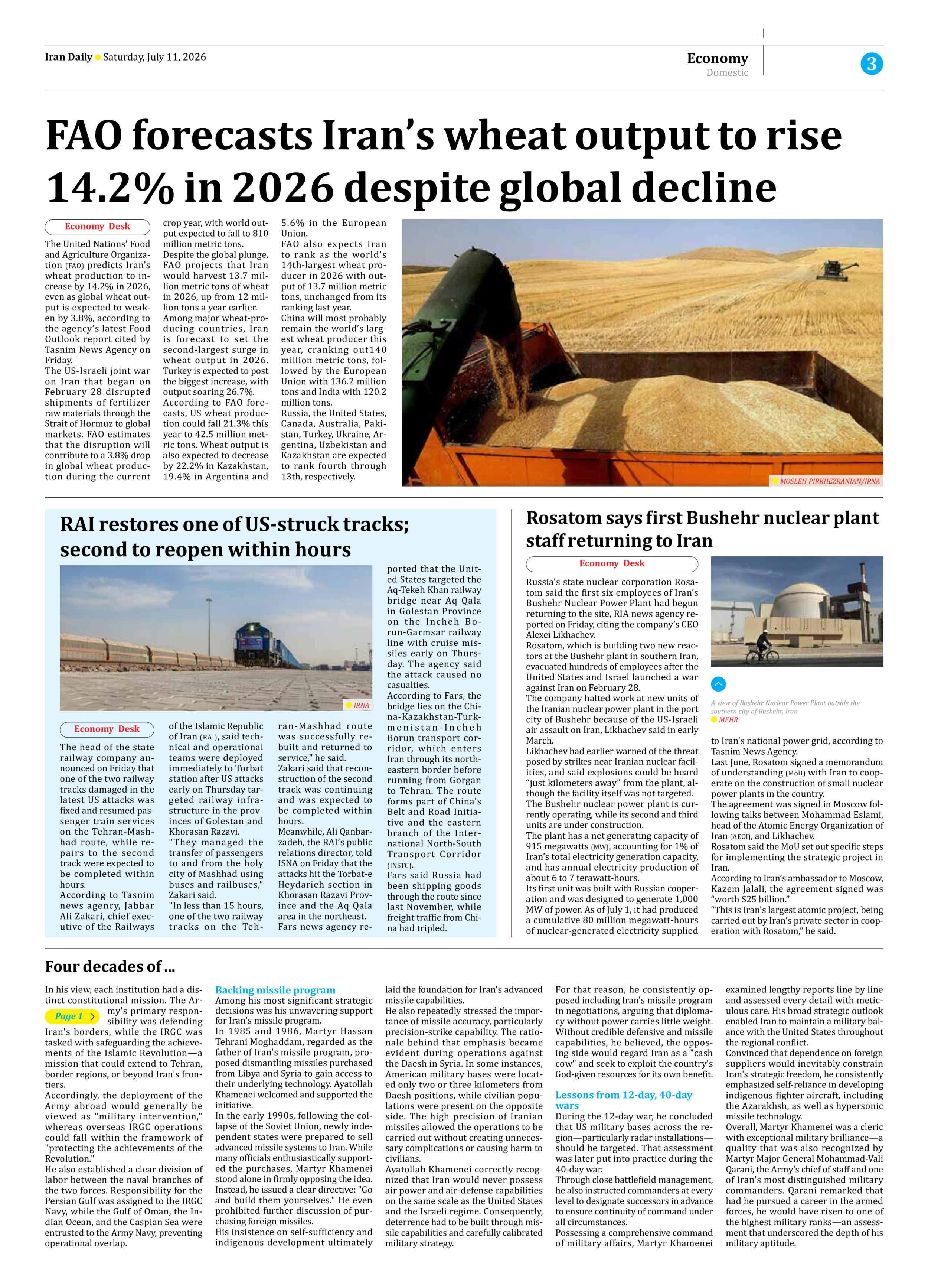


FAO forecasts Iran’s wheat output to rise 14.2% in 2026 despite global decline
The United Nations’ Food and Agriculture Organization (FAO) predicts Iran’s wheat production to increase by 14.2% in 2026, even as global wheat output is expected to weaken by 3.8%, according to the agency’s latest Food Outlook report cited by Tasnim News Agency on Friday.
The US-Israeli joint war on Iran that began on February 28 disrupted shipments of fertilizer raw materials through the Strait of Hormuz to global markets. FAO estimates that the disruption will contribute to a 3.8% drop in global wheat production during the current crop year, with world output expected to fall to 810 million metric tons.
Despite the global plunge, FAO projects that Iran would harvest 13.7 million metric tons of wheat in 2026, up from 12 million tons a year earlier.
Among major wheat-producing countries, Iran is forecast to set the second-largest surge in wheat output in 2026. Turkey is expected to post the biggest increase, with output soaring 26.7%.
According to FAO forecasts, US wheat production could fall 21.3% this year to 42.5 million metric tons. Wheat output is also expected to decrease by 22.2% in Kazakhstan, 19.4% in Argentina and 5.6% in the European Union.
FAO also expects Iran to rank as the world’s 14th-largest wheat producer in 2026 with output of 13.7 million metric tons, unchanged from its ranking last year.
China will most probably remain the world’s largest wheat producer this year, cranking out140 million metric tons, followed by the European Union with 136.2 million tons and India with 120.2 million tons.
Russia, the United States, Canada, Australia, Pakistan, Turkey, Ukraine, Argentina, Uzbekistan and Kazakhstan are expected to rank fourth through 13th, respectively.