







Copy in clipboard...
Top security official warns anti-Iran attacks will trigger retaliation
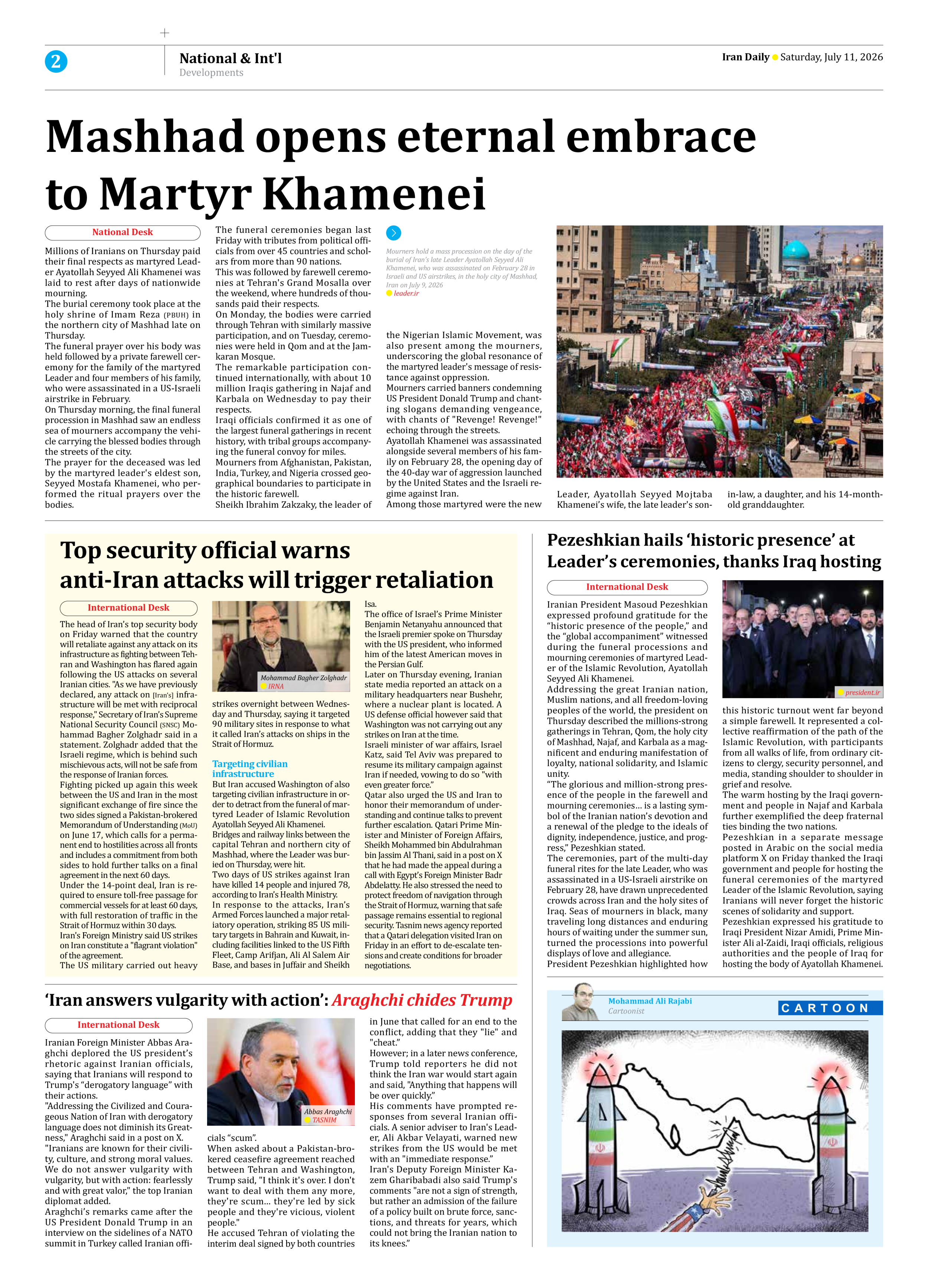
The head of Iran’s top security body on Friday warned that the country will retaliate against any attack on its infrastructure as fighting between Tehran and Washington has flared again following the US attacks on several Iranian cities. "As we have previously declared, any attack on [Iran’s] infrastructure will be met with reciprocal response," Secretary of Iran’s Supreme National Security Council (SNSC) Mohammad Bagher Zolghadr said in a statement. Zolghadr added that the Israeli regime, which is behind such mischievous acts, will not be safe from the response of Iranian forces.
Fighting picked up again this week between the US and Iran in the most significant exchange of fire since the two sides signed a Pakistan-brokered Memorandum of Understanding (MoU) on June 17, which calls for a permanent end to hostilities across all fronts and includes a commitment from both sides to hold further talks on a final agreement in the next 60 days.
Under the 14-point deal, Iran is required to ensure toll-free passage for commercial vessels for at least 60 days, with full restoration of traffic in the Strait of Hormuz within 30 days.
Iran's Foreign Ministry said US strikes on Iran constitute a "flagrant violation" of the agreement.
The US military carried out heavy strikes overnight between Wednesday and Thursday, saying it targeted 90 military sites in response to what it called Iran’s attacks on ships in the Strait of Hormuz.
Targeting civilian infrastructure
But Iran accused Washington of also targeting civilian infrastructure in order to detract from the funeral of martyred Leader of Islamic Revolution Ayatollah Seyyed Ali Khamenei.
Bridges and railway links between the capital Tehran and northern city of Mashhad, where the Leader was buried on Thursday, were hit.
Two days of US strikes against Iran have killed 14 people and injured 78, according to Iran’s Health Ministry.
In response to the attacks, Iran’s Armed Forces launched a major retaliatory operation, striking 85 US military targets in Bahrain and Kuwait, including facilities linked to the US Fifth Fleet, Camp Arifjan, Ali Al Salem Air Base, and bases in Juffair and Sheikh Isa.
The office of Israel’s Prime Minister Benjamin Netanyahu announced that the Israeli premier spoke on Thursday with the US president, who informed him of the latest American moves in the Persian Gulf.
Later on Thursday evening, Iranian state media reported an attack on a military headquarters near Bushehr, where a nuclear plant is located. A US defense official however said that Washington was not carrying out any strikes on Iran at the time.
Israeli minister of war affairs, Israel Katz, said Tel Aviv was prepared to resume its military campaign against Iran if needed, vowing to do so "with even greater force.”
Qatar also urged the US and Iran to honor their memorandum of understanding and continue talks to prevent further escalation. Qatari Prime Minister and Minister of Foreign Affairs, Sheikh Mohammed bin Abdulrahman bin Jassim Al Thani, said in a post on X that he had made the appeal during a call with Egypt’s Foreign Minister Badr Abdelatty. He also stressed the need to protect freedom of navigation through the Strait of Hormuz, warning that safe passage remains essential to regional security. Tasnim news agency reported that a Qatari delegation visited Iran on Friday in an effort to de-escalate tensions and create conditions for broader negotiations.