







Qaleh Bala village makes third bid for UNWTO list
The historic village of Qaleh Bala, located 21 kilometers from the town of Beyarjomand in eastern Shahroud, Semnan Province, is recognized as one of Iran’s most significant natural and cultural tourism destinations thanks to its terraced architecture, valuable historical fabric, and proximity to the protected Turan region.
The village has been nominated twice before for world heritage listing but was rejected each time due to weak documentation and deficiencies in its dossier. Now, for the third and final time, the village has been nominated for inclusion in the “Best Tourism Villages” list of the World Tourism Organization (UNWTO), with all deficiencies addressed, targeted planning in place, and support from various sectors, according to IRNA.
The head of Cultural Heritage, Tourism, and Handicrafts Department of Shahroud stated that registering Qaleh Bala on the UNWTO’s global list plays an important role in boosting tourism and the economy of Semnan Province, and that every effort is being made to achieve this goal.
Seyyed Sadegh Razavian added that the global registration of Qaleh Bala is a cross-sectoral matter requiring collective support. Accordingly, he expressed hope that various executive bodies would cooperate more than ever by fulfilling their duties.
He explained that the village is moving toward global registration by holding 20 events in various social, cultural, educational, and community spirit fields, documenting the customs and traditions of the residents, and focusing on visual beautification grounded in historical identity, natural assets, and environmental features. According to reports, the evaluation of dossiers for villages nominated for global registration and the announcement of results will take until early autumn 2026.
Razavian added that the village’s historical fabric and terraced structure, women’s participation in rural activities such as handicrafts, the village’s geographical position as the gateway to the Turan Biosphere Reserve — the only breeding ground of the Asiatic cheetah in the world — collective participation in wildlife protection, and the tradition of offering fodder as a religious vow for feeding wildlife are among the reasons for Qaleh Bala’s nomination.
An artistic and meaningful monument has been installed as a comprehensive symbol of the identity, nature, and distinctive architecture of Qaleh Bala. The aim is to highlight the unique capacities of this tourist village as it pursues global registration.
Razavian explained that the metal structure of the monument is an intelligent combination of key elements, including the Podoces pleskei known as Zagh-e Boor, an endemic species to the region, and the Asiatic cheetah, as symbols of the area’s rich biodiversity.
He reminded that the Asiatic cheetah is an endangered species and a symbol of valuable wildlife in the Khar Turan Biosphere Reserve and Qaleh Bala. The design and installation of the village monument, drawing on this asset, not only significantly increases visual appeal and creates a landmark for tourists but also sends a clear message to the world about the determination of residents and officials to protect and introduce the natural and cultural heritage of this region.
Razavian stated that the installation of the monument is very important for public awareness and preparing the necessary infrastructure for the global registration process of the village.
Referring to the installation of wooden signage for facades in the tourist village, he added that wooden directional signs were designed and installed to improve tourist guidance and strengthen the village’s visual identity.
He added that these signs were installed along the routes to eco-lodges, natural attractions, and scenic spots in the village, and will aid the global registration process by enhancing the quality of the landscape, infrastructure, and visitor experience.
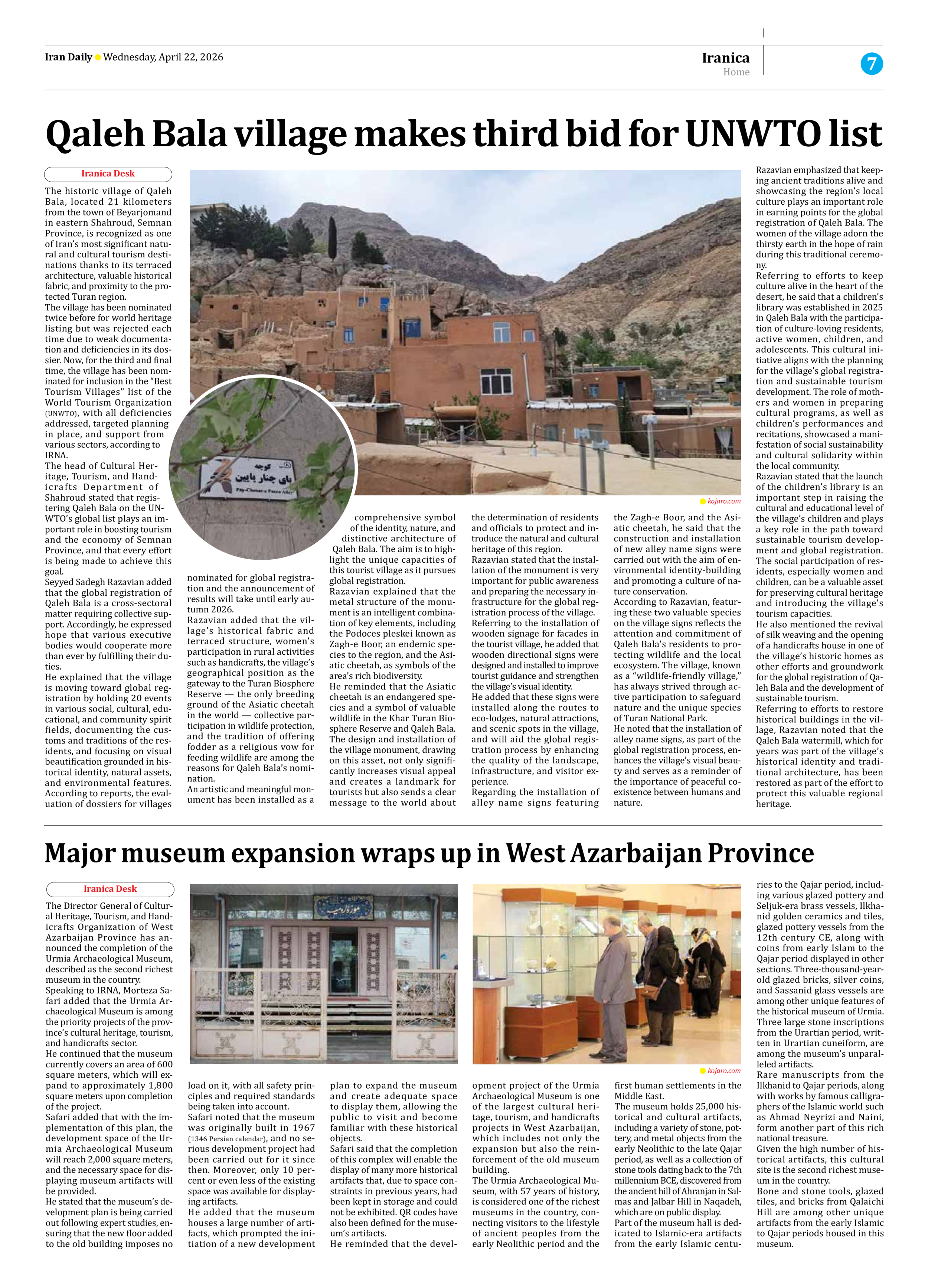
Regarding the installation of alley name signs featuring the Zagh-e Boor, and the Asiatic cheetah, he said that the construction and installation of new alley name signs were carried out with the aim of environmental identity-building and promoting a culture of nature conservation.
According to Razavian, featuring these two valuable species on the village signs reflects the attention and commitment of Qaleh Bala’s residents to protecting wildlife and the local ecosystem. The village, known as a “wildlife-friendly village,” has always strived through active participation to safeguard nature and the unique species of Turan National Park.
He noted that the installation of alley name signs, as part of the global registration process, enhances the village’s visual beauty and serves as a reminder of the importance of peaceful coexistence between humans and nature.
Razavian emphasized that keeping ancient traditions alive and showcasing the region’s local culture plays an important role in earning points for the global registration of Qaleh Bala. The women of the village adorn the thirsty earth in the hope of rain during this traditional ceremony.
Referring to efforts to keep culture alive in the heart of the desert, he said that a children’s library was established in 2025 in Qaleh Bala with the participation of culture-loving residents, active women, children, and adolescents. This cultural initiative aligns with the planning for the village’s global registration and sustainable tourism development. The role of mothers and women in preparing cultural programs, as well as children’s performances and recitations, showcased a manifestation of social sustainability and cultural solidarity within the local community.
Razavian stated that the launch of the children’s library is an important step in raising the cultural and educational level of the village’s children and plays a key role in the path toward sustainable tourism development and global registration. The social participation of residents, especially women and children, can be a valuable asset for preserving cultural heritage and introducing the village’s tourism capacities.
He also mentioned the revival of silk weaving and the opening of a handicrafts house in one of the village’s historic homes as other efforts and groundwork for the global registration of Qaleh Bala and the development of sustainable tourism.
Referring to efforts to restore historical buildings in the village, Razavian noted that the Qaleh Bala watermill, which for years was part of the village’s historical identity and traditional architecture, has been restored as part of the effort to protect this valuable regional heritage.