







Richard Falk: Trump diplomacy mockery of int’l law, morality
By Asgar Ghahremanpour
Editor-in-chief
Richard Anderson Falk, a prominent American jurist and one of the most influential figures in contemporary international law, was born on November 13, 1930, in New York. He taught at Princeton University for more than three decades before retiring as a professor of International Law. Falk began his academic studies in economics at the Wharton School, later earning his law degree from Yale University and a doctorate in law from Harvard University — an academic trajectory that consolidated his standing as a major theorist of world order.
His early intellectual formation was influenced by thinkers such as Karl Marx, Herbert Marcuse, and C. Wright Mills; an influence reflected in his critical approach to power, capitalism, militarism, and structures of global domination. Falk has consistently sought to bridge scholarly inquiry and moral commitment, employing international law as an instrument to restrain war and injustice. He is the author and editor of dozens of books on international law and the United Nations.
In 2008, the United Nations Human Rights Council appointed him Special Rapporteur on the situation of human rights in the occupied Palestinian territories. Falk has been a steadfast critic of military interventionism and an advocate for strengthening global accountability, international justice, and a transition toward a more humane world order. Richard Falk is currently 96 years old and, over the past decades, has devoted considerable effort to the prevention of war.
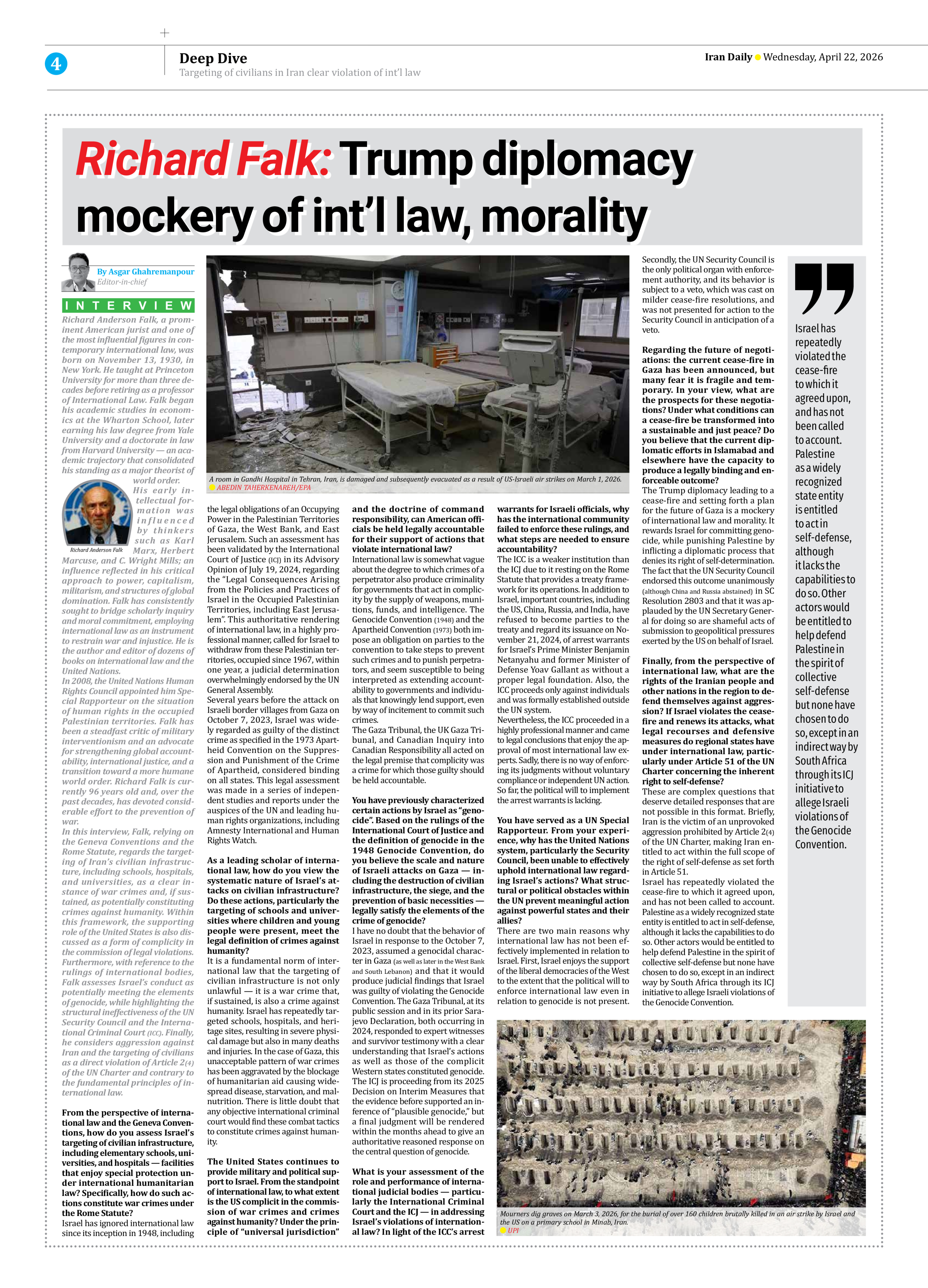
In this interview, Falk, relying on the Geneva Conventions and the Rome Statute, regards the targeting of Iran’s civilian infrastructure, including schools, hospitals, and universities, as a clear instance of war crimes and, if sustained, as potentially constituting crimes against humanity. Within this framework, the supporting role of the United States is also discussed as a form of complicity in the commission of legal violations. Furthermore, with reference to the rulings of international bodies, Falk assesses Israel’s conduct as potentially meeting the elements of genocide, while highlighting the structural ineffectiveness of the UN Security Council and the International Criminal Court (ICC). Finally, he considers aggression against Iran and the targeting of civilians as a direct violation of Article 2(4) of the UN Charter and contrary to the fundamental principles of international law.
From the perspective of international law and the Geneva Conventions, how do you assess Israel’s targeting of civilian infrastructure, including elementary schools, universities, and hospitals — facilities that enjoy special protection under international humanitarian law? Specifically, how do such actions constitute war crimes under the Rome Statute?
Israel has ignored international law since its inception in 1948, including the legal obligations of an Occupying Power in the Palestinian Territories of Gaza, the West Bank, and East Jerusalem. Such an assessment has been validated by the International Court of Justice (ICJ) in its Advisory Opinion of July 19, 2024, regarding the “Legal Consequences Arising from the Policies and Practices of Israel in the Occupied Palestinian Territories, including East Jerusalem”. This authoritative rendering of international law, in a highly professional manner, called for Israel to withdraw from these Palestinian territories, occupied since 1967, within one year, a judicial determination overwhelmingly endorsed by the UN General Assembly.
Several years before the attack on Israeli border villages from Gaza on October 7, 2023, Israel was widely regarded as guilty of the distinct crime as specified in the 1973 Apartheid Convention on the Suppression and Punishment of the Crime of Apartheid, considered binding on all states. This legal assessment was made in a series of independent studies and reports under the auspices of the UN and leading human rights organizations, including Amnesty International and Human Rights Watch.
As a leading scholar of international law, how do you view the systematic nature of Israel’s attacks on civilian infrastructure? Do these actions, particularly the targeting of schools and universities where children and young people were present, meet the legal definition of crimes against humanity?
It is a fundamental norm of international law that the targeting of civilian infrastructure is not only unlawful — it is a war crime that, if sustained, is also a crime against humanity. Israel has repeatedly targeted schools, hospitals, and heritage sites, resulting in severe physical damage but also in many deaths and injuries. In the case of Gaza, this unacceptable pattern of war crimes has been aggravated by the blockage of humanitarian aid causing widespread disease, starvation, and malnutrition. There is little doubt that any objective international criminal court would find these combat tactics to constitute crimes against humanity.
The United States continues to provide military and political support to Israel. From the standpoint of international law, to what extent is the US complicit in the commission of war crimes and crimes against humanity? Under the principle of “universal jurisdiction” and the doctrine of command responsibility, can American officials be held legally accountable for their support of actions that violate international law?
International law is somewhat vague about the degree to which crimes of a perpetrator also produce criminality for governments that act in complicity by the supply of weapons, munitions, funds, and intelligence. The Genocide Convention (1948) and the Apartheid Convention (1973) both impose an obligation on parties to the convention to take steps to prevent such crimes and to punish perpetrators, and seem susceptible to being interpreted as extending accountability to governments and individuals that knowingly lend support, even by way of incitement to commit such crimes.
The Gaza Tribunal, the UK Gaza Tribunal, and Canadian Inquiry into Canadian Responsibility all acted on the legal premise that complicity was a crime for which those guilty should be held accountable.
You have previously characterized certain actions by Israel as “genocide”. Based on the rulings of the International Court of Justice and the definition of genocide in the 1948 Genocide Convention, do you believe the scale and nature of Israeli attacks on Gaza — including the destruction of civilian infrastructure, the siege, and the prevention of basic necessities — legally satisfy the elements of the crime of genocide?
I have no doubt that the behavior of Israel in response to the October 7, 2023, assumed a genocidal character in Gaza (as well as later in the West Bank and South Lebanon) and that it would produce judicial findings that Israel was guilty of violating the Genocide Convention. The Gaza Tribunal, at its public session and in its prior Sarajevo Declaration, both occurring in 2024, responded to expert witnesses and survivor testimony with a clear understanding that Israel’s actions as well as those of the complicit Western states constituted genocide. The ICJ is proceeding from its 2025 Decision on Interim Measures that the evidence before supported an inference of “plausible genocide,” but a final judgment will be rendered within the months ahead to give an authoritative reasoned response on the central question of genocide.
What is your assessment of the role and performance of international judicial bodies — particularly the International Criminal Court and the ICJ — in addressing Israel’s violations of international law? In light of the ICC’s arrest warrants for Israeli officials, why has the international community failed to enforce these rulings, and what steps are needed to ensure accountability?
The ICC is a weaker institution than the ICJ due to it resting on the Rome Statute that provides a treaty framework for its operations. In addition to Israel, important countries, including the US, China, Russia, and India, have refused to become parties to the treaty and regard its issuance on November 21, 2024, of arrest warrants for Israel’s Prime Minister Benjamin Netanyahu and former Minister of Defense Yoav Gallant as without a proper legal foundation. Also, the ICC proceeds only against individuals and was formally established outside the UN system.
Nevertheless, the ICC proceeded in a highly professional manner and came to legal conclusions that enjoy the approval of most international law experts. Sadly, there is no way of enforcing its judgments without voluntary compliance or independent UN action. So far, the political will to implement the arrest warrants is lacking.
You have served as a UN Special Rapporteur. From your experience, why has the United Nations system, particularly the Security Council, been unable to effectively uphold international law regarding Israel’s actions? What structural or political obstacles within the UN prevent meaningful action against powerful states and their allies?
There are two main reasons why international law has not been effectively implemented in relation to Israel. First, Israel enjoys the support of the liberal democracies of the West to the extent that the political will to enforce international law even in relation to genocide is not present. Secondly, the UN Security Council is the only political organ with enforcement authority, and its behavior is subject to a veto, which was cast on milder cease-fire resolutions, and was not presented for action to the Security Council in anticipation of a veto.
Regarding the future of negotiations: the current cease-fire in Gaza has been announced, but many fear it is fragile and temporary. In your view, what are the prospects for these negotiations? Under what conditions can a cease-fire be transformed into a sustainable and just peace? Do you believe that the current diplomatic efforts in Islamabad and elsewhere have the capacity to produce a legally binding and enforceable outcome?
The Trump diplomacy leading to a cease-fire and setting forth a plan for the future of Gaza is a mockery of international law and morality. It rewards Israel for committing genocide, while punishing Palestine by inflicting a diplomatic process that denies its right of self-determination. The fact that the UN Security Council endorsed this outcome unanimously (although China and Russia abstained) in SC Resolution 2803 and that it was applauded by the UN Secretary General for doing so are shameful acts of submission to geopolitical pressures exerted by the US on behalf of Israel.
Finally, from the perspective of international law, what are the rights of the Iranian people and other nations in the region to defend themselves against aggression? If Israel violates the cease-fire and renews its attacks, what legal recourses and defensive measures do regional states have under international law, particularly under Article 51 of the UN Charter concerning the inherent right to self-defense?
These are complex questions that deserve detailed responses that are not possible in this format. Briefly, Iran is the victim of an unprovoked aggression prohibited by Article 2(4) of the UN Charter, making Iran entitled to act within the full scope of the right of self-defense as set forth in Article 51.
Israel has repeatedly violated the cease-fire to which it agreed upon, and has not been called to account. Palestine as a widely recognized state entity is entitled to act in self-defense, although it lacks the capabilities to do so. Other actors would be entitled to help defend Palestine in the spirit of collective self-defense but none have chosen to do so, except in an indirect way by South Africa through its ICJ initiative to allege Israeli violations of the Genocide Convention.