





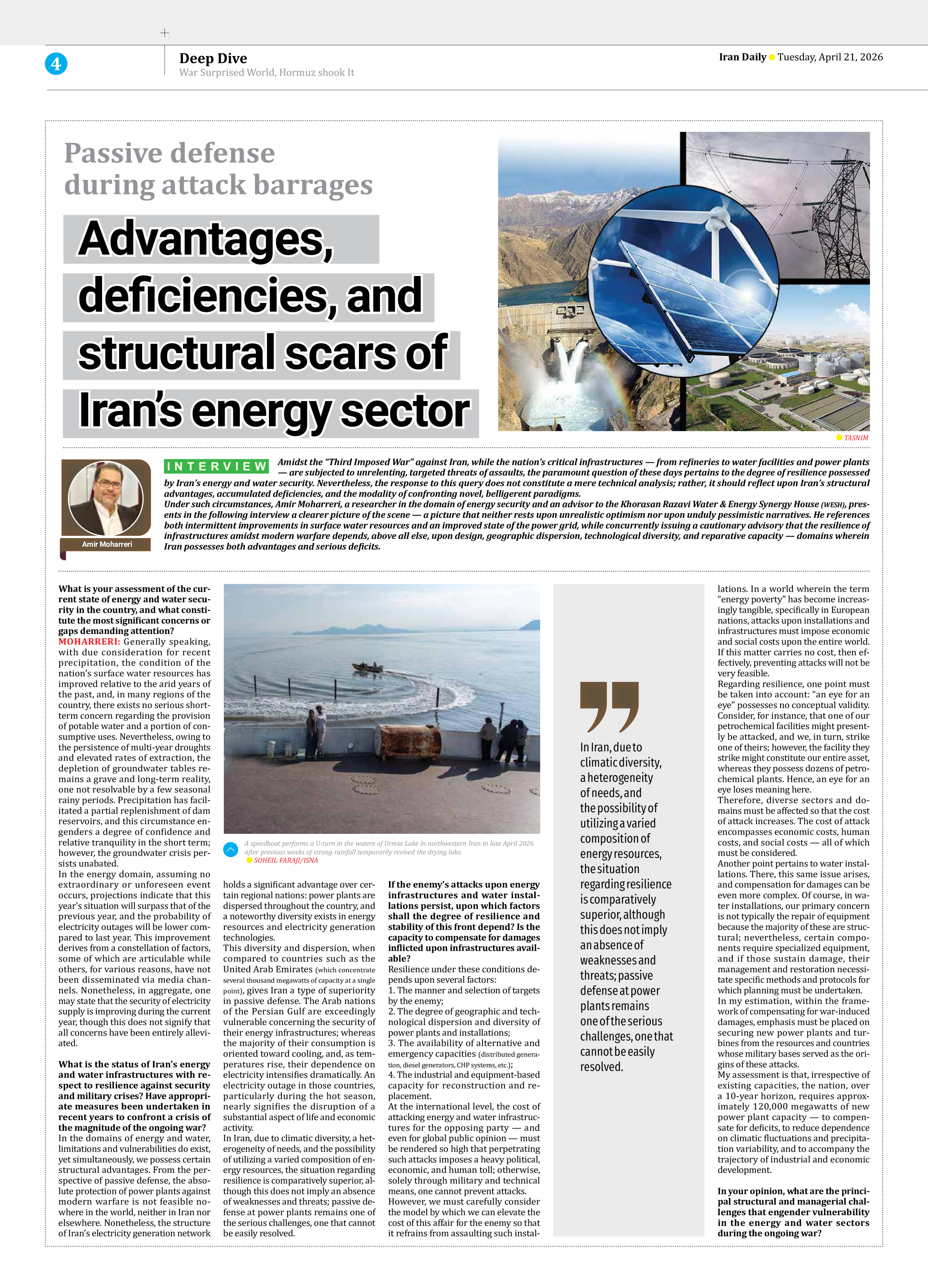


Passive defense during attack barrages
Advantages, deficiencies, and structural scars of Iran’s energy sector
Amidst the “Third Imposed War” against Iran, while the nation’s critical infrastructures — from refineries to water facilities and power plants — are subjected to unrelenting, targeted threats of assaults, the paramount question of these days pertains to the degree of resilience possessed by Iran’s energy and water security. Nevertheless, the response to this query does not constitute a mere technical analysis; rather, it should reflect upon Iran’s structural advantages, accumulated deficiencies, and the modality of confronting novel, belligerent paradigms. Under such circumstances, Amir Moharreri, a researcher in the domain of energy security and an advisor to the Khorasan Razavi Water & Energy Synergy House (WESH), presents in the following interview a clearer picture of the scene — a picture that neither rests upon unrealistic optimism nor upon unduly pessimistic narratives. He references both intermittent improvements in surface water resources and an improved state of the power grid, while concurrently issuing a cautionary advisory that the resilience of infrastructures amidst modern warfare depends, above all else, upon design, geographic dispersion, technological diversity, and reparative capacity — domains wherein Iran possesses both advantages and serious deficits.
What is your assessment of the current state of energy and water security in the country, and what constitute the most significant concerns or gaps demanding attention?
MOHARRERI: Generally speaking, with due consideration for recent precipitation, the condition of the nation’s surface water resources has improved relative to the arid years of the past, and, in many regions of the country, there exists no serious short-term concern regarding the provision of potable water and a portion of consumptive uses. Nevertheless, owing to the persistence of multi-year droughts and elevated rates of extraction, the depletion of groundwater tables remains a grave and long-term reality, one not resolvable by a few seasonal rainy periods. Precipitation has facilitated a partial replenishment of dam reservoirs, and this circumstance engenders a degree of confidence and relative tranquility in the short term; however, the groundwater crisis persists unabated.
In the energy domain, assuming no extraordinary or unforeseen event occurs, projections indicate that this year’s situation will surpass that of the previous year, and the probability of electricity outages will be lower compared to last year. This improvement derives from a constellation of factors, some of which are articulable while others, for various reasons, have not been disseminated via media channels. Nonetheless, in aggregate, one may state that the security of electricity supply is improving during the current year, though this does not signify that all concerns have been entirely alleviated.
What is the status of Iran’s energy and water infrastructures with respect to resilience against security and military crises? Have appropriate measures been undertaken in recent years to confront a crisis of the magnitude of the ongoing war?
In the domains of energy and water, limitations and vulnerabilities do exist, yet simultaneously, we possess certain structural advantages. From the perspective of passive defense, the absolute protection of power plants against modern warfare is not feasible nowhere in the world, neither in Iran nor elsewhere. Nonetheless, the structure of Iran’s electricity generation network holds a significant advantage over certain regional nations: power plants are dispersed throughout the country, and a noteworthy diversity exists in energy resources and electricity generation technologies.
This diversity and dispersion, when compared to countries such as the United Arab Emirates (which concentrate several thousand megawatts of capacity at a single point), gives Iran a type of superiority in passive defense. The Arab nations of the Persian Gulf are exceedingly vulnerable concerning the security of their energy infrastructures; whereas the majority of their consumption is oriented toward cooling, and, as temperatures rise, their dependence on electricity intensifies dramatically. An electricity outage in those countries, particularly during the hot season, nearly signifies the disruption of a substantial aspect of life and economic activity.
In Iran, due to climatic diversity, a heterogeneity of needs, and the possibility of utilizing a varied composition of energy resources, the situation regarding resilience is comparatively superior, although this does not imply an absence of weaknesses and threats; passive defense at power plants remains one of the serious challenges, one that cannot be easily resolved.
If the enemy’s attacks upon energy infrastructures and water installations persist, upon which factors shall the degree of resilience and stability of this front depend? Is the capacity to compensate for damages inflicted upon infrastructures available?
Resilience under these conditions depends upon several factors:
1. The manner and selection of targets by the enemy;
2. The degree of geographic and technological dispersion and diversity of power plants and installations;
3. The availability of alternative and emergency capacities (distributed generation, diesel generators, CHP systems, etc.);
4. The industrial and equipment-based capacity for reconstruction and replacement.
At the international level, the cost of attacking energy and water infrastructures for the opposing party — and even for global public opinion — must be rendered so high that perpetrating such attacks imposes a heavy political, economic, and human toll; otherwise, solely through military and technical means, one cannot prevent attacks.
However, we must carefully consider the model by which we can elevate the cost of this affair for the enemy so that it refrains from assaulting such installations. In a world wherein the term “energy poverty” has become increasingly tangible, specifically in European nations, attacks upon installations and infrastructures must impose economic and social costs upon the entire world. If this matter carries no cost, then effectively, preventing attacks will not be very feasible.
Regarding resilience, one point must be taken into account: “an eye for an eye” possesses no conceptual validity. Consider, for instance, that one of our petrochemical facilities might presently be attacked, and we, in turn, strike one of theirs; however, the facility they strike might constitute our entire asset, whereas they possess dozens of petrochemical plants. Hence, an eye for an eye loses meaning here.
Therefore, diverse sectors and domains must be affected so that the cost of attack increases. The cost of attack encompasses economic costs, human costs, and social costs — all of which must be considered.
Another point pertains to water installations. There, this same issue arises, and compensation for damages can be even more complex. Of course, in water installations, our primary concern is not typically the repair of equipment because the majority of these are structural; nevertheless, certain components require specialized equipment, and if those sustain damage, their management and restoration necessitate specific methods and protocols for which planning must be undertaken.
In my estimation, within the framework of compensating for war-induced damages, emphasis must be placed on securing new power plants and turbines from the resources and countries whose military bases served as the origins of these attacks.
My assessment is that, irrespective of existing capacities, the nation, over a 10-year horizon, requires approximately 120,000 megawatts of new power plant capacity — to compensate for deficits, to reduce dependence on climatic fluctuations and precipitation variability, and to accompany the trajectory of industrial and economic development.
In your opinion, what are the principal structural and managerial challenges that engender vulnerability in the energy and water sectors during the ongoing war?
One challenge is the relative concentration upon large-scale power plants and national grids, which, if damaged, affect a substantial portion of the load. Although Iran possesses better dispersion than some countries, the dependence of the consumption and industrial structure upon the national grid remains high.
Another significant challenge is the reliance of vital infrastructures upon these grids. Although appropriate measures have been undertaken in recent years, and for many sensitive centers, alternative energy supply systems have been designated so that service provision does not cease upon disconnection from the grid, this process must be rendered deeper and more complete.
From a managerial perspective, in many domains, the passive defense approach to the siting, design, and operation of power plants and water installations has not yet been systematically institutionalized. Dependence upon a few limited technologies and weaknesses in the indigenous development of certain sensitive equipment constitute additional challenges.
In the current situation, what role do you ascribe to novel technologies, demand-side management, and renewable energies in enhancing the country’s energy and water security?
In the domain of novel electricity generation technologies, no extraordinary leap has occurred in the country during recent years. This matter represents a double-edged sword: on one hand, technological backwardness may generate risks, but on the other hand, rushed entry into certain technologies without localization and without passive defense considerations can itself constitute a point of vulnerability.
Renewable energies, particularly solar power, are undergoing development in the country and can play an important role in peak management and fluctuation mitigation, especially given that the daily consumption peak and solar irradiation partially overlap. However, one must note that renewable energies are costly and, at times, do not deliver stable load to the grid.
Drawing inspiration from the experiences of the current war, what changes in approach or policymaking are necessary to fortify the energy front and the security of its infrastructures?
The experience of war and sanctions has demonstrated that dependence upon large, centralized power plants must be reduced, and passive defense in energy production and supply must be pursued more seriously. In recent years, appropriate measures have been taken, and for many sensitive points, alternative energy supply systems have been provided so that, in the event of grid disconnection, vital services do not cease.
In my view, policymaking must, more than ever before, concentrate upon the development of distributed generation (DG), Combined Heat and Power (CHP) and Combined Cooling, Heat, and Power (CCHP) systems, diesel generators, and other local and regional energy supply solutions, particularly for sensitive centers and vital infrastructures.
The overarching approach must be a transition from “sole dependence upon the national grid” toward a “hybrid of the national grid plus emergency and sustainable local generation”. This approach elevates the cost of attacking infrastructures for the enemy and augments the nation’s resilience.
Upon which factors does the compensation for damages inflicted upon energy and water infrastructures depend in the short term, medium term, and long term, and what actions must officials undertake in each phase?
In the short term, focus must be placed upon maintaining service continuity and preventing grid collapse. Here, the role of emergency generation, demand-side management, load shifting, and the utilization of reserve capacities is paramount. The employment of diesel generators, DG units, and existing capacities, alongside consumption management, constitutes the principal toolkit.
In the medium term, the reconstruction of damaged equipment, the replacement of lost units with new and more resilient ones, and the diversification of resources and siting configurations must be placed on the agenda. At this stage, the experience of attacks must be leveraged, and design and siting weaknesses must be rectified.
In the long term, the approach must move toward the partial redesign of the energy and water system’s structure. This means that policies must be calibrated such that they simultaneously fulfill the nation’s developmental needs (a minimum of 120,000 megawatts of new capacity over the next 10 years) and reduce dependence upon sensitive and vulnerable points. Over this horizon, the nature of war damage compensation contracts also assumes importance, and, as I have indicated, the provision of new turbines and power plant units by the countries that served as the origins of attacks must be among the central pillars of negotiation and agreement.
The full article was published in Persian by Iran Think Tanks.