







Cease-fire talks, how war could end
After the first round of cease-fire negotiations in Pakistan collapsed, the following interview was conducted with two former nuclear negotiators about prospects for ending the ongoing US-Israeli war on Iran, including what another nuclear deal might look like. Robert Malley, a US negotiator for the 2015 nuclear deal (which President Trump withdrew from in his first term), says Trump’s “mercurial” behavior makes it difficult to predict his objectives and the course of any future talks. “Iran was in full compliance with the JCPOA” and was blindsided by the US’s decision to pull out of the deal, says Hossein Mousavian, who served as spokesperson for Iran’s nuclear negotiation team from 2003 to 2005. Now, its leaders “don’t know whether the US is really for diplomacy or not.”
Why don’t we start off with your assessment of what’s taken place? It can be right through to this week, the failed negotiations, and before that, the US-Israeli attack on Iran. Why don’t we begin with you, Rob Malley?
MALLEY: Well, first, we can’t ignore the fact that this war was unlawful, unjustified, unnecessary. And I think even if we’re now going to talk about negotiations, even if the negotiations are to succeed, none of that could let us forget or excuse how we got here. So, I do want to insist on that because, you know, if negotiations succeed, it’s going to be too quick for the administration to say, “You see? We were right.”
But I think the real question now is whether the US and Iran are engaging in these negotiations, trying to find a solution that will meet both their sides’ core needs, or whether, in this case, the US takes the attitude that “we won the war because we’re stronger, and if you’re not accepting the war, then we’re going to inflict more pain.” That won’t work. And it won’t work because Iran believes, and with some justification, that it has inflicted pain on the US and that every day that goes by, it’s going to inflict more. So, they’re not in a position right now where Iran is sort of begging for a deal because it wants to avoid an escalation. They believe, again, rightly or wrongly, that they could sustain the pain longer than the US can.
Let’s go to the Iranian ambassador, Hossein Mousavian. Your assessment of what has taken place? Now it seems to be coming down to the nuclear negotiations, around, well, Iran saying they’ll do a moratorium for five years and the United States demanding 20. But, overall, the picture?
MOUSAVIAN: I think Iranians now they’re coming to negotiation table with mistrust more than ever because once the deal was agreed in 2015, Iran was in full compliance, and the US withdrew. The second, there was a nuclear negotiation between Iran and the US in 2025. Negotiation, as the foreign minister of Oman said, had significant progress. Deal was within reach. The US withdrew and attacked Iran. We had negotiation in 2026. Again, as Oman foreign minister said, negotiations had significant progress, deal was within reach. Again, the US attacked. Then we had the latest in Islamabad. They had just one-day negotiation. It was the highest level after the Revolution, after 48 years. And the US side said there was progress. Iranian foreign minister also said we were very close to a final deal. And then immediately the US imposed a sea blockade there. That’s why they really don’t know whether the US is really for diplomacy or not.
If you’re talking now about nuclear, first of all, every assessment of all US intelligence establishments since 2007, every year, they have insisted no evidence of weaponization and no evidence of decision of Iranians, even in ‘25, even in ‘26 — this is the US security assessment — no decision to go to nuclear and no evidence of weaponization. Every IAEA report since 2003 says there is no evidence of weaponization. Therefore, there was no imminent threat. And I believe it was really illegal war, no doubt. Overwhelming majority of international community, they have insisted the war was illegal. Now, we are coming to the negotiations.
The biggest issue you have heard during the last two years is about Iran 450 kilogram of enriched uranium, 60%. They say Iran can make 10 nuclear bombs if they decide to do. And even you hear from every American officials, they are insisting on this stockpile. But I don’t know whether the people know that in 2025 negotiation, Iran said we are ready to dilute all 60% to below 5%. In negotiation during 2026, Iran officially told Americans we are ready to dilute. This was said by the Omani foreign minister in his interview with the Face the Nation officially, that Iran was and is ready to dilute all stockpile to below 5%. Iran accepted to suspend enrichment for some years. Iran accepted to have zero stockpile. Therefore, there is no worry, and there was no worry, about the high-level enriched uranium stockpile.
I mean, I really don’t understand whether the issue is nuclear or not because we heard from American officials officially, publicly, that the aim was controlling Iranian oil reserve. They said the aim was regime change. If the aim is controlling Iranian oil reserve like Venezuela, if the aim is regime change, using nuclear as pretext, we are not going to have any deal.
We need to understand, respecting the rights of Iran, like other members of NPT, for peaceful nuclear technology is one issue. Confidence-building measures by Iran to go for transparency measures, suspending enrichment, zero stockpile, just as a confidence-building measures, is another issue. I think we need to have a distinction between these two.
The negotiators for the Trump administration in the latest round have continued to include Steve Witkoff and Jared Kushner, two people who would have, some would say, virtually no knowledge of the complexity of negotiations over nuclear enrichment and the development of nuclear bombs. Your assessment of their role in all of this, and also why, in all of this talk about Iran coming under some kind of international control, there is no mention of the fact that there’s one power that does have nuclear weapons in the Middle East — Israel — and it is not a party to the NPT?
MALLEY: No, Jared Kushner and Steve Witkoff are not nuclear experts — by the way, nor am I. That’s not the issue. The issue is whether they’re surrounded by nuclear experts. And everything — all the reports that I’ve received is that when they negotiated with the Iranians in the past — I don’t know what happened in Islamabad, but in the past, they didn’t have nuclear experts. And so, there was — and I think this has been well documented, that they misunderstood Iranian positions. They couldn’t appreciate what they were actually trying to convey.
And part of it, I think, is because of the oddity of this administration, where so many of the decisions seem to rely and reside in one person, not the most reliable of all people. It’s the president of the United States. And he is very mercurial, and he’s very unpredictable, and he changes his mind, and he changes his objectives. We don’t really know what his objectives are in this conflict.
And so, I think what Steve Witkoff and Jared Kushner did is they relayed what they heard from the Iranians. They didn’t really fully understand them. And then, depending on the president’s mood, he varied on whether he was in the mood to accept a negotiated deal or was more eager for confrontation. And my assessment is that, in this case, a bit emboldened by Venezuela, he felt he could not fail at a military endeavor. He was going to win. He was going to bring Iran to knees and then be able to dictate the terms of a settlement. That’s not what happened.
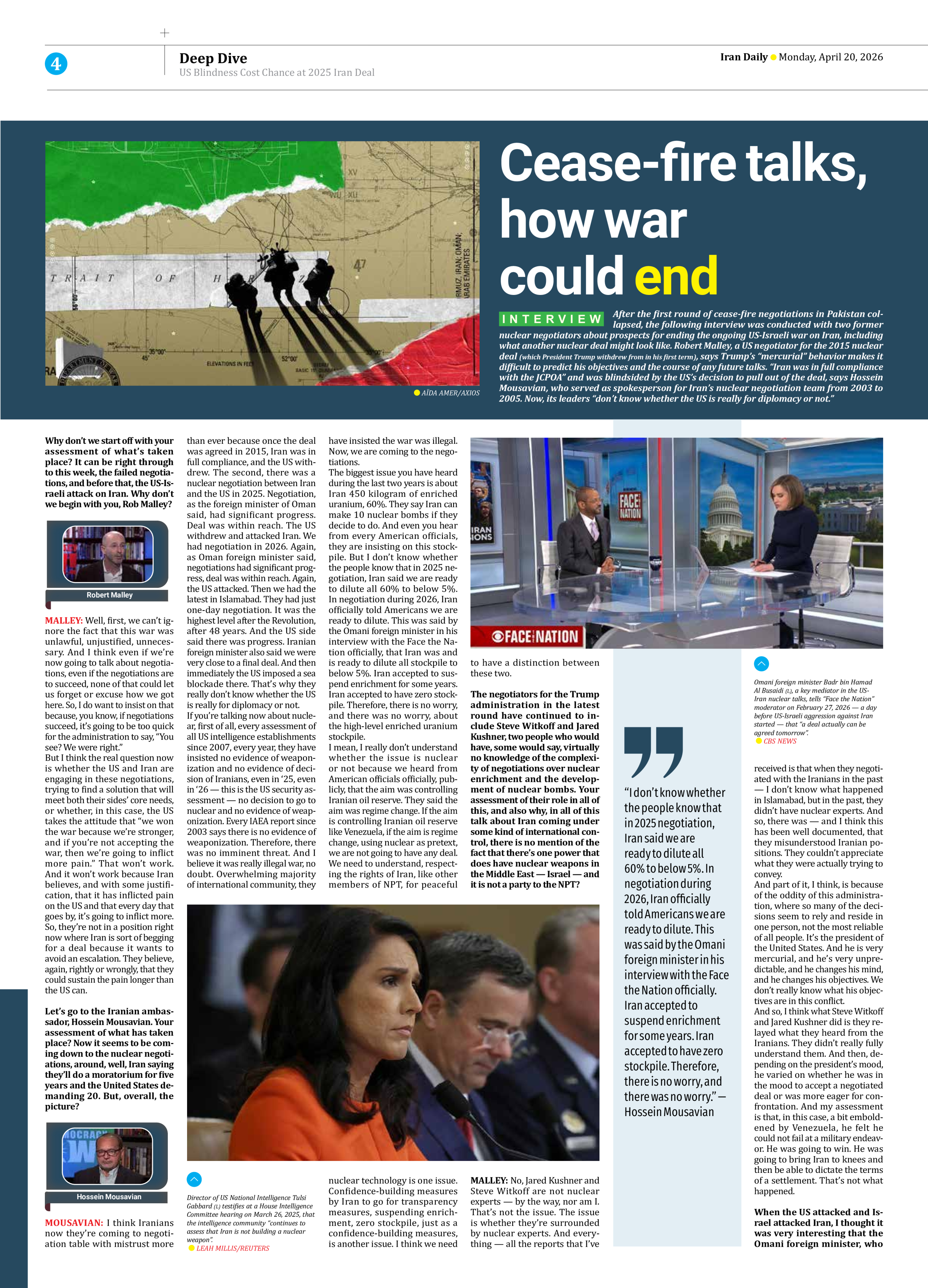
When the US attacked and Israel attacked Iran, I thought it was very interesting that the Omani foreign minister, who was mediating, actually took a plane to Washington because he didn’t feel that Kushner and Witkoff were conveying what Iran was agreeing to. And he went on all the US media he could, so that he could get President Trump’s attention, particularly on Fox. But I want to go to what he said on Face the Nation. This is Badr bin Hamad Albusaidi. He said Iran had agreed to abandon its nuclear enrichment and stockpiling program. He actually kept repeating in all these interviews — he had a phrase — “This is better than Obama.” You know, someone had trained — it’s like they had said to him, “This is what Trump needs to hear,” because that’s Trump’s main motivating factor, “better than Obama.” You are, Rob Malley, one of the lead negotiators for the JCPOA, the Joint Comprehensive Plan of Action. If you can explain why you — if you think this was better than what you achieved, and why, anyway, President Trump and Israeli Prime Minister Netanyahu attacked the very next day? And what happened that very next day, the Iranian girls’ school in Minab was taken out, it looks like with a US missile, and 175 people, about, died, overwhelmingly primary school girls.
MALLEY: So, I mean, I said it at the same time, either before or after the Omani foreign minister, because based on the reports, and Hossein just said that, Iran was agreeing to suspend enrichment for a period of years. That is beyond anything that either President Obama achieved or President Biden was — could have achieved. I mean, at that time, Iran was not talking about suspending; it was accepting limits. I think those limits were sufficient to contain Iran’s nuclear program. But if what President Trump wanted was to be able to say at the end of these negotiations, “I beat President Obama,” I would have granted him that, if it could have spared us a war because it was — you know, it was a truism. Suspension is better than the limited enrichment that Iran had.
Now, again, I want to emphasize that marginal gain between suspension of enrichment or very low enrichment does not justify in any way, does not excuse, an illegal war that has caused the deaths that you mentioned, far more than that, destruction and now disruptions of the world economy, that then hurt the poorest nations first and foremost. And that’s, of course, also because of Iran’s reaction, but the trigger was the war that was launched by the United States and Israel.
But I think it goes back to the point that I was making earlier. I think the war was launched by President Trump because he felt he could and he felt that he was on a roll after Venezuela, after the attack on Iran a year ago, that he could be the president who finally deals with this issue. He’s changed, in his view, the regime in Venezuela. He thought he could change the regime in Iran, and then, next, Cuba, and that he would go down in history as this person. The details didn’t matter. And I think he really felt unstoppable. And he felt that the experts who were warning him didn’t know what they were talking about; he knew better.
In his gut.
MALLEY: In his gut, whatever gut he has, yes.
Where do we go from here? Especially now that — after Trump announced this blockade of Iranian ports, and yet he’s getting no support from the European Union on this. And, of course, China has made it very clear that they are going to continue to expect to be able to get through, have their ships go through the Strait of Hormuz and to trade with Iran. What are the options for the United States? And also, can Iran survive a long-term blockade, economic blockade, by the United States?
MOUSAVIAN: The naval blockade, based on United Nation Resolution 1974, is act of war, is aggression. Therefore, internationally, legally, what the US is doing is a clear aggression or act of war because suffering a 90 million nation, and the fear of famine, hunger against a nation. This is not about just state.
Nevertheless, about Strait of Hormuz, the reality is that this strait was open, free for navigation for 48 years, 47 years. Never there was any problem. Even after the first US-Israeli war on Iran, 2025, Iran did not put any limit on navigation. But when the US and Israel, they attacked for the second time, in 2026, Iranians, they really felt this is an existential threat. This was really the difference. That’s why they tried to use all cards they have. One of them was Strait of Hormuz. Nevertheless, they did not close the strait. They put some limits. There is international regulations that during war, a country which is attacked by another country can put some calculated limits on navigation, not broad.
For the future, if the US is looking for a nuclear deal as what we have been already discussed, and Rob said they already got what they wanted, more than Obama period, more than JCPOA, but even they can have one big more achievement on the nuclear issue because President Trump can offer Iran to go for a multilateral enrichment mechanism in the Persian Gulf.
I and the nuclear scientists at Princeton University, we published multiple articles. The last one was 10 days before 2025 war. We said, rather than national enrichment — because Saudi Arabia also is looking for enrichment. If Saudi gets, Egyptians, they will get. If Egypt get, Turkish will get it. Therefore, we will have many countries with enrichment. Rather than this trend risking nonproliferation in the region, a multilateral enrichment nuclear arrangement in this region would be the best way out, where it would be fully under the control of International Atomic Energy Agency. And even the US, Russia, China, the world powers, they can participate. This would be international, like Urenco enrichment in Europe, where Germany, Spain, UK, Netherlands, they have multilateral enrichment. Therefore, beyond of what already the nuclear negotiators during President Trump have achieved already, which is more than JCPOA during President Obama, they can have one more big deal on nuclear, which is regional, which will free the whole Persian Gulf from nuclear weapon.
And on the Strait of Hormuz, Iranians, they have not closed it. They say, if there is a deal, if the US will accept not to attack Iran or to end the war, they will open it. Therefore, the US can say, “OK, we will continue negotiations, but we are committed not to attack Iran for the fourth time maybe.” I mean because once the US indirectly cooperated with Saddam attacking Iran, providing material technology for Saddam to use chemical weapons in 1980s. The second war was in 2025. The third war was in 2026. And now the blockade is act of war again in 2026. If the US is really serious for diplomacy, they can achieve diplomacy, but they should promise Iran not to attack Iran again. Then, Iran will open the Hormuz issue. I mean, that would be a good solution.
Israel has been attacking Iran but is not part of the current negotiations. What do you feel has happened between Israel and the Trump administration? Is there a divergence occurring between the two?
MALLEY: So, I think they have different objectives. I mean, first of all, we don’t know what President Trump’s objectives are, so it’s hard to say how they’re different or they’re similar to Israel’s. But I think Israel has been consistent in its actions. What it wants is to weaken its neighbors, whoever they are. I mean, it’s happened in Gaza, which they destroyed. The West Bank, we just saw what they’re doing there. Lebanon, they’ve devastated the country. A million people fled the south. They’ve killed hundreds of people even since the recent cease-fire. And they would like to weaken, fragment Iran as much as possible because they have this view that this is their opportunity to extinguish any threat, real or pretextual, imminent or into the future.
That’s not really, I think, President Trump’s view. Again, it’s hard to define it. But what that means is, Israel would prefer to prolong this war as long as possible. I don’t think that that’s President Trump’s ambition. And I think the day President Trump says it’s it, Prime Minister Netanyahu will not be able to do anything but acquiesce. So, we have to wait for that moment to happen, for the president to tell the Israelis it’s over, it’s over both in Iran and in Lebanon. I don’t think Prime Minister Netanyahu could afford to stand in his way.
We’ve talked to so many Iranian professors, dissidents. I wanted to ask you about the — my surprise at how many of those, even people who have been on death row in the Evin Prison, have condemned the US-Israeli attack on Iran. They say that this does not accomplish their ends. I’m wondering your thoughts on all of these people who are coming out now and saying they want to be in charge of their own country; they don’t want these outside forces because they’re destroying Iran.
MOUSAVIAN: I think what Americans, they need to understand is to have a clear distinction between Iranian unsatisfaction with the current governing system in Iran. They have problem with economic inflation, poverty, corruption, I mean, mismanagement, dysfunctionality of the system, no doubt about it. I’m sure majority of Iranians, they want major reforms. They want — their main issue is about economic issue and corruption and mismanagement and dysfunctionality of the system.
Having said that, when they are attacked by the US, or specifically Israel more, the whole nation, they will be united to defend their integrity, independence, identity, especially when they are — they have been said, I mean, by the US president, that he will eradicate the civilization of Iran, when the US is saying Iranians are animal, when they said “bastard,” Iranian “bastards,” I mean such a wording, humiliation, threats, bullying, attacking. I mean, Iranians, we have had about 30,000 Iranians either killed or injured during the two wars, hundreds of millions of damages. Over 100,000 buildings, nonmilitary buildings, have been destroyed. And then it’s normal the nation would be united to defend its country.
The full article first appeared on
Democracy Now!