







A paradigmatic metamorphosis in media warfare
Iran mastered memes, AI, and narrative contestation
By Mehdi Salami
Expert at Institute for Political and International Studies
The formal and informal utilization of a novel modality of message transmission and perspective articulation — such as image-based jokes (memes) and AI-generated viral videos — during the course of the American and Zionist regime’s aggression against the Islamic Republic of Iran evinces a profound metamorphosis in media warfare; an area wherein success is determined not by factual credibility but, rather, by algorithmic visibility, emotional response, and cultural adoptability. Although critics deem this content merely a superficial form of propaganda, its efficacy resides precisely in its capacity to amalgamate amusement with political messaging; a phenomenon that has fundamentally reconfigured the methodology of exerting influence within the digital age.
Transition from traditional outreach to platform-based influence
In the past, narratives disseminated primarily through official and controlled media channels; the contemporary approach demonstrates a conspicuous divergence from this model; when, in lieu of official outreach, communications predicated upon memes and AI-generated videos, compatible with the viral logic of social networks, are employed. This shift signifies a fundamental transformation; messages are no longer imposed upon the audience but are, instead, embedded within content that the audience actively seeks.
Today, we observe that, in addition to informal and independent groups, even Iranian embassies across various countries have joined this initiative and, consequently, the Iranian front has succeeded in aligning its messages with the logic of platforms such as TikTok, X, and Instagram; where “engagement” and “selection” have supplanted “authority” as the determining factor of visibility.
This novel strategy demonstrates how innovation in the modality of message transmission and participation in the arena of narratives can function as a force multiplier in asymmetric war. In comparison with traditional media production, this model permits:
• Content to be generated rapidly and synchronously with field developments.
• Costs to be diminished dramatically.
• Narratives to be adapted continuously to the battlefield.
This enables a nation with comparatively limited media resources to compete with powerful actors upon the global stage and to play a role in the shaping of global public opinion that transcends its traditional capacities.
Emotional framing, logic of viral dissemination
The salient characteristic of such productions is their reliance upon emotional simplification rather than analytical complexity. In this manner, content becomes:
• More comprehensible.
• Endowed with a greater affective weight.
• More likely to spread.
Within the digital sphere, the intensity of emotions has a direct correlation with the extent of dissemination. It appears that Iran’s strategy has been configured precisely upon this basis: prioritizing emotional impact, whereby influence is achieved not solely through profound persuasion but, rather, through repetition and expansive visibility.
Strategic targeting of global audiences, youths
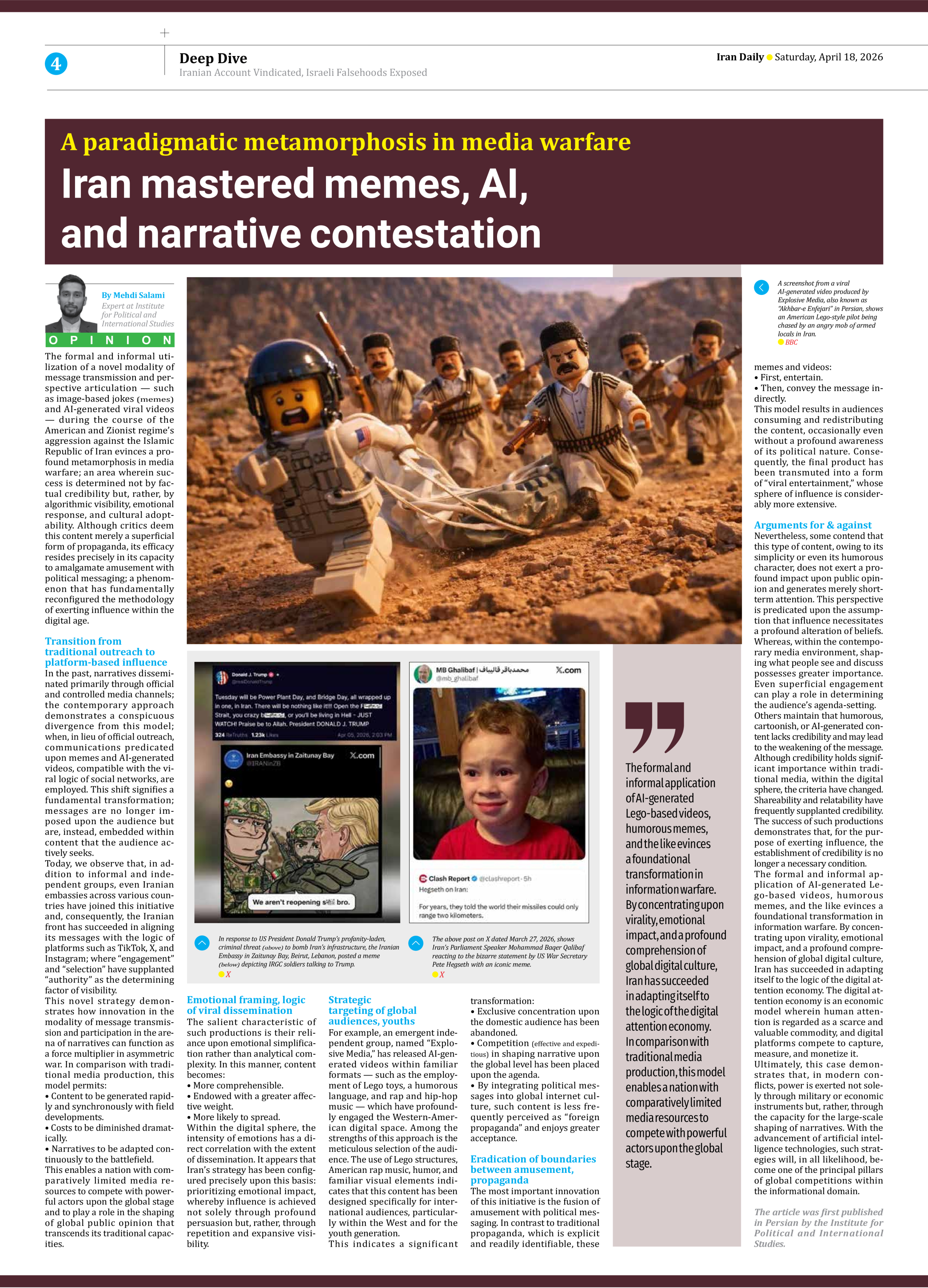
For example, an emergent independent group, named “Explosive Media,” has released AI-generated videos within familiar formats — such as the employment of Lego toys, a humorous language, and rap and hip-hop music — which have profoundly engaged the Western-American digital space. Among the strengths of this approach is the meticulous selection of the audience. The use of Lego structures, American rap music, humor, and familiar visual elements indicates that this content has been designed specifically for international audiences, particularly within the West and for the youth generation.
This indicates a significant transformation:
• Exclusive concentration upon the domestic audience has been abandoned.
• Competition (effective and expeditious) in shaping narrative upon the global level has been placed upon the agenda.
• By integrating political messages into global internet culture, such content is less frequently perceived as “foreign propaganda” and enjoys greater acceptance.
Eradication of boundaries between amusement, propaganda
The most important innovation of this initiative is the fusion of amusement with political messaging. In contrast to traditional propaganda, which is explicit and readily identifiable, these memes and videos:
• First, entertain.
• Then, convey the message indirectly.
This model results in audiences consuming and redistributing the content, occasionally even without a profound awareness of its political nature. Consequently, the final product has been transmuted into a form of “viral entertainment,” whose sphere of influence is considerably more extensive.
Arguments for & against
Nevertheless, some contend that this type of content, owing to its simplicity or even its humorous character, does not exert a profound impact upon public opinion and generates merely short-term attention. This perspective is predicated upon the assumption that influence necessitates a profound alteration of beliefs. Whereas, within the contemporary media environment, shaping what people see and discuss possesses greater importance. Even superficial engagement can play a role in determining the audience’s agenda-setting.
Others maintain that humorous, cartoonish, or AI-generated content lacks credibility and may lead to the weakening of the message. Although credibility holds significant importance within traditional media, within the digital sphere, the criteria have changed. Shareability and relatability have frequently supplanted credibility. The success of such productions demonstrates that, for the purpose of exerting influence, the establishment of credibility is no longer a necessary condition.
The formal and informal application of AI-generated Lego-based videos, humorous memes, and the like evinces a foundational transformation in information warfare. By concentrating upon virality, emotional impact, and a profound comprehension of global digital culture, Iran has succeeded in adapting itself to the logic of the digital attention economy. The digital attention economy is an economic model wherein human attention is regarded as a scarce and valuable commodity, and digital platforms compete to capture, measure, and monetize it.
Ultimately, this case demonstrates that, in modern conflicts, power is exerted not solely through military or economic instruments but, rather, through the capacity for the large-scale shaping of narratives. With the advancement of artificial intelligence technologies, such strategies will, in all likelihood, become one of the principal pillars of global competitions within the informational domain.
The article was first published in Persian by the Institute for Political and International
Studies.