





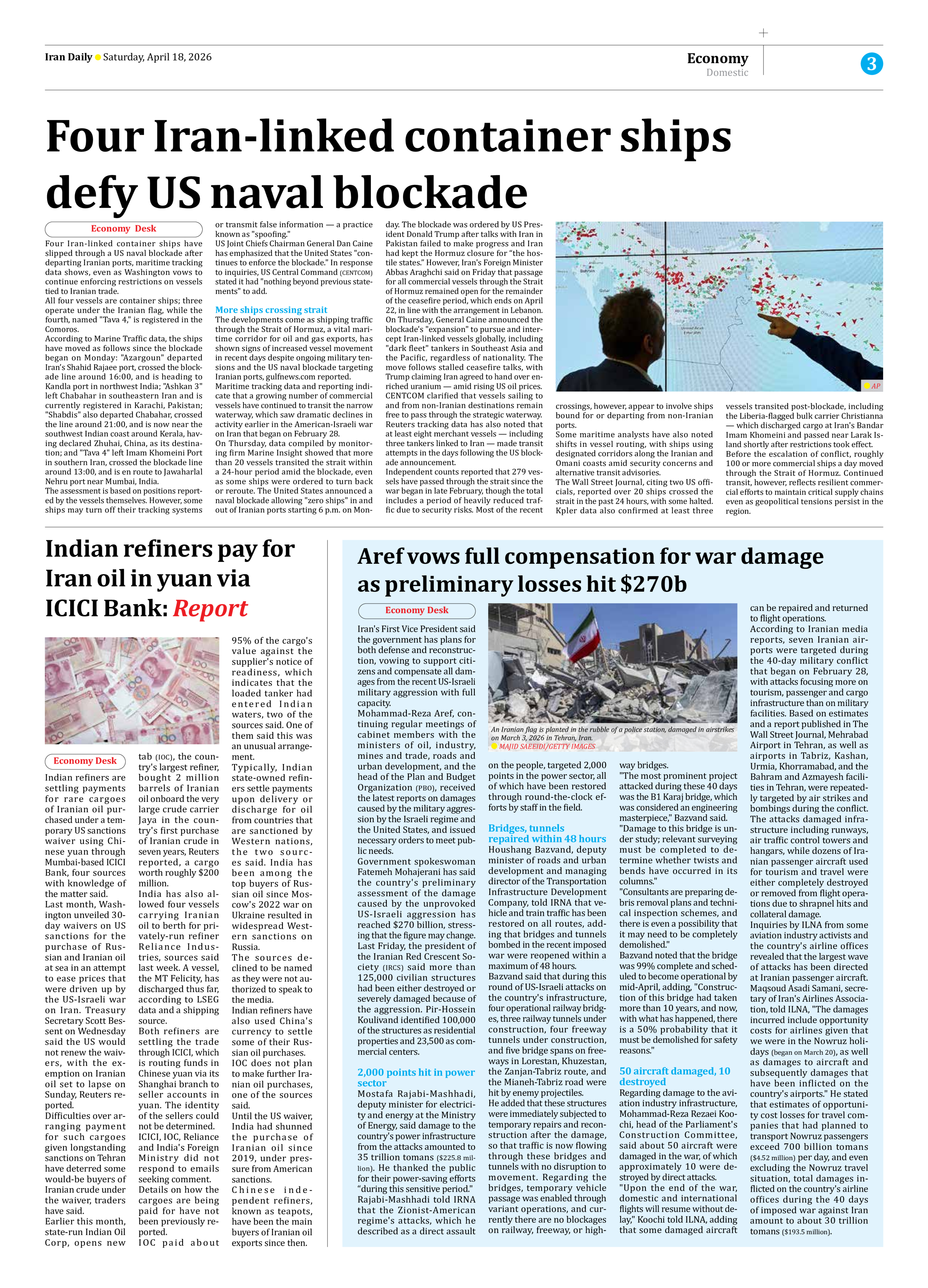


Aref vows full compensation for war damage as preliminary losses hit $270b
Iran's First Vice President said the government has plans for both defense and reconstruction, vowing to support citizens and compensate all damages from the recent US-Israeli military aggression with full capacity.
Mohammad-Reza Aref, continuing regular meetings of cabinet members with the ministers of oil, industry, mines and trade, roads and urban development, and the head of the Plan and Budget Organization (PBO), received the latest reports on damages caused by the military aggression by the Israeli regime and the United States, and issued necessary orders to meet public needs.
Government spokeswoman Fatemeh Mohajerani has said the country's preliminary assessment of the damage caused by the unprovoked US-Israeli aggression has reached $270 billion, stressing that the figure may change. Last Friday, the president of the Iranian Red Crescent Society (IRCS) said more than 125,000 civilian structures had been either destroyed or severely damaged because of the aggression. Pir-Hossein Koulivand identified 100,000 of the structures as residential properties and 23,500 as commercial centers.
2,000 points hit in power sector
Mostafa Rajabi-Mashhadi, deputy minister for electricity and energy at the Ministry of Energy, said damage to the country's power infrastructure from the attacks amounted to 35 trillion tomans ($225.8 million). He thanked the public for their power-saving efforts “during this sensitive period."
Rajabi-Mashhadi told IRNA that the Zionist-American regime's attacks, which he described as a direct assault on the people, targeted 2,000 points in the power sector, all of which have been restored through round-the-clock efforts by staff in the field.
Bridges, tunnels repaired within 48 hours
Houshang Bazvand, deputy minister of roads and urban development and managing director of the Transportation Infrastructure Development Company, told IRNA that vehicle and train traffic has been restored on all routes, adding that bridges and tunnels bombed in the recent imposed war were reopened within a maximum of 48 hours.
Bazvand said that during this round of US-Israeli attacks on the country's infrastructure, four operational railway bridges, three railway tunnels under construction, four freeway tunnels under construction, and five bridge spans on freeways in Lorestan, Khuzestan, the Zanjan-Tabriz route, and the Mianeh-Tabriz road were hit by enemy projectiles.
He added that these structures were immediately subjected to temporary repairs and reconstruction after the damage, so that traffic is now flowing through these bridges and tunnels with no disruption to movement. Regarding the bridges, temporary vehicle passage was enabled through variant operations, and currently there are no blockages on railway, freeway, or highway bridges.
"The most prominent project attacked during these 40 days was the B1 Karaj bridge, which was considered an engineering masterpiece," Bazvand said.
"Damage to this bridge is under study; relevant surveying must be completed to determine whether twists and bends have occurred in its columns."
"Consultants are preparing debris removal plans and technical inspection schemes, and there is even a possibility that it may need to be completely demolished."
Bazvand noted that the bridge was 99% complete and scheduled to become operational by mid-April, adding, "Construction of this bridge had taken more than 10 years, and now, with what has happened, there is a 50% probability that it must be demolished for safety reasons."
50 aircraft damaged, 10 destroyed
Regarding damage to the aviation industry infrastructure, Mohammad-Reza Rezaei Koochi, head of the Parliament's Construction Committee, said about 50 aircraft were damaged in the war, of which approximately 10 were destroyed by direct attacks.
"Upon the end of the war, domestic and international flights will resume without delay," Koochi told ILNA, adding that some damaged aircraft can be repaired and returned to flight operations.
According to Iranian media reports, seven Iranian airports were targeted during the 40-day military conflict that began on February 28, with attacks focusing more on tourism, passenger and cargo infrastructure than on military facilities. Based on estimates and a report published in The Wall Street Journal, Mehrabad Airport in Tehran, as well as airports in Tabriz, Kashan, Urmia, Khorramabad, and the Bahram and Azmayesh facilities in Tehran, were repeatedly targeted by air strikes and bombings during the conflict. The attacks damaged infrastructure including runways, air traffic control towers and hangars, while dozens of Iranian passenger aircraft used for tourism and travel were either completely destroyed or removed from flight operations due to shrapnel hits and collateral damage.
Inquiries by ILNA from some aviation industry activists and the country's airline offices revealed that the largest wave of attacks has been directed at Iranian passenger aircraft. Maqsoud Asadi Samani, secretary of Iran's Airlines Association, told ILNA, "The damages incurred include opportunity costs for airlines given that we were in the Nowruz holidays (began on March 20), as well as damages to aircraft and subsequently damages that have been inflicted on the country's airports." He stated that estimates of opportunity cost losses for travel companies that had planned to transport Nowruz passengers exceed 700 billion tomans ($4.52 million) per day, and even excluding the Nowruz travel situation, total damages inflicted on the country's airline offices during the 40 days of imposed war against Iran amount to about 30 trillion tomans ($193.5 million).