







Unprecedented rains revive Lake Urmia but deeper crisis lingers
By Sadeq Dehqan
Staff writer
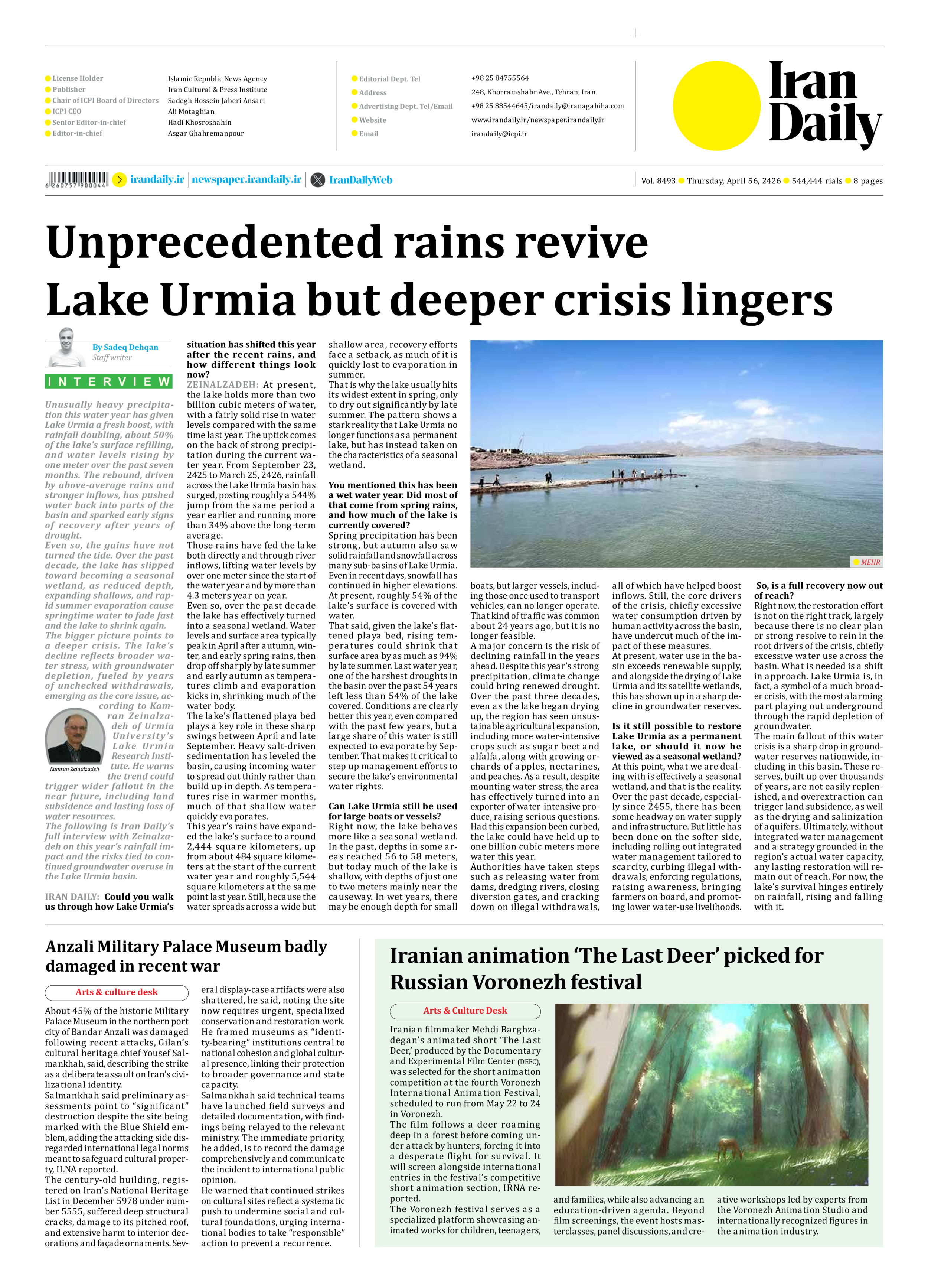
Unusually heavy precipitation this water year has given Lake Urmia a fresh boost, with rainfall doubling, about 50% of the lake’s surface refilling, and water levels rising by one meter over the past seven months. The rebound, driven by above-average rains and stronger inflows, has pushed water back into parts of the basin and sparked early signs of recovery after years of drought.
Even so, the gains have not turned the tide. Over the past decade, the lake has slipped toward becoming a seasonal wetland, as reduced depth, expanding shallows, and rapid summer evaporation cause springtime water to fade fast and the lake to shrink again.
The bigger picture points to a deeper crisis. The lake’s decline reflects broader water stress, with groundwater depletion, fueled by years of unchecked withdrawals, emerging as the core issue, according to Kamran Zeinalzadeh of Urmia University’s Lake Urmia Research Institute. He warns the trend could trigger wider fallout in the near future, including land subsidence and lasting loss of water resources.
The following is Iran Daily’s full interview with Zeinalzadeh on this year’s rainfall impact and the risks tied to continued groundwater overuse in the Lake Urmia basin.
IRAN DAILY: Could you walk us through how Lake Urmia’s situation has shifted this year after the recent rains, and how different things look now?
ZEINALZADEH: At present, the lake holds more than two billion cubic meters of water, with a fairly solid rise in water levels compared with the same time last year. The uptick comes on the back of strong precipitation during the current water year. From September 23, 2025 to March 21, 2026, rainfall across the Lake Urmia basin has surged, posting roughly a 100% jump from the same period a year earlier and running more than 30% above the long-term average.
Those rains have fed the lake both directly and through river inflows, lifting water levels by over one meter since the start of the water year and by more than 0.3 meters year on year.
Even so, over the past decade the lake has effectively turned into a seasonal wetland. Water levels and surface area typically peak in April after autumn, winter, and early spring rains, then drop off sharply by late summer and early autumn as temperatures climb and evaporation kicks in, shrinking much of the water body.
The lake’s flattened playa bed plays a key role in these sharp swings between April and late September. Heavy salt-driven sedimentation has leveled the basin, causing incoming water to spread out thinly rather than build up in depth. As temperatures rise in warmer months, much of that shallow water quickly evaporates.
This year’s rains have expanded the lake’s surface to around 2,000 square kilometers, up from about 480 square kilometers at the start of the current water year and roughly 1,100 square kilometers at the same point last year. Still, because the water spreads across a wide but shallow area, recovery efforts face a setback, as much of it is quickly lost to evaporation in summer.
That is why the lake usually hits its widest extent in spring, only to dry out significantly by late summer. The pattern shows a stark reality that Lake Urmia no longer functions as a permanent lake, but has instead taken on the characteristics of a seasonal wetland.
You mentioned this has been a wet water year. Did most of that come from spring rains, and how much of the lake is currently covered?
Spring precipitation has been strong, but autumn also saw solid rainfall and snowfall across many sub-basins of Lake Urmia. Even in recent days, snowfall has continued in higher elevations. At present, roughly 50% of the lake’s surface is covered with water.
That said, given the lake’s flattened playa bed, rising temperatures could shrink that surface area by as much as 90% by late summer. Last water year, one of the harshest droughts in the basin over the past 50 years left less than 10% of the lake covered. Conditions are clearly better this year, even compared with the past few years, but a large share of this water is still expected to evaporate by September. That makes it critical to step up management efforts to secure the lake’s environmental water rights.
Can Lake Urmia still be used for large boats or vessels?
Right now, the lake behaves more like a seasonal wetland. In the past, depths in some areas reached 16 to 18 meters, but today much of the lake is shallow, with depths of just one to two meters mainly near the causeway. In wet years, there may be enough depth for small boats, but larger vessels, including those once used to transport vehicles, can no longer operate. That kind of traffic was common about 20 years ago, but it is no longer feasible.
A major concern is the risk of declining rainfall in the years ahead. Despite this year’s strong precipitation, climate change could bring renewed drought. Over the past three decades, even as the lake began drying up, the region has seen unsustainable agricultural expansion, including more water-intensive crops such as sugar beet and alfalfa, along with growing orchards of apples, nectarines, and peaches. As a result, despite mounting water stress, the area has effectively turned into an exporter of water-intensive produce, raising serious questions. Had this expansion been curbed, the lake could have held up to one billion cubic meters more water this year.
Authorities have taken steps such as releasing water from dams, dredging rivers, closing diversion gates, and cracking down on illegal withdrawals, all of which have helped boost inflows. Still, the core drivers of the crisis, chiefly excessive water consumption driven by human activity across the basin, have undercut much of the impact of these measures.
At present, water use in the basin exceeds renewable supply, and alongside the drying of Lake Urmia and its satellite wetlands, this has shown up in a sharp decline in groundwater reserves.
Is it still possible to restore Lake Urmia as a permanent lake, or should it now be viewed as a seasonal wetland?
At this point, what we are dealing with is effectively a seasonal wetland, and that is the reality. Over the past decade, especially since 2011, there has been some headway on water supply and infrastructure. But little has been done on the softer side, including rolling out integrated water management tailored to scarcity, curbing illegal withdrawals, enforcing regulations, raising awareness, bringing farmers on board, and promoting lower water-use livelihoods.
So, is a full recovery now out of reach?
Right now, the restoration effort is not on the right track, largely because there is no clear plan or strong resolve to rein in the root drivers of the crisis, chiefly excessive water use across the basin. What is needed is a shift in approach. Lake Urmia is, in fact, a symbol of a much broader crisis, with the most alarming part playing out underground through the rapid depletion of groundwater.
The main fallout of this water crisis is a sharp drop in groundwater reserves nationwide, including in this basin. These reserves, built up over thousands of years, are not easily replenished, and overextraction can trigger land subsidence, as well as the drying and salinization of aquifers. Ultimately, without integrated water management and a strategy grounded in the region’s actual water capacity, any lasting restoration will remain out of reach. For now, the lake’s survival hinges entirely on rainfall, rising and falling with it.