





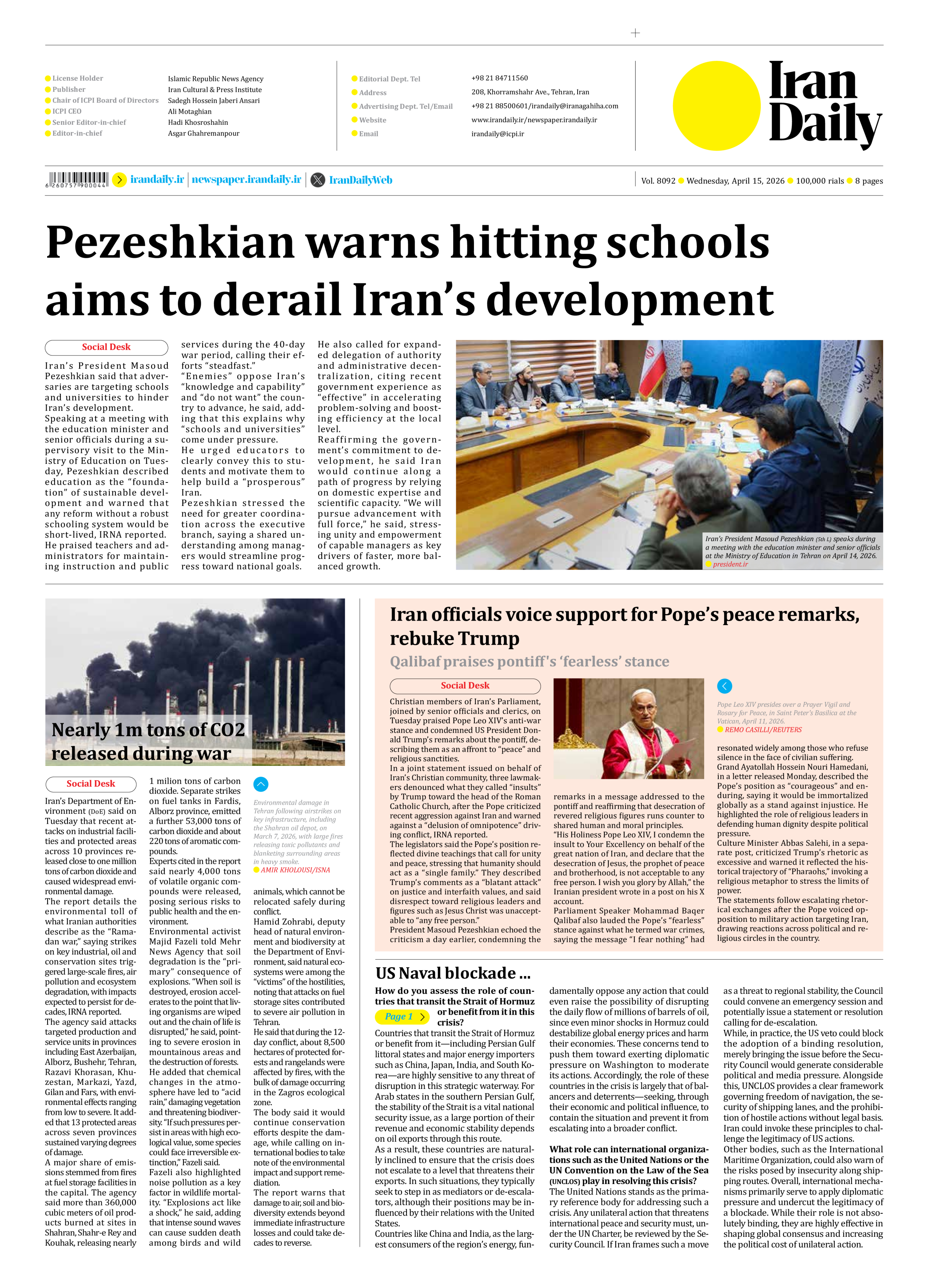


Nearly 1m tons of CO2 released during war
Iran’s Department of Environment (DoE) said on Tuesday that recent attacks on industrial facilities and protected areas across 10 provinces released close to one million tons of carbon dioxide and caused widespread environmental damage.
The report details the environmental toll of what Iranian authorities describe as the “Ramadan war,” saying strikes on key industrial, oil and conservation sites triggered large-scale fires, air pollution and ecosystem degradation, with impacts expected to persist for decades, IRNA reported.
The agency said attacks targeted production and service units in provinces including East Azerbaijan, Alborz, Bushehr, Tehran, Razavi Khorasan, Khuzestan, Markazi, Yazd, Gilan and Fars, with environmental effects ranging from low to severe. It added that 13 protected areas across seven provinces sustained varying degrees of damage.
A major share of emissions stemmed from fires at fuel storage facilities in the capital. The agency said more than 360,000 cubic meters of oil products burned at sites in Shahran, Shahr-e Rey and Kouhak, releasing nearly 1 milion tons of carbon dioxide. Separate strikes on fuel tanks in Fardis, Alborz province, emitted a further 53,000 tons of carbon dioxide and about 220 tons of aromatic compounds.
Experts cited in the report said nearly 4,000 tons of volatile organic compounds were released, posing serious risks to public health and the environment.
Environmental activist Majid Fazeli told Mehr News Agency that soil degradation is the “primary” consequence of explosions. “When soil is destroyed, erosion accelerates to the point that living organisms are wiped out and the chain of life is disrupted,” he said, pointing to severe erosion in mountainous areas and the destruction of forests.
He added that chemical changes in the atmosphere have led to “acid rain,” damaging vegetation and threatening biodiversity. “If such pressures persist in areas with high ecological value, some species could face irreversible extinction,” Fazeli said.
Fazeli also highlighted noise pollution as a key factor in wildlife mortality. “Explosions act like a shock,” he said, adding that intense sound waves can cause sudden death among birds and wild animals, which cannot be relocated safely during conflict.
Hamid Zohrabi, deputy head of natural environment and biodiversity at the Department of Environment, said natural ecosystems were among the “victims” of the hostilities, noting that attacks on fuel storage sites contributed to severe air pollution in Tehran.
He said that during the 12-day conflict, about 8,500 hectares of protected forests and rangelands were affected by fires, with the bulk of damage occurring in the Zagros ecological zone.
The body said it would continue conservation efforts despite the damage, while calling on international bodies to take note of the environmental impact and support remediation.
The report warns that damage to air, soil and biodiversity extends beyond immediate infrastructure losses and could take decades to reverse.