







Copy in clipboard...
Kashkan Bridge stands after thousand years
Ata Hassanpour, the Director General of the Cultural Heritage, Tourism and Handicrafts Organization of Lorestan Province, highlighted the strategic position of the province as a historical corridor. “Iranian engineers in ancient times, understanding the importance of this region, built numerous bridges over its turbulent rivers,” he stated, ISNA wrote.
He further explained that, among these, the Kashkan Bridge, as the largest and most prominent of them all, embodies the genius and creativity of Iranian architects from the fourth century AH (the tenth century CE).
“The construction of this astonishing bridge, which took place from 998 to 1008 CE, was carried out by order of Abu Najm Badr ibn Hasanuyeh, the then-governor of Lorestan,” Hassanpour added.
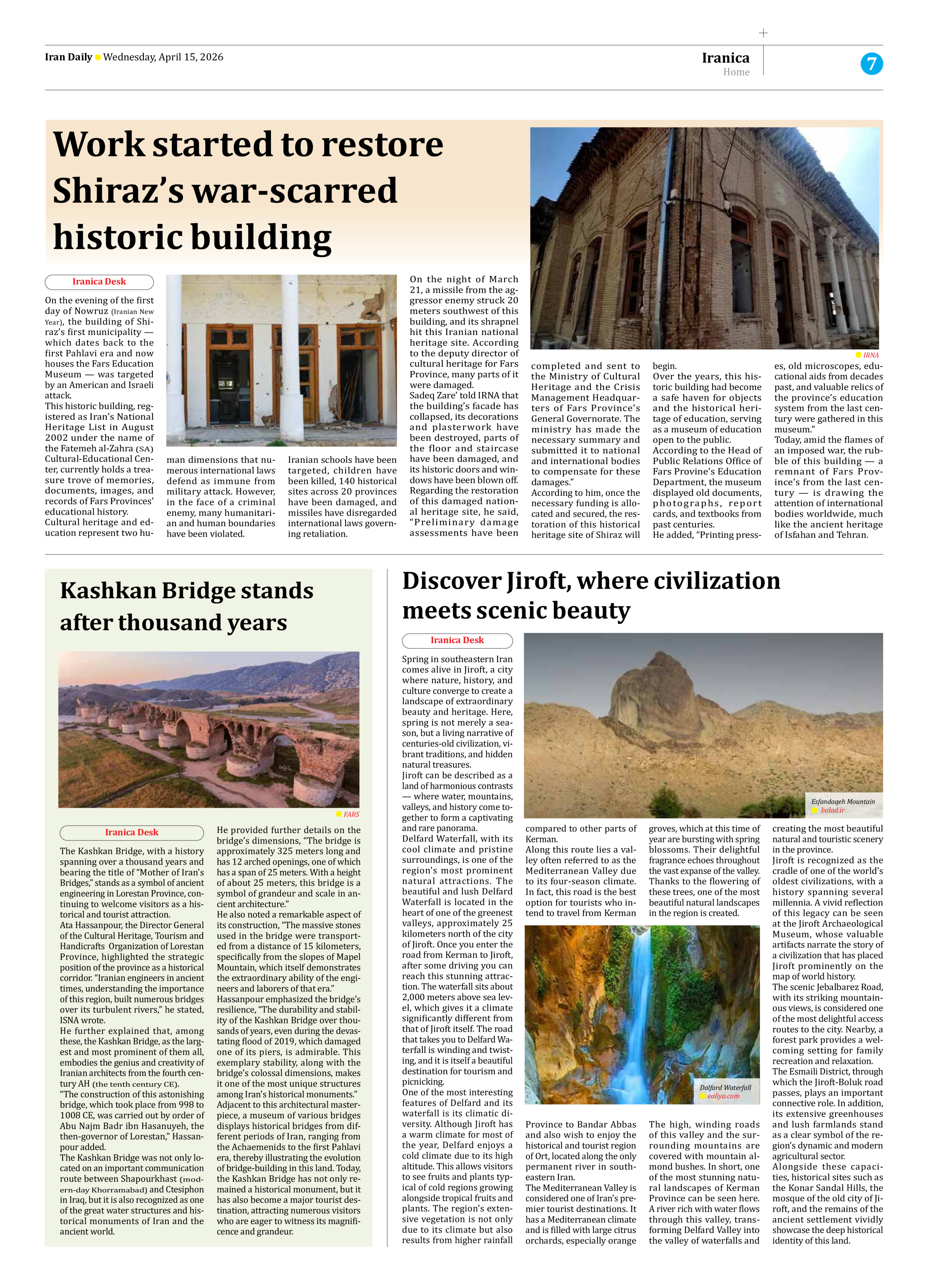
The Kashkan Bridge was not only located on an important communication route between Shapourkhast (modern-day Khorramabad) and Ctesiphon in Iraq, but it is also recognized as one of the great water structures and historical monuments of Iran and the ancient world.
He provided further details on the bridge’s dimensions, “The bridge is approximately 325 meters long and has 12 arched openings, one of which has a span of 25 meters. With a height of about 25 meters, this bridge is a symbol of grandeur and scale in ancient architecture.”
He also noted a remarkable aspect of its construction, “The massive stones used in the bridge were transported from a distance of 15 kilometers, specifically from the slopes of Mapel Mountain, which itself demonstrates the extraordinary ability of the engineers and laborers of that era.”
Hassanpour emphasized the bridge’s resilience, “The durability and stability of the Kashkan Bridge over thousands of years, even during the devastating flood of 2019, which damaged one of its piers, is admirable. This exemplary stability, along with the bridge’s colossal dimensions, makes it one of the most unique structures among Iran’s historical monuments.”
Adjacent to this architectural masterpiece, a museum of various bridges displays historical bridges from different periods of Iran, ranging from the Achaemenids to the first Pahlavi era, thereby illustrating the evolution of bridge-building in this land. Today, the Kashkan Bridge has not only remained a historical monument, but it has also become a major tourist destination, attracting numerous visitors who are eager to witness its magnificence and grandeur.