







Copy in clipboard...
US ‘excessive demands’ hindered deal in Islamabad talks: Araghchi
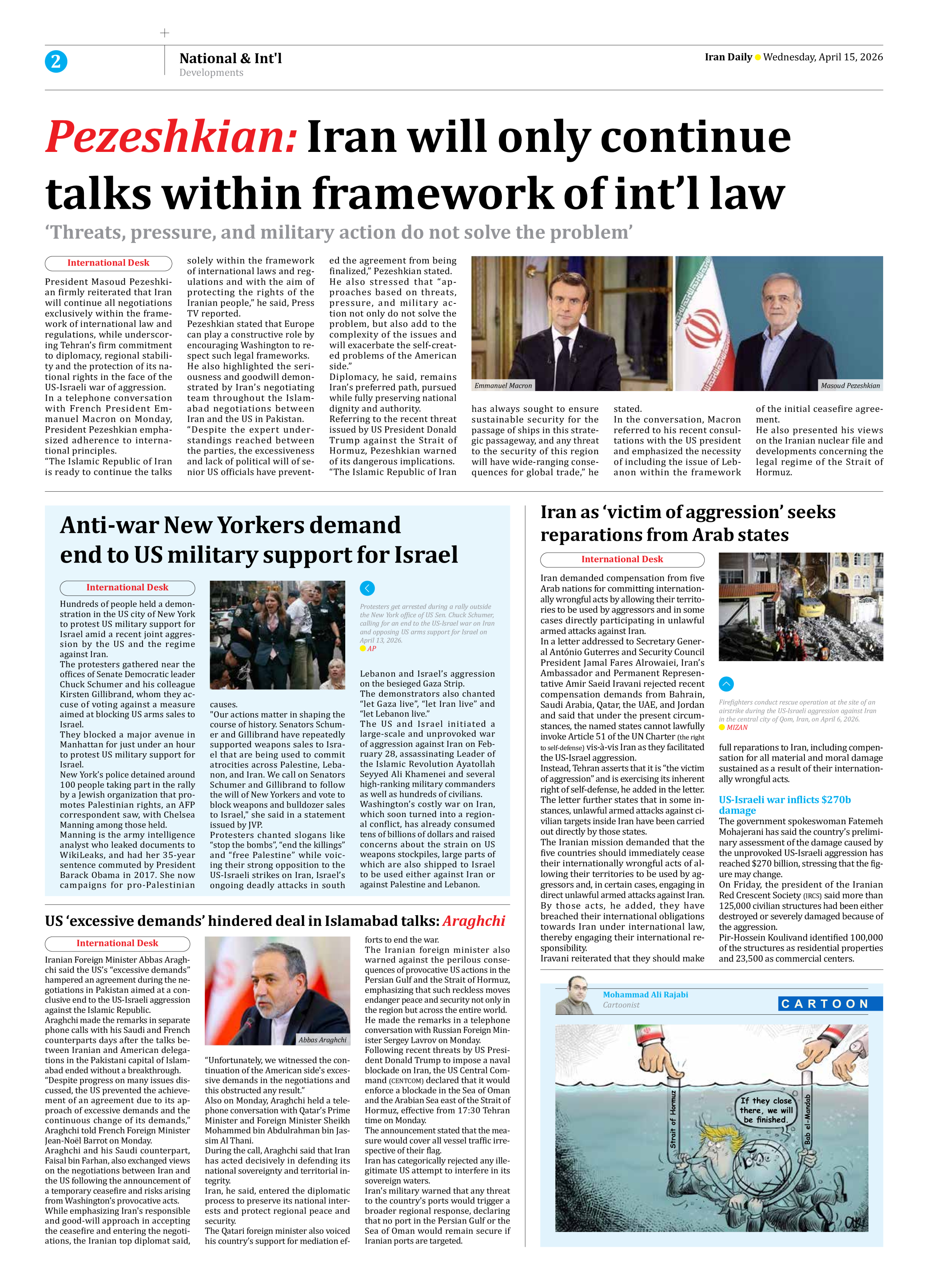
Iranian Foreign Minister Abbas Araghchi said the US’s “excessive demands” hampered an agreement during the negotiations in Pakistan aimed at a conclusive end to the US-Israeli aggression against the Islamic Republic.
Araghchi made the remarks in separate phone calls with his Saudi and French counterparts days after the talks between Iranian and American delegations in the Pakistani capital of Islamabad ended without a breakthrough.
“Despite progress on many issues discussed, the US prevented the achievement of an agreement due to its approach of excessive demands and the continuous change of its demands,” Araghchi told French Foreign Minister Jean-Noël Barrot on Monday.
Araghchi and his Saudi counterpart, Faisal bin Farhan, also exchanged views on the negotiations between Iran and the US following the announcement of a temporary ceasefire and risks arising from Washington’s provocative acts.
While emphasizing Iran's responsible and good-will approach in accepting the ceasefire and entering the negotiations, the Iranian top diplomat said, “Unfortunately, we witnessed the continuation of the American side's excessive demands in the negotiations and this obstructed any result.”
Also on Monday, Araghchi held a telephone conversation with Qatar’s Prime Minister and Foreign Minister Sheikh Mohammed bin Abdulrahman bin Jassim Al Thani.
During the call, Araghchi said that Iran has acted decisively in defending its national sovereignty and territorial integrity.
Iran, he said, entered the diplomatic process to preserve its national interests and protect regional peace and security.
The Qatari foreign minister also voiced his country’s support for mediation efforts to end the war.
The Iranian foreign minister also warned against the perilous consequences of provocative US actions in the Persian Gulf and the Strait of Hormuz, emphasizing that such reckless moves endanger peace and security not only in the region but across the entire world.
He made the remarks in a telephone conversation with Russian Foreign Minister Sergey Lavrov on Monday.
Following recent threats by US President Donald Trump to impose a naval blockade on Iran, the US Central Command (CENTCOM) declared that it would enforce a blockade in the Sea of Oman and the Arabian Sea east of the Strait of Hormuz, effective from 17:30 Tehran time on Monday.
The announcement stated that the measure would cover all vessel traffic irrespective of their flag.
Iran has categorically rejected any illegitimate US attempt to interfere in its sovereign waters.
Iran's military warned that any threat to the country's ports would trigger a broader regional response, declaring that no port in the Persian Gulf or the Sea of Oman would remain secure if Iranian ports are targeted.